


Project at a Glance | |
Project Name | Navi Mumbai International Airport (NMIA) |
Project Type | Greenfield |
Project Sector | Infrastructure |
Project Location | Ulwe, Navi Mumbai |
Project Cost | INR 19,646 crore (USD 2.36 billion) (Phase I & II) |
Project Start Date | February 18, 2018 |
Project Completion Date | 2032 (Expected) |
Developer | Navi Mumbai International Airport Limited (NMIAL) |
Owners |
|
Runway Length | 3,700 meters |
Full Capacity | 90 million passengers per annum (MPPA). |
Cargo Handling Capacity | 3.2 Million Metric Tones (Upon completion) |
Airport Code | (IATA CODE) “NMI” |
Project Overview
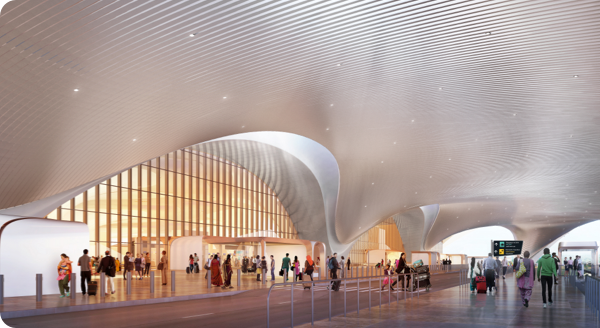
The Navi Mumbai International Airport (NMIA) is a greenfield infrastructure project located in Ulwe, Navi Mumbai. Developed by Navi Mumbai International Airport Limited (NMIAL), the airport is also known as the D.B. Patil International Airport. The airport spans an area of approximately 1,160 hectares, and its design is inspired by India’s national flower, the Lotus.
Being developed in five phases, the first phase comprises Terminal 1 for handling both domestic & international travellers. Additionally, it includes two parallel runways, taxiways, an apron area, and a general aviation terminal, all built with sustainable and energy-efficient design principles.
Once operational, the NMIA will be the largest airport in Mumbai, reducing congestion on Mumbai’s Chhatrapati Shivaji Maharaj International Airport (CSMIA). Upon its full completion (expected by 2032), the Navi Mumbai International Airport will comprise up to four terminals and two parallel runways, achieving a full capacity of approximately 90 million passengers per annum (MPPA).
Navi Mumbai International Airport Phase I Opening Date
After a long-awaited period, the first phase of Navi Mumbai International Airport was scheduled for inauguration on September 30, 2025. However, due to heavy rain in the Mumbai Metropolitan Region and the Konkan Area, the inauguration date has been postponed to October 2025.
On Wednesday, 8 October 2025, Prime Minister Narendra Modi inaugurated the Navi Mumbai International Airport, which has a handling capacity of up to 20 million passengers per annum (MPPA) and 0.5 Million Metric Tons (MMT) of cargo in its Phase I.
Navi Mumbai International Airport Location
The Navi Mumbai International Airport (NMIA) is located in Ulwe, Navi Mumbai, between Ulwe and Panvel. Located in Panvel Taluka, Raigad District, the site is situated between Amra Marg and National Highway 48.
NMIA is about 40 km east of South Mumbai (Nariman Point) and around 35 km southeast of Chhatrapati Shivaji Maharaj International Airport (CSMIA).
Background
The NMIA project concept originated in 1997, with planning led by the Ministry of Civil Aviation and CIDCO (City and Industrial Development Corporation) following operational capacity concerns at Chhatrapati Shivaji Maharaj International Airport (CSMIA).
The project received government approval in 2007, and environmental clearance was granted in 2017, enabling the commencement of pre-development activities. It is a greenfield project expected to be the second International Airport for the Mumbai Metropolitan Region (MMR). It is built under the public-private partnership (PPP) model.
Adani Airport Holding Limited (AAHL) and City and Industrial Development Corporation of Maharashtra Ltd. (CIDCO), the development authority of Navi Mumbai, were appointed to undertake the development process. In May 2016, CIDCO issued a tender to prequalified bidders, and Mumbai International Airport Limited (MIAL) was awarded the contract for the project in October 2017.
A new company, Navi Mumbai International Airport Private Limited (NMIAL), a subsidiary of AAHL, was granted the exclusive right and authority for development of the Airport under PPP on Design, Build, Finance, Operate and Transfer (DBFOT) basis, pursuant to the concession agreement dated January 08, 2018, entered into between CIDCO and NMIA.
NMIA Ownership Details
The Adani Airport Holdings Ltd (AAHL) (74% share) and the City and Industrial Development Corporation of Maharashtra Ltd. (CIDCO) (26% share) are the owners of the NMIA. It is developed by the Navi Mumbai International Airport Private Limited (NMIAL), a subsidiary of AAHL under the DBFOT model.
Navi Mumbai International Airport Project Cost Details
The total estimated cost for the Phase I & II is approximately INR 19,646 crore (USD 2.36 billion). Furthermore, Phase III of the project will involve an investment of INR 30,000 crore (3.6 billion) to take the project to the next level.
The cost to passengers (UDF)
The User Development Fee (UDF) is an airport fee charged to fund infrastructure. For NMIA, the regulator AERA has allowed a temporary UDF until March 31, 2026, or until AERA finalizes the regular traffic (whichever is earlier). The charged fee is as follows:
Domestic Departure: INR 620
International Departure: INR 1,225
Domestic Arrival: INR 270
International Arrival: INR 525
40+ reviews
Find the Latest Airport Terminal Facility Projects In India
Gain exclusive access to our industry-leading database of Airport Infrastructure Project opportunities with detailed project timelines and stakeholder information.
Collect Your Free Leads Here!
No credit cardUp-to-date coverage
Joined by 750+ industry professionals last month
Navi Mumbai International Airport Project Timeline
Date | Event |
2032 | Expected completion of the NMIA Project |
October 2025 | PM Modi Inaugurated Phase 1 |
December 2024 | First commercial test flight by IndiGo |
August 2021 | Adani Group takes over as developer, construction officially starts |
2019 | Land acquisition process completed |
March 2018 | NMIAL appointed Zaha Hadid Architects to design Terminal 1 |
February 18, 2018 | Groundbreaking ceremony held by Prime Minister Narendra Modi |
2017 | Final environmental and forest clearance received. |
October 2017 | Mumbai International Airport Limited (MIAL) was awarded the contract for the project |
May 2016 | CIDCO issued a tender to prequalified bidders. |
Project Scope
The project scope includes the following:
Passenger-related facilities: The western and northern parts of the airport were built to use passenger-related facilities, including automated check-in zones, a world-class baggage claim system, and smart security zones featuring single-lane passage and advanced screening systems.
Access for Cargo and General Aviation: The eastern part of the airport will be used to access Cargo, MRO, and General Aviation, thereby splitting vehicular traffic between the eastern and western parts of the airport.
Lotus-designed terminal airport: The airport designs are inspired by India’s National Flower, the Lotus. It is designed by the Zaha Hadid Architects, featuring interconnected terminal buildings, food courts, lounges, and efficient passenger facilities.
Boost International Trade: The NMIA incorporates Cargo Terminal Facilities equipped with separate handling areas to boost regional and international trade.
Major connectivity to NMIA: Navi Mumbai International Airport has direct connectivity from Mumbai Trans Harbour Link (MTHL), Navi Mumbai Metro Line 1, suburban railway stations, the Sion-Panvel and Mumbai-Pune Expressways, and plans for future water transport connectivity.
Technology Used In The NMIA
The NMIA is being built using high technologies, making it more efficient. It includes the following:
Automated Check-In and Biometrics: Self-service kiosks and biometrics are used to streamline passenger processing and reduce queues.
Baggage handling systems: The NMIA uses an automated baggage handling system, reducing time and improving accuracy in luggage handling systems.
Smart Security Lines: The NMIA comprises single-lane automated security screening with advanced scanning technologies, maintaining high security standards.
Digital Twin Technology: NMIA highlights digital twin technology, enabling real-time monitoring and consistent operational management through simulation and data integration.
Navi Mumbai International Airport Connectivity
The NMIA plans a dual entry from both the West and East sides through Rail, Road, and Water Connectivity. Below follows a detailed description of all three connectivities.
Road Connectivity
People can access the Navi Mumbai International Airport through multiple routes:
Mumbai Trans Harbour Link (MTHL) (Atal Setu): The MTHL (Atal Setu) connects Sewri in South Mumbai to Navi Mumbai, reflecting a reduced travel time between South Mumbai and Ulwe.
Other connecting roads: NMIA is easily accessible from the Sion-Panvel Highways, Eastern Freeways, and other connecting roads through Vashi, Nerul, and Belapur.
New Elevated Corridors: A new elevated corridor is planned for construction between Thane and NMIA to reduce commute time further.
Express Buses: In the coming days, Mumbaikars will witness a dedicated airport express bus service from multiple locations, including Pune, Thane, Dadar, Vashi, Panvel, and others. It is currently under the planning stage.
Rail Connectivity
There are multiple options to access NMIA through rail connectivity.
Panvel Station: Panvel Station, a suburban/intercity hub, will be a key route for passengers coming from a greater distance and transferring to NMIA.
Short Elevated Rail Links: Surveys have been approved for the short elevated/stilted rail links connecting NMIA to Khandeshwar Station (on Harbour Line) and Targhar Station (on the Port/Nehrul-Uran line).
Metro Connections: Metro connections are in the planning stages. It includes two metro lines: (i) Metro-Line 1, (ii) Metro-Line 8.
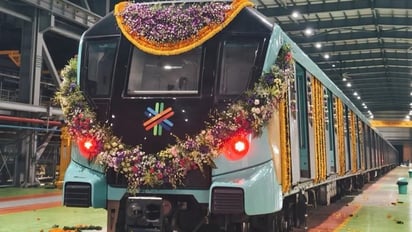
Metro-Line 1 (Belapur-Kharghar-Taloja) provides an east-west link for Navi Mumbai; the campus has long been envisioned as being integrated with NMIA as it expands.
Metro-Line 8 (CSMIA-NMIA), also known as “Golden Line,” is a long-horizon inter-airport connector that will make travel easier in the future.
NMIA Contractors Details
Contractors | Role |
Adani Group (Adani Airport Holdings) | Lead developer and operator |
CIDCO | Project authority, land acquisition, and rehabilitation |
Larsen & Toubro Ltd (L&T) | Main construction contractor |
Zaha Hadid Architects | Terminal architectural design |
CAC Admixtures | Concrete admixtures supplier for structural works |
Central Water & Power Research Station (CWPRS) | Hydrological impact study and recommendation for Ulwe River Diversion. |
40+ reviews
Find the Latest Airport Terminal Facility Projects Around the World
Gain exclusive access to our industry-leading database of Airport Infrastructure Project opportunities with detailed project timelines and stakeholder information.
Collect Your Free Leads Here!
No credit cardUp-to-date coverage
Joined by 750+ industry professionals last month
Navi Mumbai International Airport (NMIA) Latest News
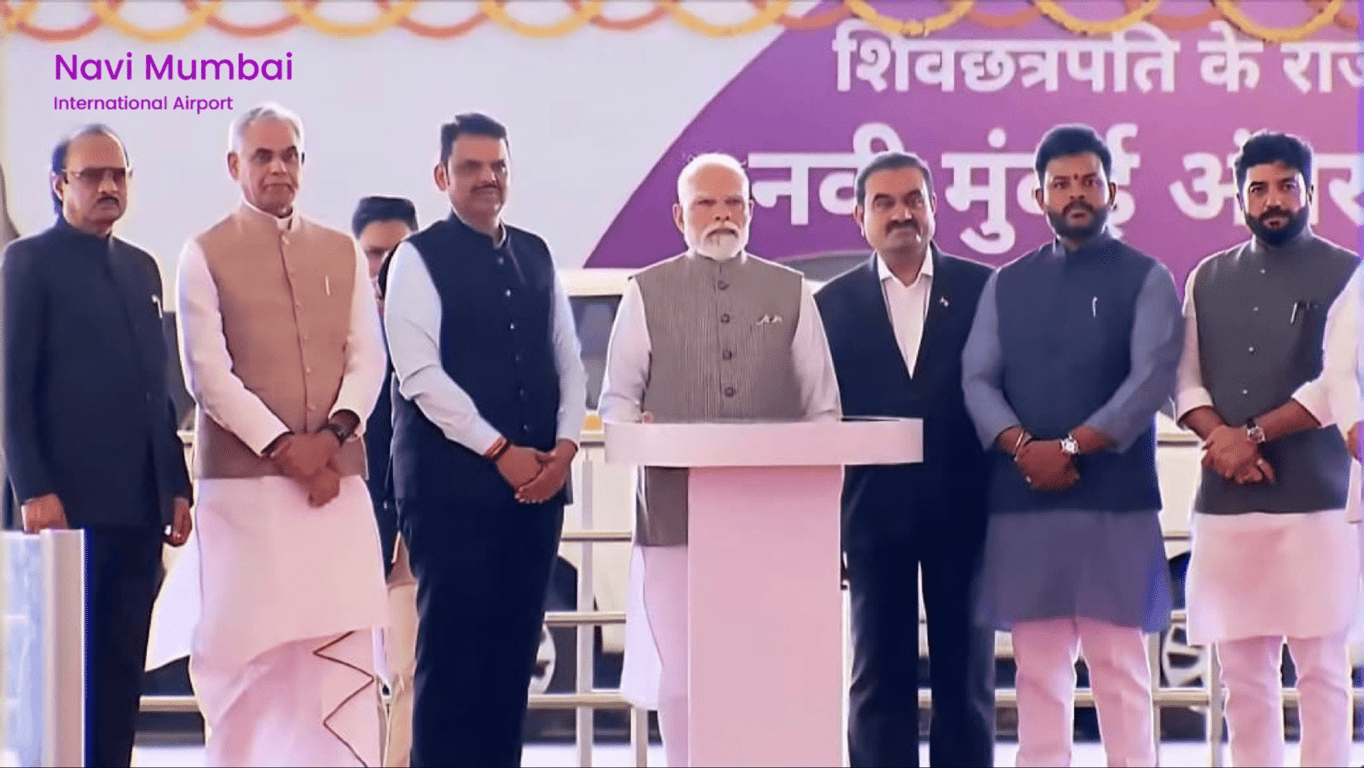
Prime Minister Narendra Modi inaugurated the Navi Mumbai International Airport on Wednesday, 8 October 2025, marking a significant milestone for Mumbai's aviation infrastructure. The airport will commence commercial operations for both domestic and international flights in December this year.
During the inauguration ceremony, PM Modi investigated the newly-constructed facility and described it as a ‘glimpse of “Viksit Bharat”, highlighting its role in transforming travel and connectivity in Mumbai.
The airport infrastructure will initially manage 20 to 22 flights per hour, with provisions to expand this capacity the following year. The first terminal is expected to reach its maximum operational capacity within 12 to 15 months of opening. The terminal features extensive facilities, including 66 check-in points, 22 self-service baggage drop stations, 29 passenger boarding bridges, and 10 gates for bus boarding. The facility also houses purpose-built sections for express deliveries, high-value items, hazardous materials, and animal transportation.
Navi Mumbai International Airport Future Prospects
NMIA will witness the following additions and changes in the coming days:
IndiGo Flight Operation: IndiGo will launch 18 daily flights to more than 15 domestic cities. It is expected that it will expand to include international routes by March 2026. In the coming days, IndiGo plans to expand its operations to 140 daily flights, including 30 international flights.
Akasa Air Operations: Akasa Air has confirmed that it will launch flights at NMIA upon its commencement of operations. Currently, it plans to launch 15 domestic flights daily, before ramping up to over 300 domestic and 50 international flights weekly.
Completion of additional phases: In the upcoming years, Terminal 2 and the subsequent phases (Terminal 3, Terminal 4, and the second runway) are expected to be completed, with Terminal 2 anticipated to be finished by FY 2028-29.
Benefits
The following are the benefits of the NMIA Project:
Economic Development in the region: The construction of an aerocity and commercial districts near the airport leads to an economic boost in the region. Furthermore, it also increases logistics and employment in Navi Mumbai.
Reduce Congestion: NMIA is designed to reduce congestion at the Chhatrapati Shivaji Maharaj International Airport (CSMIA), thereby improving travel efficiency.
Extended route choices: With new plans and increased capacity, the NMIA will offer multiple domestic and international flights with varying timings, thereby improving flexibility.
Improved regional connectivity: Residents of Navi Mumbai, Ulwe, Panvel, Kharghar, and nearby suburbs will benefit from quick access to the airport, resulting in saved travel time.
Increased trade and cargo: Advanced cargo handling facilities will make NMIA a hub for export, import, and logistics, boosting industries across Western India, Pune, and nearby business clusters.
Conclusion
The Navi Mumbai International Airport (NMIA) is a greenfield airport located in Ulwe, Navi Mumbai. Spanning an area of 1,160 hectares, the NMIA will be the second International Airport for the Mumbai Metropolitan Region (MMR). It is designed to reduce congestion at the Chhatrapati Shivaji Maharaj International Airport (CSMIA). It is being developed in five phases by Navi Mumbai International Airport Limited (NMIAL).
This lotus flower design airport, designed by Zaha Hadid Architects, features advanced technology systems, making it efficient to use. NMIA will handle up to 20 million passengers annually in Phase 1, with plans to expand to four terminals and two runways, serving up to 90 million passengers per year by 2032.
Upon its full completion, expected by 2032, the NMIA will position Mumbai as one of the Indian cities with a dual-airport system, supporting India’s vision for aviation expansion and global transit connectivity for decades to come.
Track the Latest Airport Terminal Facility Projects in India for Business Opportunities.
Subscribe to our upcoming and ongoing Airport Terminal Facility Projects in India to access reliable, high-quality insights on forthcoming and completed infrastructure projects across the country.
Our user-friendly platform provides essential details, timely updates, key stakeholder contact information, and business opportunities tailored for engineering companies, industry professionals, investors, and government agencies.
Start a free demo to take your business to the next level.
Leave a Comment
We love hearing from our readers and value your feedback. If you have any questions or comments about our content, feel free to leave a comment below.
We read every comment and do our best to respond to them all.