



Project at a Glance | |
Project Name | Delhi-Katra Expressway |
Project Type | Greenfield & Brownfield |
Project Sector | Infrastructure |
Project Status | Under Construction |
Project Cost | INR 40,000 crore (approximately USD 4.82 billion) |
Project Start Date | April 2022 |
Project Completion Date | March 2027 (Expected) |
Owner | National Highway Authority of India (NHAI) |
Expressway Length | 667 km |
Lanes | 4 lanes (Expandable to 8 lanes) |
Starting Point | Jasaur Kheri village, Delhi |
Ending Point |
|
Speed Limit | 120 km/hr |
Project Overview
The Delhi-Amritsar-Katra Expressway is an infrastructure project connecting the three major states of India, including Jammu & Kashmir, Punjab, and Delhi. It is a 667 km long, four-lane (expandable to eight-lane) expressway. It begins at Jasaur Kheri village, near the Bahadurgarh border in Delhi, and ends at Sri Guru Ram Dass Jee International Airport in Amritsar, Punjab. Its other endpoint is at Katra in Reasi district, Jammu and Kashmir (near the Vaishno Devi temple).
Currently, it takes approximately 14 hours to cover the distance of nearly 727 km between Delhi and Katra. Upon its full completion, it would reduce travel time to 6 hours, covering 588 km. Moreover, it also reduces the travel time between Delhi and Amritsar from 8 hours to 4 hours.
The expressway aims to improve connections to famous religious sites, such as the Amritsar and Vaishno Devi temples in the Punjab & Kashmir region. Furthermore, it provides an improved transport network, boosting trade.
Project Background
The Delhi-Katra Expressway is a project owned by the National Highway Authority of India (NHAI) and is being constructed under the Bharatmala Pariyojana. The main objective of the project is to enhance road connectivity between the National Capital, Delhi, and the holy city of Katra, in Jammu & Kashmir, via Punjab.
A final alignment was announced in January 2019, and the land acquisition process began. The Detailed Project Report (DPR) was prepared in November 2019 by M/S Feedback Infra Pvt Ltd.
The land acquisition process started in January 2020, covering approximately 14,000 acres in Punjab and nearly 5,000 acres in Haryana. On 24th April, 2022, the Prime Minister Narendra Modi laid the foundation stone for the project, marking the start of the construction phase.
The Delhi-Katra Expressway is also aligned with the Ludhiana–Delhi–Kolkata Industrial Corridor, one of 11 national industrial corridors in the country. As a result of this project, traffic congestion on the historic Grand Trunk Road (NH-44) will be alleviated, and pilgrims will be able to travel to holy places like Amritsar and Katra more quickly, which attract millions of pilgrims every year.
Delhi-Katra Expressway Status
As of November 2026, the Delhi–Amritsar–Katra (Delhi–Katra) Expressway is under active construction across multiple packages in Haryana, Punjab, and Jammu & Kashmir. Major sections of the expressway were inaugurated in July 2026, marking a significant milestone in improving connectivity between Delhi and Katra.
In Haryana, the initial 34-km section was reported as complete and operational in a September 2026 government report, having been removed from the list of ongoing projects and recorded as a completed project.
Delhi-Katra Expressway Completion Date
The Delhi–Amritsar–Katra (Delhi–Katra) Expressway is currently targeted for completion by March 2027, according to the latest official announcement from the National Highways Authority of India (NHAI) in November 2026. This timeline applies to the overall completion of the expressway, as stated by NHAI’s Project Implementation Unit, Jammu.
Project Timeline
Date | Event |
March 2027 | Expected completion of the project. |
September 2026 | In Haryana, the initial 34-km section was reported as complete |
January 2026 | Officials expect the road work from Delhi to Malerkotla to be completed by the end |
February 2025 | The government revised the completion date. |
October 2022 | 408 km of the expressway is under construction |
April 2022 | Prime Minister Narendra Modi laid the foundation stone |
April 2021 | NHAI awards the construction contracts |
June-July 2020 | The land acquisition process begins |
November 2019 | Detailed Project Report completed by NHAI |
December 2017 | NHAI hires consultants to prepare a Detailed Project Report (DPR) for the expressway. |
Also Read: Ahmedabad Dholera Expressway
Project Scope
The project scope includes the following:
Four-lane expressway: The Delhi-Katra Expressway is a 4-lane (expandable to 8 lanes) expressway connecting Jammu & Kashmir, Punjab, and Delhi.
Reduced travel time: The expressway reduces travel time from Delhi to Katra to 6 hours, and from Delhi to Amritsar, it will only take 4 hours.
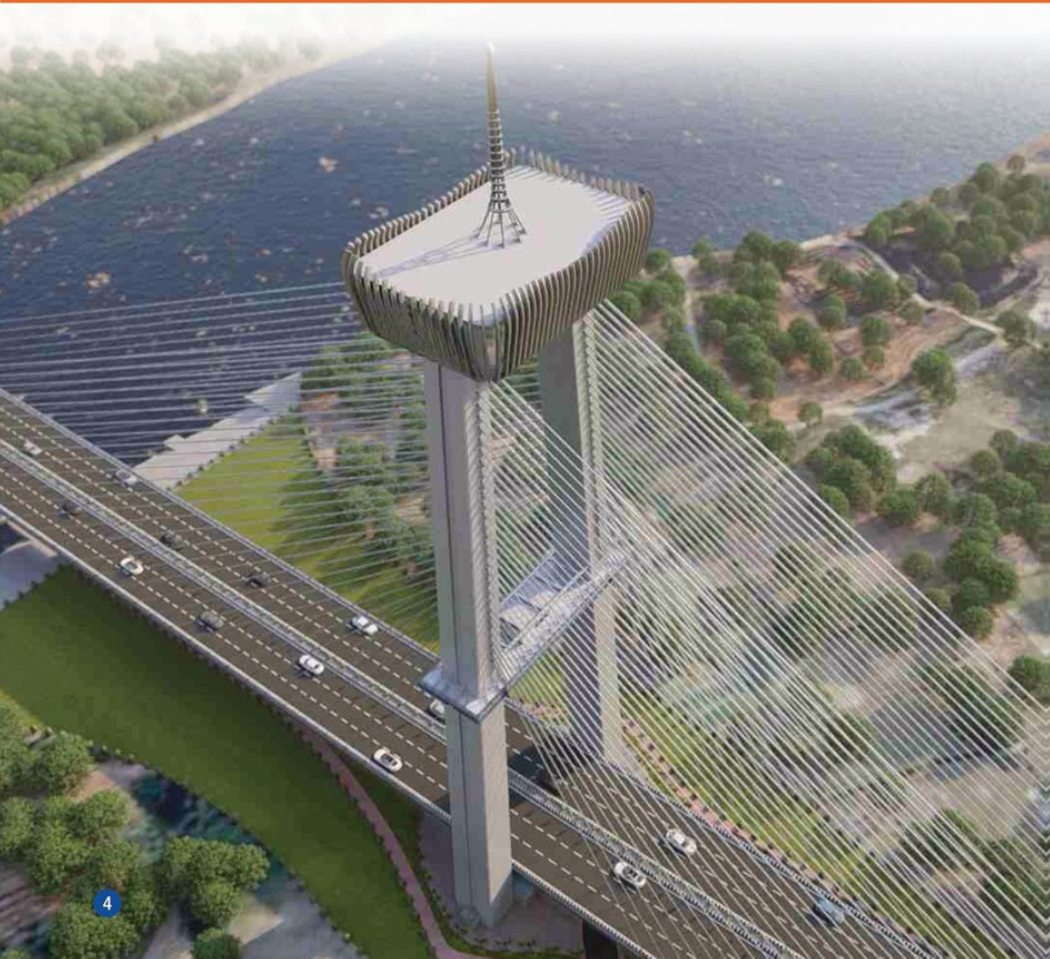
Advanced Infrastructure: The expressway features advanced infrastructure, including trauma centers, bus bays, truck stops, food courts, recreational areas, green medians, and boothless tolling. It also includes a 1,300-meter cable-stayed bridge over the Beas River.
Spur Corridor: The expressway includes a 99 km spur corridor from Nakodar to Sri Guru Ram Das Ji International Airport, Amritsar, via Sultanpur Lodhi, Goindwal Sahib, Khadoor Sahib, and Tarn Taran.
Speed Limit: Fully access-controlled with a speed limit of 120 km/h for light vehicles and 80 km/h for heavy vehicles.
Environmental Protection: The expressway embraces green medians and safety railings. Furthermore, it addresses environmental concerns, such as structural safety in excavation areas (e.g., Reasi district).
Advanced Technologies used in the Delhi-Katra Expressway
The advanced technologies used to ensure safety and efficiency, before and after the operation, are as follows:
Intelligent Transportation System (ITS): Installation of real-time traffic monitoring systems with CCTV Cameras and sensors to manage traffic and improve safety.
The recent announcement clarified that all the traffic signals installed in Jammu under the Intelligent Traffic Management System (ITMS) that have been inoperative for more than three months will become operational only upon the opening of the Delhi-Katra Expressway.
Geographical Information System (GIS): Utilization of GIS and GPS for precise route alignment, land acquisition planning, and monitoring construction progress.
Toll Collection Systems: Automated toll collection systems using FASTag (RFID-based) for seamless and efficient tolling.
Use of HPC: Utilizing high-performance concrete and steel composites for bridges and elevated sections to withstand environmental stresses.
Trusted by Leading Manufacturers & EPCs
Find The Latest Road Infrastructure Projects In India
Gain exclusive access to our industry-leading database of Road Infrastructure Project opportunities with detailed project timelines & stakeholder information
No credit card Up-to-date coverage
Project Cost
The total estimated cost of constructing the Delhi-Katra Expressway is INR 40,000 crore (approximately USD 4.82 billion). Initially, the project cost was estimated at INR 39,500 crore.
For the recently inaugurated 157.92-km section comprising Packages 1 to 5, the official project cost is approximately INR 9,680 crore. This section was dedicated to the nation in July 2026 and forms part of the wider 667-km greenfield corridor.
Delhi-Katra Expressway Route Map
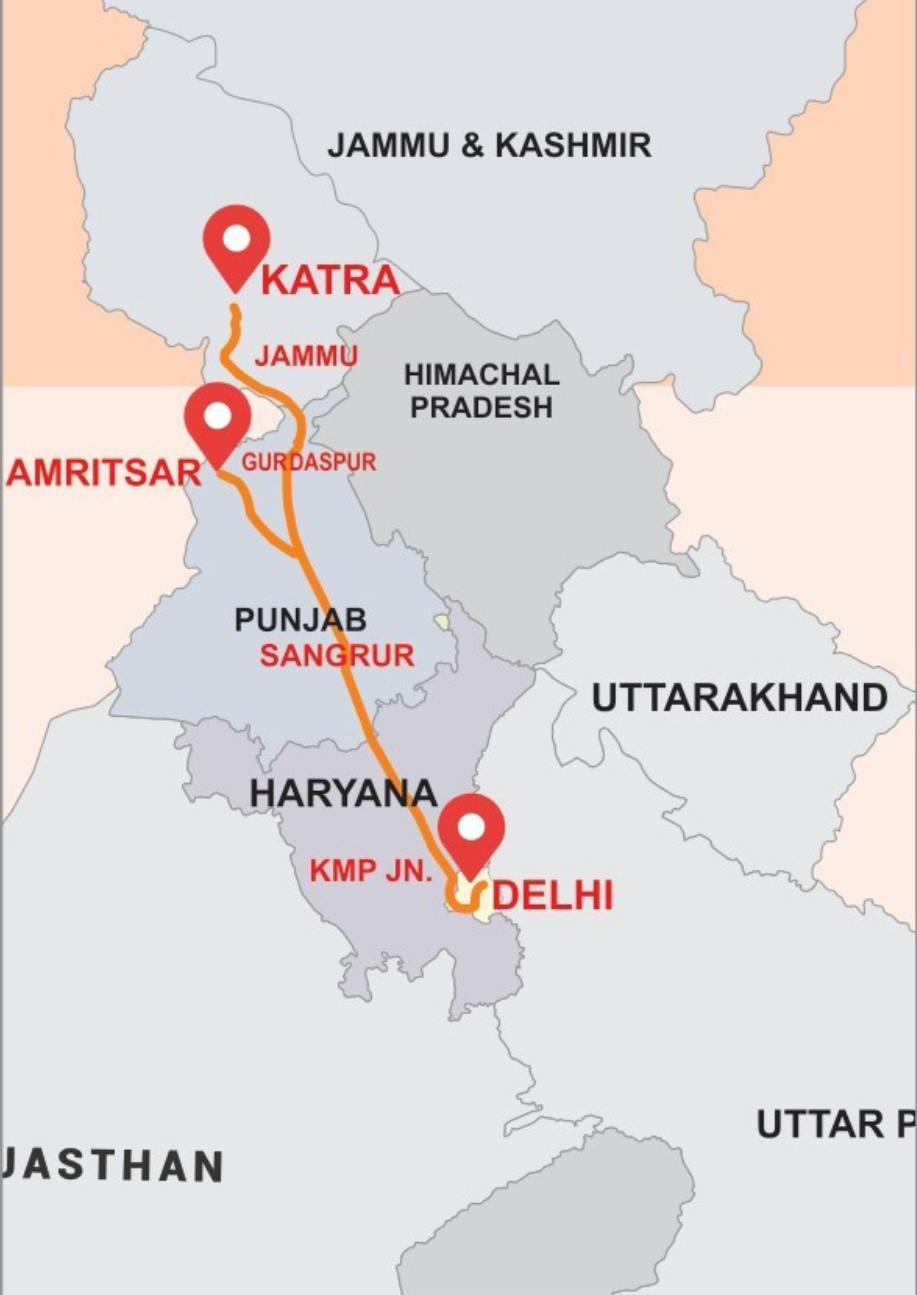
Delhi-Katra Expressway Route
The Delhi-Katra Expressway is a 667 km-long stretch connecting Delhi and Katra via Amritsar. It covers the major states, including Haryana, Punjab, and Jammu & Kashmir. It bypasses old congested roads, cutting the distance from Delhi to Katra to 588 km and from Delhi to Amritsar to 405 km.
Passing through major interchanges like Ambala–Kaithal–Hisar Road (NH-152) near Kharak Pandwa & Amritsar–Tanda Road (NH-503A) near Sri Hargobindpur, the expressway connects religious destinations, such as Amritsar and Vaishno Devi temples in the Punjab & Kashmir region.
Furthermore, the expressway reduces congestion on the heavily trafficked highways and integrates with existing highways like the Kundli–Manesar–Palwal (KMP) Expressway.
As National Expressway 5 (NE-5), it covers approximately 571 km of the Delhi–Katra corridor, including the 397.7 km Delhi–Nakodar–Gurdaspur section, and as NE-5A for the 99 km Nakodar–Amritsar spur. Light vehicles can travel at a speed of 120 km/h on it as it crosses Haryana, Punjab, and Jammu and Kashmir.
Entry & Exit Points at Delhi-Katra Expressway
Starting Point: Junction with the KMP Expressway near Nilauthi/Jasaur Kheri village in Jhajjar district, Haryana. There is a proposal to extend this southward to Urban Extension Road II in Delhi, with DPR expected by September–October 2025.
Ending Point: Katra in Reasi district, Jammu and Kashmir (near the Vaishno Devi temple).
Amritsar Spur: Sri Guru Ram Das Ji International Airport on Amritsar–Ajnala Road (NH-354) in Amritsar district, Punjab
States & Districts covered by the Delhi-Katra Expressway
States | Districts |
Haryana | Jhajjar, Rohtak, Sonipat, Jind, Karnal, Kaithal. |
Punjab | Patiala, Sangrur, Malerkotla, Ludhiana, Jalandhar, Kapurthala, Tarn Taran, Amritsar, Gurdaspur, Pathankot. |
Jammu & Kashmir | Kathua, Samba, Jammu, Udhampur, and Reasi. |
Haryana Stretch Completion
The Haryana stretch of the Delhi-Katra Expressway is 135 km long, covering the Jhajjar district (Jasaur Kheri), Rohtak district (Hassangarh), and areas between Sampla and Kharkhoda in Sonipat district, as well as Lahkan Majra and Gohana in Jind district, and Kaithal, Narwana, and Kaithal districts.
The expressway has a speed limit of 120 km/hr for light motor vehicles and 80 km/hr for heavy vehicles. The Haryana stretch includes a total of seven toll plazas and only allows light motor vehicles and heavy motor vehicles.
The Delhi-Punjab highway has improved connectivity since it began its operation in November 2024. Easily accessible to Delhi, the expressway can be bridged near the Rukhi village in Gohana, connecting to the KMP Expressway at Nilothi in Jhajjar.
Toll Rates at Haryana Section
Toll rates on the Haryana section of the Delhi Amritsar Katra Expressway are as follows:
Light motor vehicles (Cars and Jeeps): INR 240 for a one-way trip and INR 360 for a round trip.
Light commercial vehicles: INR 385 for one way and INR 580 for both ways
Two-axle buses and trucks: INR 805 for one way and INR 1210 for a return journey
Three-axle commercial vehicles: INR 880 one way and INR 1320 for both sides.
Trusted by Leading Manufacturers & EPCs
Find The Latest Road Infrastructure Projects In India
Gain exclusive access to our industry-leading database of Road Infrastructure Project opportunities with detailed project timelines & stakeholder information
No credit card Up-to-date coverage
Phases of Delhi Katra Expressway
The Delhi-Katra Expressway is built in two phases. Below is a detailed description of the two phases:
Phase I
Phase I of the Delhi-Katra Expressway is a 397.7 km greenfield stretch and includes a 99 km greenfield spur heading towards Amritsar, Punjab. The 397.7 km greenfield stretch, which begins at the Kundli-Manesar-Palwal (KMP) Expressway and heads towards Gurdaspur, Punjab. It falls on the Delhi-Nakodar-Gurdaspur (NE-5) Expressway.
Nakodar–Amritsar (NE-5A) is a 99 km greenfield spur that starts from Nakodar, Punjab, and extends towards Sri Guru Ram Das Ji International Airport in Raja Sansi, Amritsar, passing through religious sites such as Sultanpur Lodhi, Goindwal Sahib, Khadoor Sahib, and Tarn Taran.
Phase I includes a total of 12 main packages & 3 spur packages connecting Nakodar to Amritsar. It includes facilities like trauma centers, ambulances, fire brigades, traffic police, bus bays, truck stops, and refreshment areas.
Phase II
Phase II of the Delhi-Katra Expressway is approximately 161 km long. It is a mix of brownfield and greenfield expressways, connecting Gurudaspur to Katra, through Jammu & Kashmir.
The brownfield expressway focuses on the expansion of the existing highways NH-54 (old NH-15) and NH-44 (old NH-1), upgrading and widening them into a controlled-access expressway.
The Greenfield expressway focuses on the construction of a 12.345 km Pathankot Link Road, connecting the expressway at Gobindsar village (Package 14) with Talwara Jattan Village on NH-44 in Gurdaspur District.
Upgrades existing highways, such as NH-54 (Amritsar–Gurdaspur) and NH-44, with new greenfield sections to bypass congested areas, thereby enhancing connectivity to Katra, the gateway to the Vaishno Devi temple.
Also Read: Ganga Expressway
Packages & Contractors of Delhi Katra Expressway
Phases | Packages | Contractors |
Phase I | Package 1 | KCC Buildcon Pvt. Ltd |
| Package 2 | CDS Infra Projects Ltd. |
| Package 3 | KCC Buildcon Pvt. Ltd |
| Package 4 | NKC Projects |
| Package 5 | CDS Infra Projects Ltd. |
| Package 6 | Shiv Build India - Mehta Construction Co. JV |
| Package 7 | Ceigall India Ltd. |
| Package 8 | Evrascon _ MKC Infrastructure Ltd. |
| Package 9 | Evrascon _ MKC Infrastructure Ltd. |
| Package 10 | Evrascon _ MKC Infrastructure Ltd. |
| Package 11 | Evrascon _ MKC Infrastructure Ltd. |
| Package 12 | Evrascon _ MKC Infrastructure Ltd. |
| Spur Package 1 | SP Singla is the lowest bidder. |
| Spur Package 2 | Ceigall India - Krishna Constructions JV |
| Spur Package 3 | Joint Stock Company Industrial Association Vozrozhdenie. |
Phase II | Package 13 | Tender still pending |
| Package 14 | Megha Engineering and Infrastructure Ltd. (MEIL) |
| Package 15 | Vishwa Samdra Engineering Pvt. Ltd. |
| Package 16 | Shivalaya Construction Co. Pvt. Ltd |
| Package 17 | APCO Infratech |
| Package 18 | Gawar Construction Ltd. |
Benefits of the Expressway
The following are the benefits of the Delhi-Katra Expressway:
Reduced Travel Time: Delhi-Katra Travel Time reduced to six hours, and Delhi-Amritsar Travel Time reduced to 4 hours.
Improved Connectivity: Connecting existing highways, such as the Kundli-Manesar-Palwal (KMP) Expressway, NH-54, and NH-44, improves regional accessibility.
Rise in Religious Tourism: Connections to religious places, like Vaishno Devi & Amritsar, boost visitors' experience with faster and safer travel to these destinations.
Economic Boost: The easy access to Haryana, Punjab, and Jammu & Kashmir boosts trade and logistics, resulting in improved economic growth in the state.
Job Opportunities: The expressway offers multiple job opportunities during construction and operation.
Improved logistics: Provides a high-speed, access-controlled corridor for efficient movement of goods, reducing transportation costs and delays.
Installation of Safety Tools: Incorporates crash barriers, retro-reflective signage, and LED lighting to improve safety.
Delhi-Katra Expressway Package 8 Updates
As of the latest official parliamentary information, Package 8 had achieved 31.08% physical progress and was under foreclosure/termination. The original completion date was 13 March 2025, but the package could not be completed on schedule.
As of November 2026, the balance work under Package 8 is being re-tendered. No revised official completion date has been announced for the package, as the re-tendering process is still underway.
Conclusion
The Delhi-Katra Expressway, built under the Bharatmala Pariyojana, is a transformative infrastructure project aimed at improving connectivity among the three states of Jammu & Kashmir, Punjab, and Delhi. The reduced travel time eventually boosts tourism in pilgrimage areas such as Vaishno Devi and the Golden Temple. It overall boosts the country's economy.
It is a combination of greenfield and brownfield expressways, built to create a high-speed road corridor that boosts economic growth, reduces logistics costs, and improves regional connectivity. It includes features such as trauma centers, ambulances, fire brigades, traffic police stations, bus bays, truck stops, interchanges with refreshment facilities, and recreational areas to ensure safety and convenience.
It further incorporates advanced technologies, such as intelligent transportation systems, precast concrete construction, and eco-friendly measures like rainwater harvesting, ensuring efficiency, safety, and sustainability.
Track the Latest Infrastructure Projects in India for Business Opportunities.
Subscribe to our upcoming and ongoing infrastructure projects in India to access reliable, high-quality insights on forthcoming and completed infrastructure projects across the country.
Our user-friendly platform provides essential details, timely updates, key stakeholder contact information, and business opportunities tailored for engineering companies, industry professionals, investors, and government agencies.
Start a free demo to take your business to the next level.
Leave a Comment
We love hearing from our readers and value your feedback. If you have any questions or comments about our content, feel free to leave a comment below.
We read every comment and do our best to respond to them all.