


Global offshore wind reached 90.3 GW by the first quarter of 2026, adding 254 MW in the first few months. The industry has expanded at an average rate of 10% annually over the past decade, pushing global offshore capacity to reach between 17 GW and 19.6 GW, driven by major lease awards and auctions in regions like the UK.
Largest offshore wind farms in the world, including Dogger Bank (all phases), Hollandse Kust Zuid, Hornsea Two, Hornsea One, and Yangjiang Shaba (Phases 1-5) continue to set benchmarks in scale and engineering. China once again led new installations, followed by the UK, Taiwan, Germany, and France, with these five markets accounting for 94% of last year’s additions.
This article explores the ten biggest offshore wind farms globally as of May 2026. It outlines their size, location, ownership, technology, and role within regional energy strategies.
Wind farm | Location | Capacity | Operator/owner | Status |
Dogger Bank Phases A, B & C | North Sea, UK | 3,600 MW | SSE Renewables, Equinor & Vårgrønn (JV) | Commissioning |
Hollandse Kust Zuid | North Sea, Netherlands | 1,529 MW | Vattenfall (op.); Allianz, BASF (owners) | Operational |
Hornsea Two | North Sea, UK | 1,386 MW | Ørsted, AXA IM Alts, Crédit Agricole Assurances | Operational |
Hornsea One | North Sea, UK | 1,218 MW | Ørsted | Operational |
Yangjiang Shaba Phases 1-5 combined | South China Sea, Guangdong | ~1,700 MW | China Three Gorges, Guangdong Energy, Mingyang | Operational |
Seagreen | Firth of Forth, Scotland | 1,075 MW | SSE Renewables & TotalEnergies | Operational |
Moray East | Moray Firth, Scotland | 950 MW | KEPCO, Mitsubishi Corp., Ocean Winds | Operational |
Greater Changhua 1 & 2a | Taiwan Strait | 900 MW | Ørsted | Operational |
Hollandse Kust Noord | North Sea, Netherlands | 759 MW | Shell & Eneco (Crosswind JV) | Operational |
Triton Knoll | North Sea, UK | 857 MW | innogy / RWE, J-Power, Kansai Electric | Operational |
Dogger Bank Phases A, B & C
Located between 80 and 125 miles off the coast of Yorkshire, Dogger Bank is being developed across three 1.2 GW phases (A, B, and C), each using GE Haliade-X 13 MW turbines, totaling 277 turbines and a GBP 7.8 billion investment.
When complete, it will power six million UK homes and supply around 5% of total UK electricity demand. The project was also a technological first: it is the world's first offshore wind farm to use HVDC technology to transmit power to shore.
The first phase of the larger project, Dogger Bank A, produced its first power in October 2024. The first of Phase B's 95 turbines was installed in early March 2026, with turbine installation continuing until approximately Q2 2027. All 277 foundations are in place across the three phases, and inter-array cable work is complete on Phases A and B.
On the regulatory front, in May 2026, the UK government granted development consent to two planned Dogger Bank South wind farms by RWE and Masdar, each with 1.5 GW of capacity, paving the way for a potential fourth and fifth phase.
Trusted by Leading EPCs & Manufacturers
Find the Latest Offshore Wind Farm Projects Around the World
Gain exclusive access to our industry-leading database of offshore wind opportunities with detailed project timelines and stakeholder information.
Request Free Trial → Learn More →
No credit card Up-to-date coverage
Hollandse Kust Zuid
Hollandse Kust Zuid is the largest subsidy-free offshore wind farm in operation and sits 18 to 36 kilometers off the Dutch coast between Scheveningen and Zandvoort. The 1.5 GW project includes 139 Siemens Gamesa 11 MW turbines across an area of about 225 square kilometers and supplies enough electricity for roughly 1.5 million households.
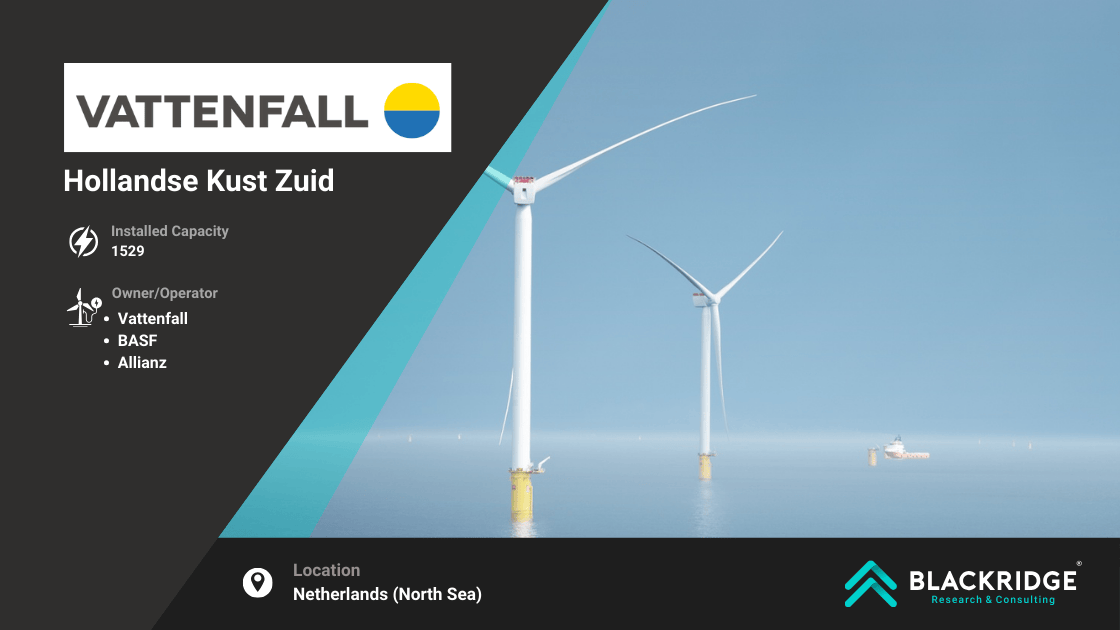
It reached full operation in 2024 after delivering its first power in 2022, with Vattenfall operating the site on behalf of its owners Vattenfall, BASF, and Allianz. The wind farm uses artificial reef structures to strengthen marine habitats and hosts an innovation hub called SeaLab, which tests concepts such as seaweed cultivation within the array.
Power is transmitted to shore through TenneT’s offshore grid system, part of the Netherlands’ broader Net op Zee program. HKZ’s scale and subsidy-free model make it a milestone for offshore wind development in Europe.
In early 2026, BASF reduced its stake in the project by selling a 25.2% share to Allianz Capital Partners, bringing Allianz in as a financial co-owner alongside Vattenfall, which continues to operate the farm. The project remains fully operational and is widely cited as a benchmark for the economics of large-scale offshore wind.
Hornsea Two
Hornsea 2 came online in 2022 and has 165 Siemens Gamesa 8 MW turbines across 462 square kilometers, lying 89 kilometers from the Yorkshire coast. It generates enough power for about 1.4 million homes. At commissioning, it was the world's largest offshore wind farm, a title it held until Dogger Bank's phased handover began. Ørsted operates the site and owns it alongside institutional investment partners.
Hornsea 2 is generating reliably as part of Ørsted's flagship UK portfolio. Attention has increasingly shifted to the cluster's next phase - Hornsea 3, at 2.9 GW, is now under active construction in the southern North Sea, with offshore cable-laying activities underway through 2026, and offshore substation installation progressing. The success of Hornsea 2 underpinned the case for the larger investment.
Hornsea One
Hornsea 1 sits 120 kilometers off the Yorkshire coast and operates 174 Siemens Gamesa 7 MW turbines across 407 square kilometres. It reached full operation in 2019 and supplies clean electricity to more than one million homes. It was the world's first offshore wind farm to exceed 1 GW, establishing a scale milestone that has since been surpassed repeatedly within the same North Sea cluster.
Hornsea 1 continues stable full commercial operation. The UK government's January 2025 Contracts-for-Difference auction awarded 8.4 GW of new offshore wind (7.5 GW of which will be based in the North Sea), bringing total UK North Sea installed, under-construction, or contracted offshore capacity to 32 GW, a pipeline that Hornsea 1's operational track record helped make possible. Ørsted operates the farm from its East Coast Hub in Grimsby.
Yangjiang Shaba
Yangjiang Shaba is a multi-developer offshore complex in Shaba Township, Yangxi County, off the Guangdong coast. Built across five phases commissioned between 2019 and 2022, it brought together three major Chinese energy groups (China Three Gorges, Guangdong Energy, and Mingyang Smart Energy), each developing separate but adjacent phases using turbines ranging from 5.5 MW to 6.45 MW.
The Three Gorges portion alone became China's first gigawatt-scale offshore wind farm, with cumulative output exceeding 1 billion kilowatt-hours by 2022.
The Yangjiang Shaba site remains one of the largest offshore wind installations in the world, with a combined capacity of around 1.7 GW and over 300 turbines operating in the South China Sea.
China's total offshore wind capacity grew from under 5 GW in 2018 to 42.7 GW in 2025, with more than half of the world's operational offshore turbines now in Chinese waters. Yangjiang city has set a target for a ten-million-kilowatt-class offshore wind power base to be operational by 2026, cementing the region's role as China's offshore wind capital.
Seagreen
Seagreen is located approximately 27 kilometers off the coast of Angus, Scotland, in the outer Firth of Forth. Construction began in October 2021, and the farm became fully operational in 2023, making it Scotland's largest offshore wind farm.

The site reaches water depths of up to 58.6 meters (among the deepest of any fixed-bottom offshore wind farm in the world) and uses Vestas V164-9.5 MW turbines. The project is jointly developed by SSE Renewables and TotalEnergies, who were granted development rights by the Crown Estate in 2010.
PTTEP, Thailand's national energy company, acquired a 25.5% stake in the Seagreen project from TotalEnergies, making it one of the first major Southeast Asian energy players to take a direct ownership position in a large-scale European offshore wind farm. An approved 1A extension adding 36 turbines would take Seagreen's total capacity beyond 1.5 GW when constructed.
Moray East
Moray East is located in the outer Moray Firth off the northeastern coast of Scotland, approximately 22 kilometers from the shore. The farm uses 100 MHI Vestas V164-9.5 MW turbines and was developed as a joint venture between Korea Electric Power Corporation (KEPCO), Mitsubishi Corporation, and Ocean Winds (a joint venture of EDP Renewables and ENGIE).
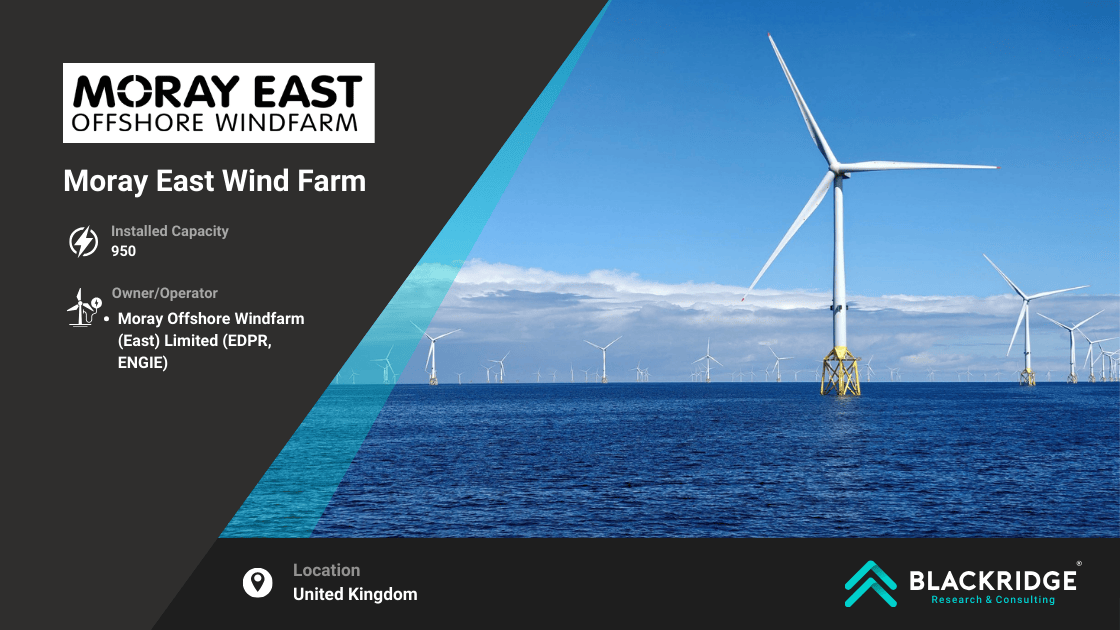
It was commissioned in 2022 and is one of the few large-scale offshore wind farms with significant Asian utility ownership, reflecting growing international investment in UK offshore wind infrastructure.
Moray East operates adjacent to the newer Moray West wind farm (882 MW), which reached full power in April 2025. Together, Moray West and Neart Na Gaoithe were among the UK's key contributions to North Sea capacity growth in 2025, adding roughly 1.6 GW of new capacity to the region. The two Moray farms now form one of Scotland's most significant offshore energy hubs.
Greater Changhua 1 & 2a
Greater Changhua 1 provides 605.2 MW and is jointly owned by Ørsted and a consortium led by CDPQ and Cathay PE, while Greater Changhua 2a contributes 294.8 MW and is fully owned by Ørsted.
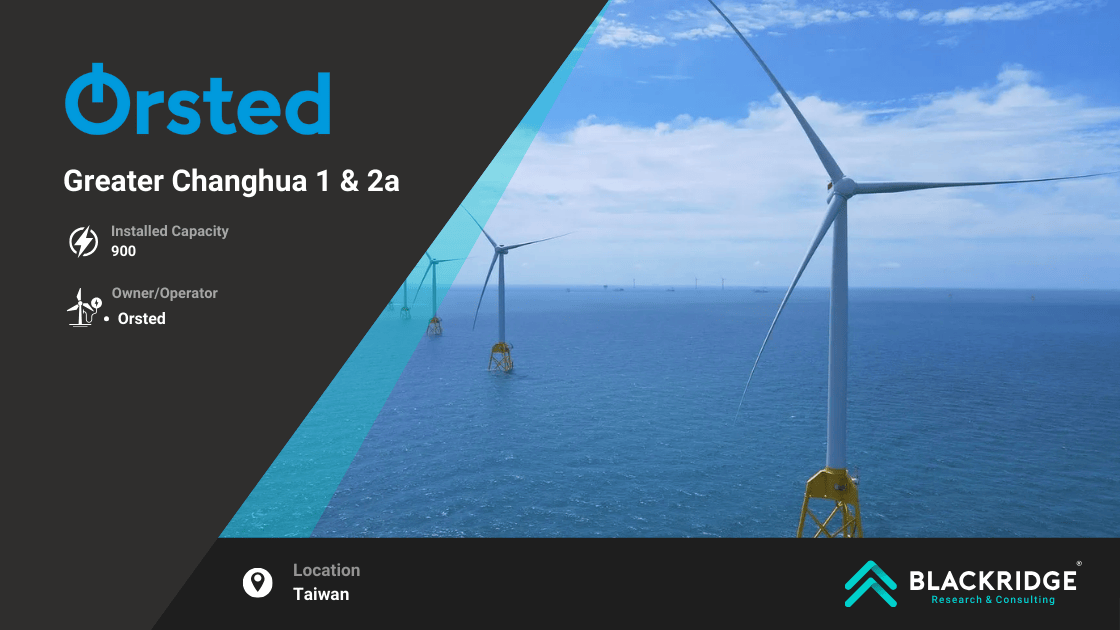
The wind farms were officially inaugurated and fully grid-connected in April 2024 and are the largest operational offshore wind development in Taiwan and the wider Asia-Pacific region. Construction began in 2021, and the project pioneered local offshore wind supply chain development in Taiwan.
Ørsted's adjacent Greater Changhua 2b and 4 complex (920 MW) has completed installation of all 66 Siemens Gamesa SG 14-236 turbines, the first 14 MW turbines with 115-meter-long blades ever deployed globally. The farm produced its first power in July 2025, and full commercial operation is expected in Q3 2026. Once complete, Ørsted's four Greater Changhua farms will together power approximately 2.8 million Taiwanese households.
Hollandse Kust Noord
Hollandse Kust Noord is located 18.5 kilometers off the Dutch coast near Egmond aan Zee and consists of 69 Siemens Gamesa SG 11-200 DD turbines across a 92 square kilometer site. Construction began in October 2022, with the final turbine installed in October 2023 and full operational notification granted in June 2024.
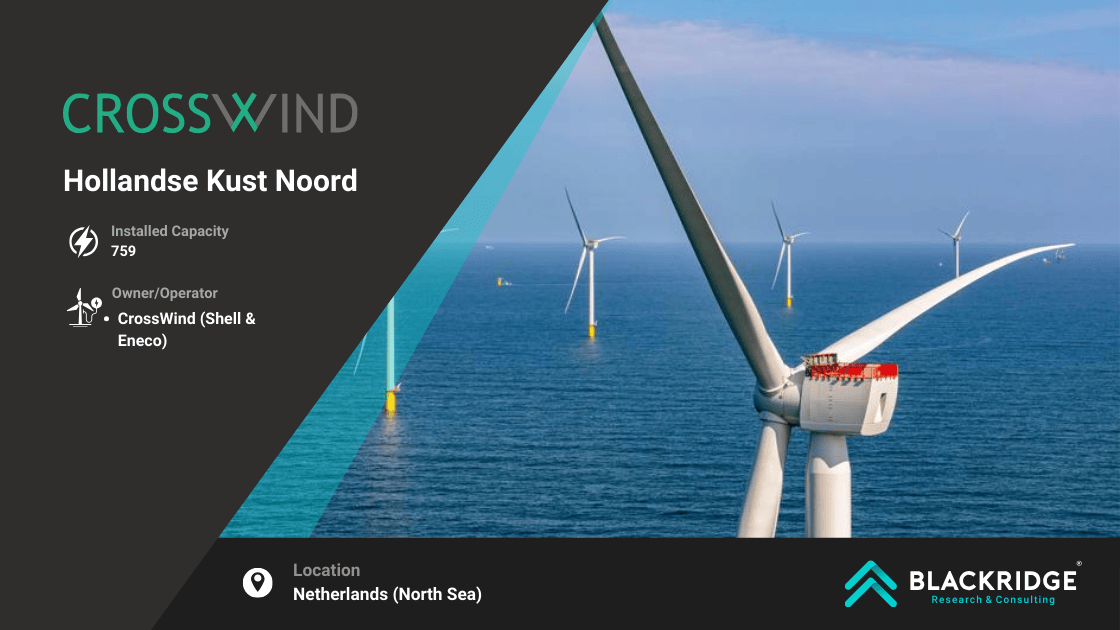
Like Hollandse Kust Zuid, it was built entirely without subsidies, reinforcing the Netherlands' early leadership in subsidy-free offshore wind. The Crosswind joint venture between Shell and Eneco developed and now operates the farm.
The farm has been generating at full capacity since mid-2024. The Netherlands operates 13 offshore wind farms totaling roughly 4.7 GW as of December 2025, with an ambitious pipeline targeting 21 GW by 2032 and 50 GW by 2040. Hollandse Kust Noord serves as a reference project for the next generation of Dutch offshore development, including the upcoming IJmuiden Ver and Doordewind zones.
Triton Knoll
Triton Knoll is located approximately 32 kilometers off the Lincolnshire coast in the southern North Sea, covering an area of around 145 square kilometres. The farm uses 90 MHI Vestas V164-9.5 MW turbines and was developed by innogy (now RWE) in partnership with Japanese utilities J-Power and Kansai Electric Power.
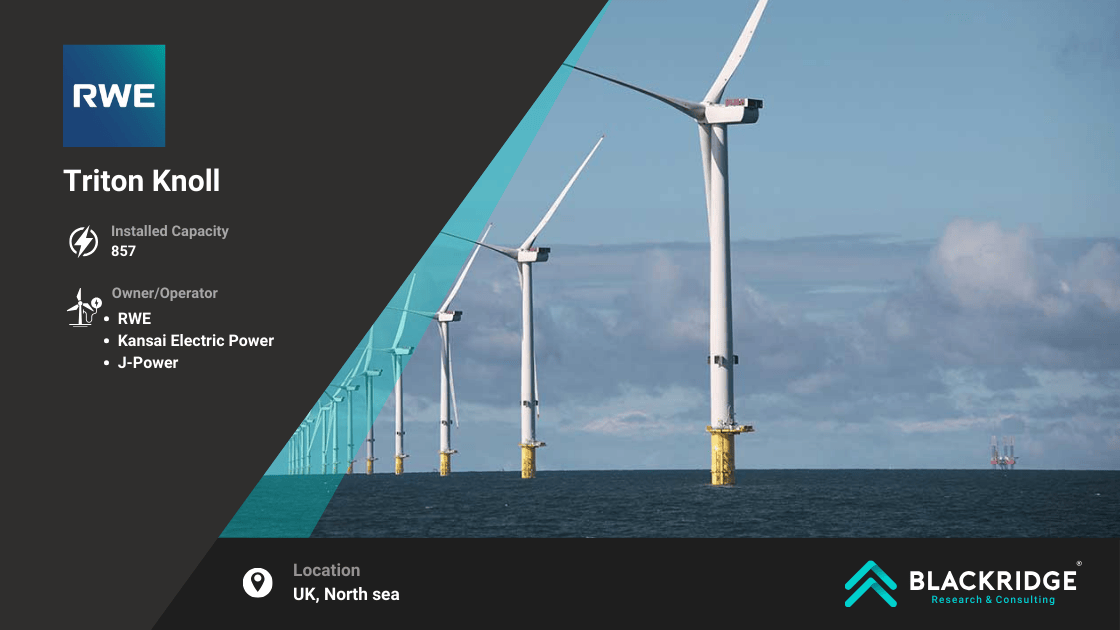
It was commissioned in 2022 and sits alongside Moray East as one of the few top-10 global offshore farms with significant Japanese utility ownership, reflecting Japan's strategic interest in building offshore wind expertise through European investments.
Triton Knoll continues to operate at full capacity as part of RWE's growing UK offshore portfolio. RWE has been active in UK offshore wind expansion in 2025-26, including its role in the newly approved Dogger Bank South projects, for which the UK government granted development consent in May 2026, adding two new 1.5 GW sites to RWE's UK development pipeline.
Conclusion
Together, these ten wind farms deliver more than 11 GW of generating capacity and supply millions of homes across Europe and Asia. They also reflect where most new additions are coming from: China, the UK, Taiwan, Germany, and France, which accounted for 94 percent of global offshore growth last year.
Floating offshore wind, still at just 19 GW by the end of 2025, is positioned for rapid acceleration as more countries move projects from pilot to commercial size. Annual installations are set to double in 2026 and surpass 55 GW by 2034, pushing total global offshore capacity to an estimated 441 GW. That shift will raise offshore wind’s share of global new wind installations from 7 percent today to roughly a quarter by the mid-2030s.
Discover Global Offshore Wind Power Projects with Ease
Are you seeking reliable and up-to-date insights into offshore wind power projects worldwide?
Explore the Global Project Tracking (GPT) platform by Blackridge Research, your go-to resource for the latest offshore wind power projects and tenders across all stages:
Upcoming Projects
Tender Notices
Contract Awards
Projects Under Construction
Completed Projects
Book a Free Demo today and see how the GPT platform can help you unlock opportunities and achieve your business goals.
Leave a Comment
We love hearing from our readers and value your feedback. If you have any questions or comments about our content, feel free to leave a comment below.
We read every comment and do our best to respond to them all.