



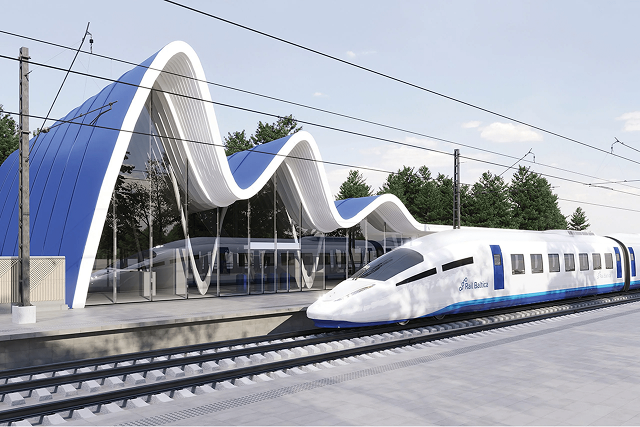
Project at a Glance | |
Project Name | Rail Baltica Project |
Project Type | Greenfield |
Project Sector | Infrastructure |
Project Location | Europe |
Project Status | Under Construction |
Project Cost | EUR 15.3 billion (USD 17.87 billion). |
Project Start Date | November 2019 |
Project Completion Date | Expected completion by 2030 (Phase I) |
Developer | RB Rail AS, a joint venture equally owned by the three Baltic States—Estonia, Latvia, and Lithuania. |
Electrified Railway Length | 870 kilometers |
Regional Train Speed | 200 km/h |
International Train Speed | 249 km/h |
Project Overview
The Rail Baltica project is one of the largest greenfield rail infrastructure projects in Europe, designed to connect the Baltic States to the European Rail Network. It will connect the five European Countries, namely:
Poland
Lithuania
Latvia
Estonia
Finland
It furthermore includes the eight cities of the Baltic, namely:
Helsinki
Tallinn
Pärnu
Riga
Panevėžys
Kaunas
Vilnius
Warsaw
There will be a standard-gauge (1435mm) electrified railway that spans 870 kilometers, running through the Baltic States to Poland, covering 392 km in Lithuania, 265 km in Latvia, and 213 km in Estonia. It aligns with the project’s aim to improve both passenger and freight transport links while reducing dependence on road and air transport.
Passenger rail services on Rail Baltica will operate at both international and regional levels. Regional trains are planned to run at speeds of up to 200 km/h, while international high-speed trains will operate at speeds of up to 249 km/h.
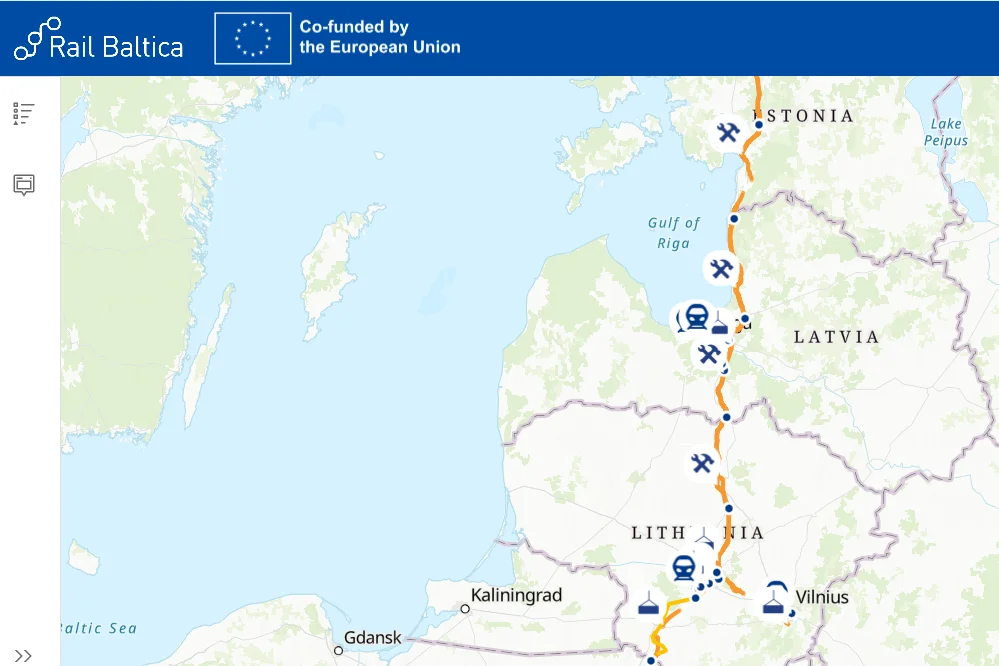
Rail Baltica Project Route
The Rail Baltica project begins in Tallinn, Estonia, and passes through several key locations, including Pärnu (Estonia), Riga and Riga Airport (Latvia), Panevėžys (Lithuania), and Kaunas (Lithuania). It continues to Warsaw, Poland, and indirectly links to Helsinki, Finland via ferry. The route passes through multiple terminals, such as Muuga Harbour (Estonia), Salaspils (Latvia), and Kaunas (Lithuania).
Rail Baltica Project Map
Project Background
The Rail Baltica project is the largest rail infrastructure project in the Baltic states in the past 100 years and forms a part of the European Union’s North Sea-Baltic TEN-T Corridor. The Idea for the Rail Baltica project emerged in the 1990s, coinciding with the dissolution of the Soviet Union and the Baltic States' gaining independence. It marks Europe’s commitment to boosting Baltic States economy and improving connectivity, offering a rich cultural experience.
A historical perspective on railway gauges in Lithuania is an interesting addition to the development of Rail Baltica. In 1851, the Russian Empire initiated the construction of the St. Petersburg-Warsaw railway with a gauge of 1524mm.
However, during World War I in 1915, the German Army, as an occupying force, replaced a significant portion of the tracks with a gauge of 1435mm. After the war, Lithuanian Railways developed a comprehensive network based on the 1,435 mm gauge.
The modern project gained momentum in the 2000s as part of EU enlargement. Following the Baltic states' accession to the EU in 2004, Rail Baltica was designated a priority project under the Trans-European Transport Network (TEN-T) framework, underlining the EU’s commitment to seamless, sustainable, and secure transport connectivity.
The project's evolution reflects a blend of EU-driven integration goals and regional aspirations for decoupling from Russian-dominated transport routes.
Rail Baltica Project Completion Date
According to the European Commission’s phased construction plan, the first phase of the Rail Baltica project is expected to be completed by 2030. It will complete a single-track, electrified line from Tallinn to the Lithuania-Poland border.
Trusted by Leading EPCs & Manufacturers
Find the Latest Rail Infrastructure Projects In Europe
Gain exclusive access to our industry-leading database of Infrastructure project opportunities with detailed project timelines and stakeholder information.
Request Free Trial → Learn More →
No credit card Up-to-date coverage
Rail Baltica Project Timeline
Year | Event |
2030 | Expected completion for Phase I |
2025 | It is expected that by the end of 2025, 43% of the mainline will be construction-ready. |
2024 | Mainline construction phase starts across all Baltic countries |
2023 | Construction of Ulemiste passenger terminal begins |
2021-22 | Construction starts at Riga Central Station and Riga Airport Station |
2018 | Spatial Planning for Estonia: Design Guidelines. Technical and design work starts. |
November 2019 | The start of the construction of the Rail Baltica high-speed rail link. |
2011 | Feasibility study and route agreement among the Baltic States |
2010 | Planning phase begins |
Project Scope
The project scope of the Rail Baltica Project is as follows:
Both Passenger and Freight Services: The project is designed to provide services for both passengers and Freight, utilizing the European standard gauge (1,435 mm) instead of the Russian gauge.
Regional and International high-speed trains: Regional trains are planned to run at speeds of up to 200 km/h, while international high-speed trains will operate at speeds of up to 249 km/h.
Infrastructures: The project includes 7 international passenger stations, over 40 local passenger stations, and more than 140 major structures, including bridges, tunnels, viaducts, and wildlife crossings.
Connections for Intermodal Logistics: Platforms connect with Riga International Airport, Vilnius port, and freight terminals for intermodal logistics.
Sustainability features: The project incorporates advanced sustainability and performance features, such as nearly 90 wildlife crossings and maintenance infrastructure.
Rail Baltica Project Cost
The total estimated cost for Phase I of the project is approximately EUR 15.3 billion (USD 17.87 billion). It includes the operation of the Rail Baltica Line around the three Baltic States and connects Poland by 2030.
Trusted by Leading EPCs & Manufacturers
Find the Latest Rail Infrastructure Projects In Europe
Gain exclusive access to our industry-leading database of Infrastructure Project opportunities with detailed project timelines and stakeholder information.
Request Free Trial → Learn More →
No credit card Up-to-date coverage
Rail Baltica Electrification Contract Signed
A consortium of Vinci subsidiary Cobra IS and Elecnor signed an electrification contract worth EUR 1.77 billion (approximately USD 2.078 billion). The procurement process was launched in May 2022, with four international consortia expressing interest.
Three companies were shortlisted in 2023, and finally, on September 15, 2025, the Cobra-Elecnor joint venture signed an electrification contract for the Rail Baltica project. It was selected based on a strong technical solution, cost competitiveness, and sustainability credentials.
As part of the contract, the joint venture, operating as COBELEC, will install overhead lines, traction substations, and link systems for the new high-speed standard-gauge line, constructed to connect the Baltic States with the European Rail Network.
Currently, being the largest railway electrification scheme in Europe, it covers nearly 870 km of railway and 2,403 km of track across three countries, namely, (i) Estonia, (ii) Lithuania, & (iii) Latvia.
The contract is to be completed in different phases, with the first phase scheduled to begin on 1 October 2025 and is expected to be completed by 2030. It will be built for EUR 949 million (USD 1.113 billion).
It will utilize Static Frequency Converter (SFC) technology in conjunction with a 2 x 25 kV, 50 Hz electrification system, supplied by 10 traction substations. The configuration aims to improve long-term reliability and efficiency while meeting environmental targets.
Rail Baltica Contract Details
Contractors | Contract Details | |
1 | Eiffage Genie Civil | Mainline construction contract for Latvia |
2 | Budimex S.A. | Mainline construction contract for Latvia |
3 | Ferrovie dello Stato Italiance Group | Construction Management contract for Latvia |
4 | AS Nordecon | Mainline construction Phase I contract for Estonia (Selja-Tootsi) |
5 | OU Rail Baltica Estonia | Mainline Infrastructure work |
6 | Eiropas Dzelzcela Linijas (EZZL) | National project implementer, contract owner |
Rail Baltica Project Status
The Rail Baltica project is progressing rapidly in its construction phase across the three countries, namely, Estonia, Latvia, and Lithuania. It focuses on the mainline development, international stations, bridges, and crossings.
Currently, in Estonia, nearly 70 km of railway substructure is under construction, along with major works at the Ulemiste Terminal.
A framework agreement in Latvia covers 230 km of mainline, with active works near Lecava and ongoing construction at the Riga Central Hub and Airport Terminals.
In Lithuania, construction on the mainline between Kaunas and Panevėžys is ongoing, with 114 km expected to be completed by the end of 2025. 9 km of tracks will be laid, and the future longest railway bridge over the Neris River is taking shape.
It is expected that by the end of 2025, 43% of the mainline will be construction-ready.
Benefits
The following are the benefits of the Rail Baltica Project:
Rich Cultural Experience: The Rail Baltica project enhances access to a wide range of cultural events, entertainment, and leisure activities across the region.
Improved access to healthcare facilities: Enhanced connectivity between major cities and regions facilitates easy access to healthcare facilities and promotes supportive community wellbeing along the route.
Stronger railway connectivity with Baltic allies: By lining up the rail gauge and technical standards with those of Europe, Rail Baltica will enhance regional defense and military mobility. It will enable faster troop and equipment movements, streamline logistics, and open strategic corridors, enhancing security for the Baltic region and its allies.
Improved Military Logistics: With Rail Baltica, both defense logistics and multimodal freight transportation are enhanced, strengthening both resilience and civilian mobility.
New Job Opportunities: The Rail Baltica project is expected to create approximately 13,000 direct jobs and over 23,000 indirect jobs during its construction phase. Upon operation, it is likely to create up to 800 permanent jobs in infrastructure management.
Boost the economy: 7 international passenger stations, three main freight terminals, connections to airports, seaports, and the road network, open doors for economic development.
Conclusion
The Rail Baltica is a transformative rail infrastructure project designed to connect the Baltic States to the European Rail Network. The aim is to enhance regional connectivity, stimulate economic growth in the region, and foster social and cultural ties across Europe. While providing a modern, high-speed, and sustainable transport corridor, the project seamlessly connects the three countries, Estonia, Latvia, and Lithuania, with the rest of the European rail network.
It is one of the largest railway electrification and standard-gauge projects in Europe. Besides contributing to the EU's environmental and climate goals, it addresses the growing demand for efficient passenger and freight transport. The project's operation leads to a redefined mobility in the Baltic region, serving as a vital link that connects the Baltics with the rest of Europe and fosters long-term regional development.
Once completed, Rail Baltica will stand as more than just a railway project—it will be a symbol of unity, innovation, and progress, firmly anchoring the Baltic states within the European transport system and driving long-term regional development for decades to come.
Track the Latest Infrastructure Projects In Europe
Subscribe to our upcoming and ongoing infrastructure projects in Europe to access reliable, high-quality insights on forthcoming and completed infrastructure projects across the country.
Our user-friendly platform provides essential details, timely updates, key stakeholder contact information, and business opportunities tailored for engineering companies, industry professionals, investors, and government agencies.
Start a free demo to take your business to the next level.


Leave a Comment
We love hearing from our readers and value your feedback. If you have any questions or comments about our content, feel free to leave a comment below.
We read every comment and do our best to respond to them all.