

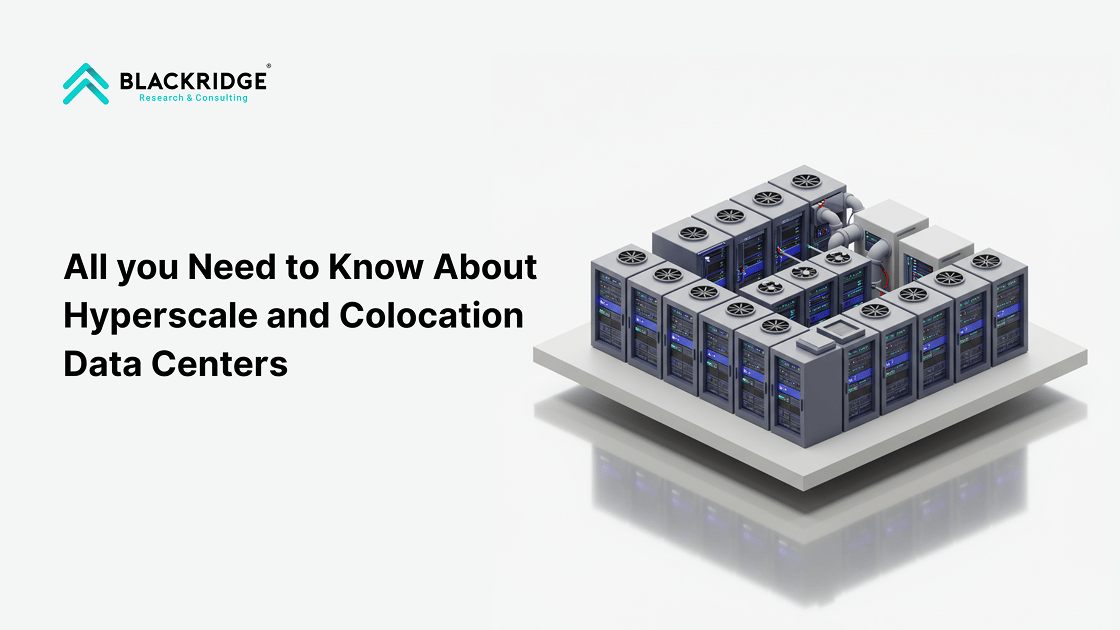
The main difference between a hyperscale data center and a colocation data center is that a hyperscale data center is owned by a single company. In contrast, colocation data centers are third-party rental services.
Hyperscale data centers are extensive in scale and are equipped with the best expertise and hi-tech IT equipment to manage, store, and process complex interconnected web of critical data.
For example, suppose you are starting your own company and want 10 TB of data storage, a server, a networking, a router, experts, and a physical space to process, store, and transmit your critical data, and you don't have enough space or resources to build and manage your own repository. In this case, you can either avail yourself of colocation services or rent space in a data center such as a hyperscale or other facility.
Hyperscale Data Center
Hyperscale data centers are massive-scale data facilities that help organizations delegate their operation and management, storage, computing needs, transmission, and all the other complicated data operations.
Traditional data centers could not keep up with the rapidly evolving and ever-increasing demands generated by the IT industry, giving rise to massive-scale data center solutions known as hyperscale data centers that are experts in making data operations hassle-free and possess extensive scalability to absorb any requirements.
Hyperscale data centers are primarily designed to accommodate vast amounts of critical data storage and processing requirements.
Some of the top hyperscalers are:
| Company | Established | No.of Data Centers |
| AWS | 2006 | 304 |
| Digital Realty | 2004 | 300+ |
| Microsoft Azure | 2008 | 300+ |
| Equinix | 1998 | 260+ |
| Google Cloud Platform | 2008 | 200+ |
Advantages of Hyperscale Data Centers
Highly Scalable: Hyperscale data centers are uniquely designed data storage and processing facilities capable of seamlessly handling extensive data traffic and heavy workloads.
Their ability to rapidly scale up is unique and feasible.
Moreover, these data center facilities often exceed 1 million square feet in size.
Security: Hyperscale data centers adopt strict multi-layered security and are equipped with 24x7 surveillance systems, machine learning, biometric access systems, and security guards to minimize the risk of unprecedented cyber-attacks and data breaches.
High-tech Design: Hyperscale data centers are designed with the use of modern technology such as artificial intelligence, the Internet of Things, automation, advanced cooling systems, and other modern IT equipment that help them operate in a complex and interconnected data ecosystem.
High Efficiency: Hyperscale data centers are much more efficient as they swiftly balance huge loads and enhance network agility using software automation. They also adopt resilient data center networks and connectivity to improve uptime.
Low latency: Hyperscale data centers provide low latency which is also made easier by 5G network rollout. Low latency facilitates fast data transmission and increases response rate.
Redundancy and better Uptime: Hyperscale data centers are redundant and offer increased up time. They adopt redundancy in their cooling system, networking and even in data storage. It helps in increased uptime and develops a secure atmosphere for their users.
Most of the hyperscale data centers offer Tier IV-level of uptime facilities ( 99.99% uptime) and maintain a redundant system to avoid failures.
Moreover, they are equipped with modern cooling technology to help them avoid system failure and data loss.
Disadvantages of Hyperscale Data Centers
High Investment: Building a hyperscale data center facility is expensive. Since its scalability can expand over millions of square feet, its investment is much higher than any other data center facility.
Moreover, high-tech equipment is costly and also requires timely maintenance.
Compliance and Standards: A hyperscale data center facility attracts a lot of compliance and standards compulsions such as ISO 27001, which is an industrial standard for information security management systems (ISMS), HIPAA, which is a security standard, SSAE, which is a standard for security and control audits etc.
Expertise: Hyperscale data center operation and management require expertise in this domain because its operation is not as simple as it sounds.
Colocation Data Center
Colocation data centers are third-party services that allow users to access cost-effective digital infrastructure on demand.
The colocation data center is one of the most feasible service options because users get access to data storage and processing facilities without owning their own data center; this way, they can avoid unnecessary investment and maintenance costs while gaining access to those facilities via third parties.
This allows users to focus on business operations and holistically manage resources.
Some of the top colocation service providers are:
| Company | Features |
| CoreSite | 4.6M square feet in 11 strategic U.S markets 40k+ customer interconnections 70% cost savings |
Cyxtera Technologies
| Providing services to more than 10,000 enterprises and government agencies across Europe, North America, Asia Pacific Global stock leader in colocation data center players at NASDAQ |
| Digital Realty Trust | 300+ data centers across 25+ countries and over 50+ metros Trusted by the world’s top tech giants like Google, AWS, IBM, Oracle and others |
| Equinix | 10,000+ customers 99.999% uptime Owns and operates a network of 260+ international business exchanges (IBX) located in over 73 metros |
| NTT | NTT global data centers are among the top 10 IT service providers in the world Top-ranked IP backbone 75+ clients of Fortune Global 100 Leader of IDC data center IP services MarketScape |
Advantages of Colocation Data Centers
Cost Effective: Leasing server racks according to demand is a cost-effective alternative without considerable investment in building and maintenance.
Flexible Pricing: Colocation data centers generally have a flexible pricing index, and the charges depend on the services taken.
Flexible Scalability: Colocation data centers are readily scalable according to future demands. Users can rent a small unit, such as a few racks, or they can rent an ample space readily available on-demand.
This way, users don't have to worry about expanding their data center following the speculative future requirement.
Compliances: When users lease a colocation data center service, the required mandatory compliance and standards are not their responsibility. All of the prerequisites are taken care of by the third parties themselves.
Interconnection and interoperability: Colocation data centers are highly efficient for interconnected interoperability across various services. It can connect with multiple clouds and networks to ensure seamless data transfer even in the most complex data ecosystems.
Disadvantages of Colocation Data Center
Fraudulent Activity: Since colocation data centers are third-party services, there is a risk of fraudulent activities concerning the service level agreement (SLA) policy and other legal agreements.
Inspecting before availing of any rental services is essential to avoid unexpected charges and legal proceedings.
Privacy: Before leasing any service, Users should ensure that their critical data is stored safely and is free from data breaches, data leaks, and cyber-attack threats.
Unauthorized Use: Users should ensure that the colocation data center provider does not practice illegal or unauthorized activity to avoid government intervention.
Comparative analysis of Hyperscale Data Center and Colocation Data Center
| Parameters | Hyperscale Data Center | Colocation Data Center |
| Ownership | Owned by the company | Third-party rental services |
| Budget | Expensive | Budget-friendly |
| Flexibility | Limited flexibility | Highly flexible |
| Scalability | Massive scale | Limited scalability but diverse service options |
| Design and build | Advanced technology | Not generally hi-tech and advanced |
| Security | Highly secure | Not much secure |
| Redundancy | Highly Redundant | Depends on the Colocation provider chosen |
| Expertise | Trained expertise | May or May not be experts |
What is best suited to your business needs?
Both hyperscale data center and colocation facilities are among the widely chosen data center service alternatives.
Their suitability depends upon the business requirements of an organization.
For example, companies like Amazon, Google Meta, and other tech giants generate vast amounts of data that need ample space as their data is ever-increasing rapidly, and their business is also operational on a large scale worldwide; for such scenarios, hyperscale data centers are the best option.
On the other hand, small business ventures can opt for colocation facilities since they generate a small amount of critical data and don't always have enough investment available to build their data center facility.
Who Needs a Hyperscale Data Center?
It is best suited for:
- Companies with large-scale computing requirements.
- Cloud service providers
- Organizations requiring high-performance computing (HPC) for research and other purposes
- Organizations use AI and ML for development, implementation, and vision inspections..
Who Needs a Colocation Data Center?
It is best suited for:
- Businesses looking for a cost-effective and budget-friendly service without having to invest in it from scratch.
- Businesses with changing data needs and companies that relocate often.
- Organization with low-latency requirements.
- Feasible for healthcare, financial and E-commerce websites and businesses.
- Cloud, telecom, and other IT companies looking for a flexible, scalable, and efficient digital infrastructure
- For start-ups with less capital and workforce to manage a data center of their own.
- For content delivery networks (CDNs)
Nevertheless, we recommend that one analyzes their requirements before choosing any of the above options and considers talking to professionals to help them identify the best choice.
Conclusion
The availability of data center facilities such as hyperscale or colocation facilities reduces high upfront costs and helps manage complexities and minimize security risks.
While each of the above alternatives has merits and demerits, they are still some of the most trending and widely chosen data center service facilities nowadays.
Frequently Asked Questions (FAQs)
What does hyperscale mean in a data center?
Hyperscale Data Centers are massive in scale, they can span over 100,000 to over 1 million sq. feet of area, and can house more than 500,000 servers.
What is the difference between wholesale and colocation data centers?
Colocation data centers can be wholesale, retail, and hybrid. Wholesale colocation services are suitable for bulk rental services.
How many MW is a hyperscale data center?
The power consumption of a hyperscale data center can vary from 10 megawatt to over 100 megawatt.
Connect With The Experts
Are you looking for a platform that gives you reliable high quality and family project insights for global data center facility projects?
Discover the Global Project Tracking (GPT) platform by Blackridge Research, designed to provide you with the most recent Global Data Center Facility Projects better and faster across various stages of development :
- Upcoming projects
- Tender notices
- Contract award announcement
- Projects in progress or under construction
- Successfully completed projects
Book a free demo to learn more about the Global Data Center Facility Projects database and how we can help you achieve your goals.



Leave a Comment
We love hearing from our readers and value your feedback. If you have any questions or comments about our content, feel free to leave a comment below.
We read every comment and do our best to respond to them all.