


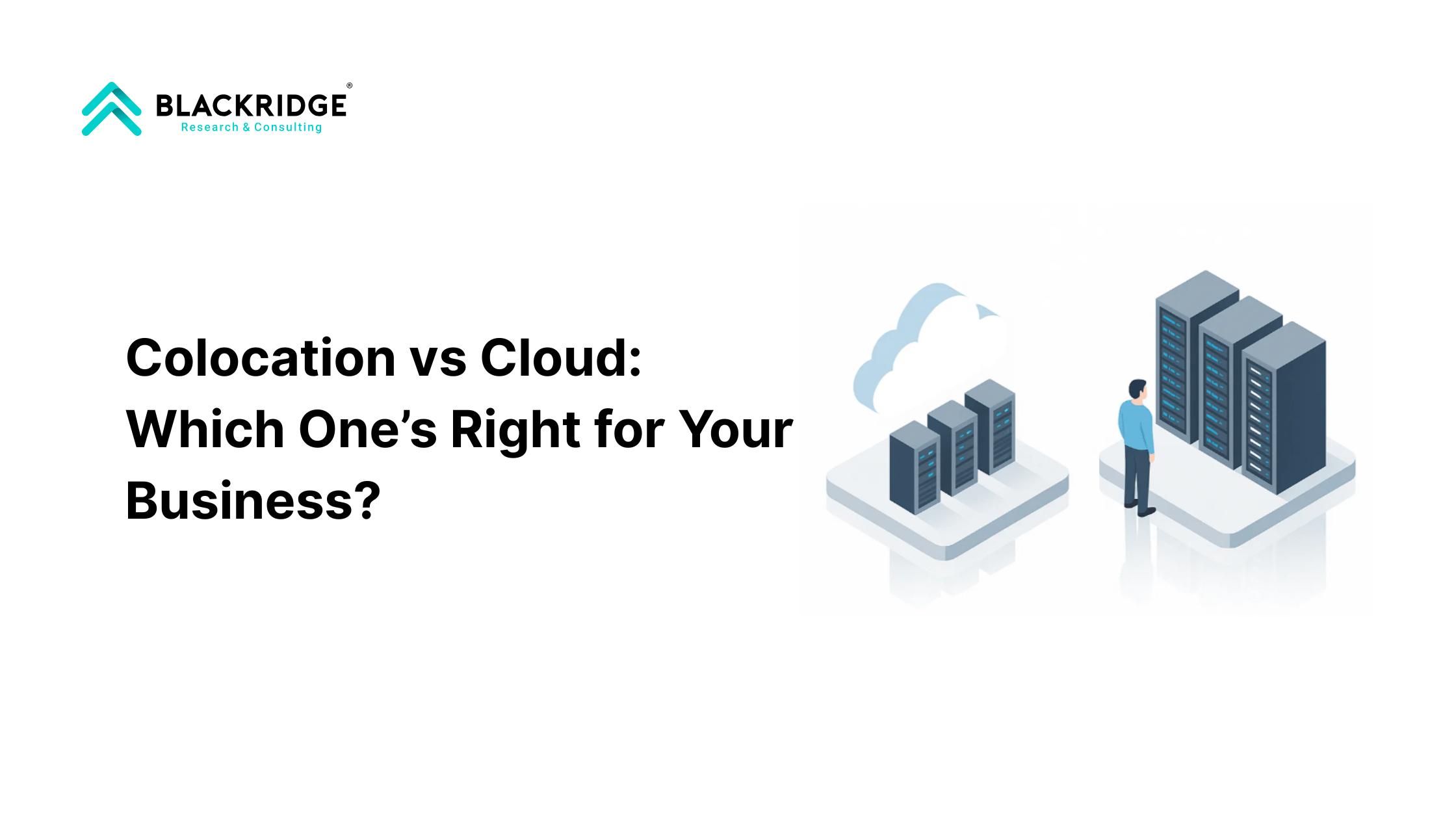
Colocation vs Cloud: Which One’s Right for Your Business?
Colocation allows companies to own and manage their servers in a rented data center, whereas a cloud provider owns and manages the servers for businesses and customers to use them virtually over the internet.
What is Colocation Service?

Colocation (or “colo”) is a rental service that provides businesses with the necessary infrastructure, like power, cooling, internet, and security, to host their own servers for daily operations.
For example, Equinix, a leading colocation provider, allows businesses to house their servers in its data centers. A growing e-commerce company might colocate its servers at Equinix to ensure reliable uptime and security while retaining full control over its hardware.
What is a Cloud Service?
The Cloud offers virtual computing resources such as servers, storage, and databases over the internet. Through the cloud, a business or individual can rent cloud services without owning or maintaining any hardware. Cloud computing is the broader concept that includes IaaS, PaaS, and SaaS.
What is Cloud Computing?

Cloud computing provides both servers and the necessary hardware for businesses to access computing resources over the internet without the need to own physical servers. This means companies can use cloud infrastructure and services without worrying about hardware, maintenance, or upfront costs.
Types of Cloud Computing
(IaaS) Infrastructure as a Service
In IaaS, you get infrastructure such as virtualized servers, storage, and networking over the cloud, and the company renting it is responsible for installing and managing operating systems, applications, and data.
(PaaS) Platform as a Service
In PaaS, you get a platform to build and run applications; it is a ready-to-use development workplace in the cloud. The cloud provider will handle hardware, runtime, and OS updates.
(SaaS) Software as a Service
Software as a service is a cloud computing service model in which a provider delivers application software to clients while managing the required physical and software resources.
Colocation vs Cloud
It is important to understand the difference between colocation and cloud in terms of ownership, control, cost, scalability, and security. The table below shows the key differences for a quick comparison.
Feature | Colocation Service | Cloud Service |
Ownership | You own and manage your spaces | Provider owns and manages servers |
Hardware | Physical servers are placed in a rented data center | Virtual servers are provided over the internet |
Scalability | Limited by physical hardware capacity | Highly scalable and flexible on demand |
Cost | High upfront investment | Pay-as-you-go, operational cost model |
Control | Full control over hardware and software | Limited control; provider handles maintenance |
Maintenance | Your team is responsible | Provider handles updates and upkeep |
Security | Physical security by the provider, network by you | Managed by a provider with shared responsibility |
Best For | Enterprises needing control, compliance, and stability | Startups and businesses needing speed, flexibility, and low upfront costs |
Colocation vs Cloud Computing
Feature | Colocation | Cloud Computing |
Ownership | You own and maintain servers | Provider owns and manages infrastructure |
Scalability | Limited by physical capacity | Highly scalable and flexible |
Cost | High upfront hardware cost | Pay-as-you-go pricing |
Control | Full control over servers | Limited control; managed by the provider |
Maintenance | You handle maintenance | Provider handles maintenance |
Security | Physical security by the provider; network security by you | Managed by a provider with shared responsibility |
Best Suited for | Large enterprises, financial institutions, and government organizations that require dedicated infrastructure, security, or data control. | Startups, SMEs, and tech-driven companies are looking for scalability and faster deployment. |
40+ reviews
Find the Latest Data Center Projects Around the World
Gain exclusive access to our industry-leading database of data center project opportunities with detailed project timelines and stakeholder information.
Collect Your Free Leads Here!
No credit cardUp-to-date coverage
Joined by 750+ industry professionals last month
Top Colocation Providers 2025
Some of the top colocation data center providers are Equinix, Digital Realty, CentersquareDC, CoreSite, CyrusOne, QTS Realty Trust, Switch, GDS Holdings, Telehouse, and NTT. Here are the Top 10 Colocation Providers as of 2025:
Digital Realty
Digital Realty is one of the top players in the colocation market, founded in 2004. This colocation provider has a capacity of 2.7 GW of IT load capacity, covering Asia Pacific, America, and Europe. With over 300 data centers, they provide scalable, enterprise-grade colocation and interconnection solutions.
CentersquareDC
CentersquareDC focuses primarily on the North American and European regions. As one of the key players in the colocation market, CentersquareDC offers 400+ MW capacity across 72+ data centers. They are known for high-performance, secure, and flexible colocation services.
CoreSite
CoreSite operates 30 data centers in 11 markets, planning over 5.0 million square feet with approximately 40,000 interconnections. Founded in 2001, it specializes in reliable, connected colocation solutions for enterprise clients with a focus on low-latency and high-availability infrastructure.
CyrusOne
CyrusOne was founded in 2000 and provided enterprise-grade colocation solutions that enable organizations to deploy and scale their IT infrastructure without facing the challenges of owning their own data center facilities.
Recently, it has expanded its presence in Madrid by completing the construction of the MAD1 data center, which is its first data center facility in Spain. The data center facility covers an area of approximately 6,000 sq. meters with an IT capacity of 18 MW. Their services focus on enterprise colocation with strong compliance, security, and operational reliability.
QTS Realty Trust (Established: 2003)
QTS Realty Trust operates 36 data centers in the US and Europe with 2 GW+ capacity. They are recognized for their innovative data center solutions and managed colocation offerings. Some of their colocation features are configured cages, customized suites, remote management solutions, private and flexible options, and more. A few of its major data center projects are Ashburn 1 and Chicago 1.
For remaining 5, Read: Top Colocation Data Center Companies You Need to Know in 2025
Top Cloud Providers 2025
Cloud services provide their users with access to on-demand computing resources, such as servers, storage, networking, and other applications. According to Blackridge Research’s Global Data Center Market Report, the cloud computing industry is mainly dominated by 5 cloud service providers, namely, AWS, Microsoft Azure, Google Cloud Platform, and Alibaba Cloud.
Amazon Web Services
Amazon Web Services is one of the leading cloud computing platforms offering services such as Amazon Elastic Compute Cloud (EC2), AWS Lambda (serverless computing service), Amazon Lightsail (virtual private server), Amazon S3 (simple storage service), Amazon Elastic Block Store (EBS), etc.
It offers more than 200 feature services and is known for its scalability and security at cost-efficient prices. It is best for web and mobile applications, storing and retrieving large amounts of data.
Microsoft Azure
Microsoft Azure is designed to support infrastructure, data, analytics, and artificial intelligence. It is one of the most trusted cloud platforms that is enterprise-friendly and integrates well with Microsoft products.
Google Cloud Platform
Google Cloud Platform enables businesses and customers to store and manage large volumes of data. It is designed such that it integrates with various other Google services, such as Google Compute Engine, Google Kubernetes Engine, Google Run, Google Cloud Storage, and various other data analytical tools.
IBM Cloud
IBM offers next-gen artificial intelligence and hybrid cloud solutions that run on the IBM Cloud Bare Metal server for a single tenancy’s high-performance benefits with reduced latency. Apart from hybrid cloud and enterprise services, IBM is known for its various products and solutions, such as SPSS software for statistical analysis and business intelligence, an on-demand Cloud computing platform, and APIs.
Alibaba Cloud
Alibaba Cloud is a leading cloud service provider with a strong global presence in Asia, North America, Europe, the Middle East, and Africa, with over 87 data center facilities spanning 29 regions worldwide. Moreover, it has over 900 international nodes. It offers a wide range of services such as Elastic Compute Service (ECS), Object Storage Service (OSS), PolarDB (a cloud-native relational database service), Container Service, Server Load Balancing (SLB), etc.
Colocation vs Cloud: Which One Should You Choose?
Colocation and Cloud both offer the service of storing and managing data. If you are a large enterprise or a financial institution, colocation offers you full control over your hardware, keeping your data secure in compliance with regulations and reliable uptime. Major enterprises, banks, and government organizations handling sensitive data rely on a colocation facility.
On the other hand, if you are a start-up or small to medium business (SMB), cloud service offers you flexibility and minimal upfront investment. With cloud, you can deploy applications and grow faster as a startup, rather than managing infrastructure and huge investments in hardware.
Business Type | Requirement | Choose Colocation/Cloud Service |
Large Enterprises / Financial Institutions | You need full control over hardware and strict data security compliance. | Colocation |
Government / Banking Organizations | You handle sensitive or confidential data that cannot be stored on public infrastructure. | Colocation |
Startups / SMBs | You need cost efficiency, flexibility, and scalability without investing heavily in hardware or maintenance. | Cloud Service |
Fast-Growing Tech Companies | You want to deploy applications quickly, scale resources on demand, and focus on innovation over infrastructure. | Cloud Service |
Businesses with IT Expertise | You have an in-house IT team capable of managing and maintaining servers and networks. | Colocation |
Businesses without Dedicated IT Staff | You prefer to outsource server management and rely on your provider for updates, security, and uptime. | Cloud Service |
Ultimately, the choice between colocation and cloud depends on your business size, budget, and control requirements.
40+ reviews
Find the Latest Data Center Projects Around the World
Gain exclusive access to our industry-leading database of data center project opportunities with detailed project timelines and stakeholder information.
Collect Your Free Leads Here!
No credit cardUp-to-date coverage
Joined by 750+ industry professionals last month
Key Terminologies You Should Know
Cloud-Native vs Cloud-Hosted
Cloud Native applications are designed for microservices, containers, and DevOps practices, whereas cloud-hosted applications are traditional applications built for on-premise services that are now moved (hosted) on cloud infrastructure.
Cloud Hosting vs Colocation
Cloud hosting owns and manages the infrastructure while businesses rent the virtual servers on demand and pay as and when they’re used. While colocation rents third-party data centers for businesses to own and manage their own servers. The major difference is that cloud hosting allows businesses to rent virtual cloud space, while colocation offers renting physical space.
Cloud vs Data Center
A data center is a physical entity that includes servers, network infrastructure, either owned by a company or rented through colocation, whereas cloud is a virtualized resource rented over the internet and is often hosted in hyperscale data centers run by providers like AWS or Microsoft Azure.
Conclusion
Colocation and cloud both offer several advantages and drawbacks for businesses. While cloud is popular due to its low upfront investment compared to colocation, the latter offers enhanced data security and regulatory compliance through full control over hardware management.
Choosing between colocation and cloud can vary depending on the business size, goals, and resources. Large enterprises, such as social media platforms, financial institutions, and government organizations, often benefit from colocation, whereas startups prefer cloud solutions to avoid heavy upfront investment and grow faster.
Many organizations adopt a hybrid approach by combining both colocation and cloud services. A hybrid model allows companies to run their business on colocation infrastructure for workloads at a fixed cost, while variable or seasonal workloads are moved to cloud solutions to avoid overspending. Understanding the differences and evaluating the top provider can help you make decisions that align with your business's future growth.
Know All About Upcoming Data Center Projects Around You!
Are you looking for a platform that gives you reliable, high-quality project insights for global data center facility projects?
Discover the Global Project Tracking (GPT) platform by Blackridge Research, designed to provide you with the most recent Global hyperscale Data Center Facility Projects better and faster across various stages of development :
Upcoming projects
Tender notices
Contract award announcement
Projects in progress or under construction
Successfully completed projects
Book a free demo to learn more about the Global Data Center Facility Projects database and how we can help you achieve your goals.
Leave a Comment
We love hearing from our readers and value your feedback. If you have any questions or comments about our content, feel free to leave a comment below.
We read every comment and do our best to respond to them all.