

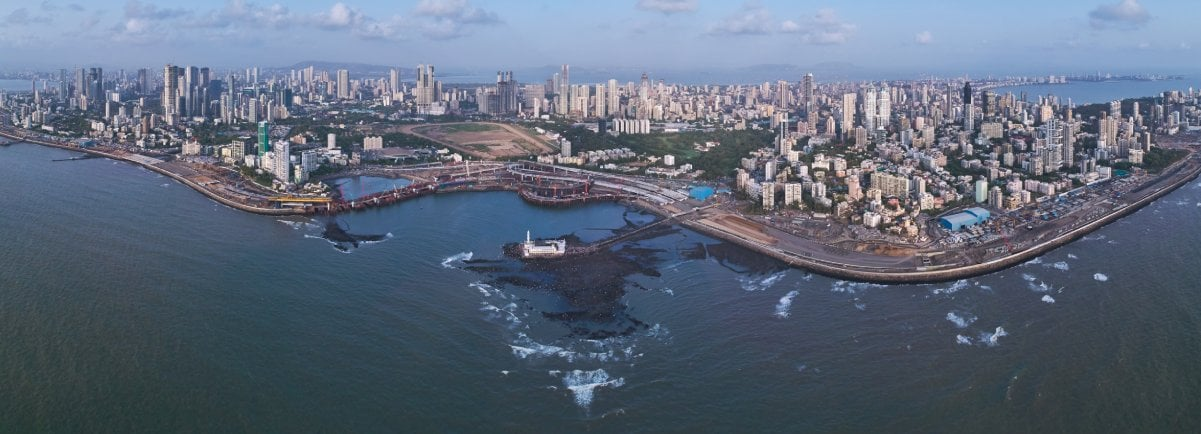
Mumbai Coastal Road Project: Latest News and Completion Date
Table of Contents
- Loading contents...
Project at a Glance | |
|---|---|
Project Name | Mumbai Coastal Road Project |
Original Name | Dharmveer Swarajya Rakshak Chhatrapati Sambhaji Maharaj Coastal Road |
Project Type | Greenfield |
Project Sector | Infrastructure |
Project Status | Phase I - Partially operational, Phase II - Under Construction |
Project Cost | INR 13,000 crore (USD 1.57 billion) |
Developer | Brihanmumbai Municipal Corporation (BMC), or The Municipal Corporation of Greater Mumbai (MCGM) |
Lanes | 8-lane Expressway |
Expressway Length | 29.2 km |
Coastal Road Speed |
|
Vehicles allowed | Cars and buses |
Project start date | October 2018 |
Project completion date (Expected) | May 2026 (Expected) |

Project Overview
The Mumbai Coastal Road Project (MCRP) is an 8-lane expressway in Mumbai. It is approximately a 29.2 km long stretch, developed in two phases. The first phase is operational, and the second phase is expected to become operational soon. It was developed by the Brihanmumbai Municipal Corporation (BMC), and its work started in 2018. It connects Marine Lines in the South to Kandivali in the North. It will start from the Princess Street Flyover and end at Kandivali.
The project aims to improve traffic flow and minimize travel time between South Mumbai and the Western Suburbs. Phase I connects Worli to Marine Drive, and on its completion, it reduces travel time from 40 minutes to 9 minutes. Also, it is a Toll-Free Expressway.
Project Background
The Municipal Corporation of Greater Mumbai (MCGM) or BMC is the developer of this Coastal Road project. The original name for the MCRP is Dharmveer Swarajya Rakshak Chhatrapati Sambhaji Maharaj Coastal Road. MCGM planned the MCRP on the western side of Mumbai. It will provide a substitute North-South Trunk route to improve mobility. It also develops open public spaces and greenery.
The MCRP is developed in two phases. The Southern part, or Phase I, is a 10.58 km long stretch between the Princess Street Flyover and the Bandra Worli Sea Link. The Northern part, or Phase II, is an approximately 19.22 km long stretch between Bandra terminus and Kandivali.
Mumbai Coastal Road Completion Date
The last section of the Coastal Road is the seventh segment of 550 meters. It improves connectivity in the region, smooths travel, and reduces traffic. The Seaside Promenade will now open on 30th May 2025. Both phases of the coastal road are expected to be operational by May 2026.
Timeline

Date | Event |
May 2026 | Expected completion of the MCRP |
30th May 2025 | Vehicular Underpass Opened Near Worli on the Mumbai Coastal Road Project |
26th January, 2025 | The Northbound bridge connecting Coastal Road to Bandra-Worli Sea Link was inaugurated. |
11th March, 2024 | The Southbound stretch (10.8 km) from Worli to Marine Drive is now open to the public. |
October 2018 | Construction work began on MCRP. |
Project Scope
The Mumbai Coastal Road is a transformative infrastructure project that will help reduce traffic congestion, improve connectivity, and benefit the environment as the route passes through mangrove trees, creeks, and forest zones. The scope includes the following:
Underground Tunnels: The expressway features a twin tunnel measuring 2.07 km in length. It passes through Malabar Hills and Girgaon Chowpatty and ensures minimum damage to the environment.
Reclamation of land: The expressway includes a reclamation of land of around 111 hectares. Out of this, 70% of the land will be used for open spaces, gardens, and recreational areas.
Interchanges: The MCRP comprises six interchanges throughout the route. This eases traffic flow.
Bus lanes and cycling tracks: The expressway features dedicated bus lanes to encourage the use of public transportation facilities. Additionally, it has also developed pedestrian pathways and cycling tracks.
Intelligent Traffic Management Systems (ITMS): The MCRP will utilize AI-based traffic monitoring systems, smart signaling, and automated toll collection to enhance travel efficiency.
Mumbai Coastal Road Route
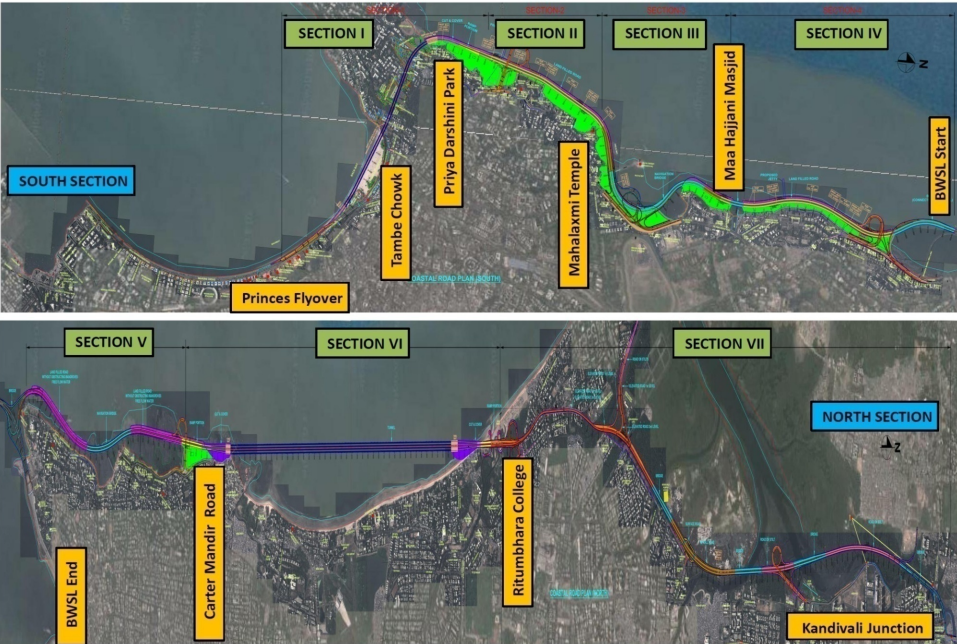
The Mumbai Coastal Road Project begins at Marine Lines in South Mumbai and extends to Kandivali in the Western Suburbs. The coastal road also comprises two underground tunnels at Malabar Hill and Girgaum Chowpatty, and multiple interchanges.
Mumbai Coastal Road Phase I
The Mumbai Coastal Road Phase I is a 10.58 km long stretch starting from the Princess Street Flyover at Marine Lines and ending at Bandra-Worli Sea Link. It splits into two parts - the Southbound arm and the Northbound arm. Phase I is operational in mid-2024.
It comprises a single underpass in a 10.58 km stretch of 550 meters. It is 11 meters wide, allowing vehicular movement from the Sewri-Worli elevated corridors that initiate a direct route to Western Mumbai. Dadar residents will be able to outstretch the Mumbai Coastal Road directly without exiting the Worli or Haji Ali interchanges.
Mumbai Coastal Road Phase II
The Mumbai Coastal Road Phase II is approximately a 19.22 km long stretch. It starts from the Bandra terminus of the Bandra-Worli Sea Link and ends at Kandivali. In addition to the 9.6 km Bandra-Versova Sea Link, connecting segments are located at Bandra (1.17 km), Carter Road (1.8 km), and Juhu Koliwada (2.8 km).
The Bandra-Versova Sea Link is an eight-lane stretch and plans to relieve traffic congestion in the Western Suburbs and on the Western Express Highway. It costs INR 11,333 crore. The route passes through mangrove trees, creeks, and forest zones. It means benefiting the environment.
BMC is also planning to add an 8.5 km long and 20 meters wide sea promenade to the city under Phase II. It will connect Priyadarshini Park at Napean Sea Road to the Worli Side of the Sea Link.
Speed enjoyed by the Mumbai Coastal Road
The Coastal Road has a minimum speed of 80 km/hr on the straight road. In the tunnel, there is a speed restriction of 60 km/hr. At the turning point, the speed limit is 40 km/hr. It is necessary to note that only cars and buses are allowed on the coastal road. Entry for the bulky vehicles and two-wheelers is restricted.
Integration of the Mumbai Coastal Road
It merges with the Bandra-Worli Sea Link, Mumbai Trans Harbour Link, and Western Express Highway.
Mumbai Coastal Road Project Cost
The 29.2 km long, 8-lane expressway is being built at an estimated cost of INR 13,000 crore (approximately USD 1.57 billion). Earlier, at the project's start, the estimated cost was INR 12,721 crore, which later increased to INR 13,060 crore due to a rise in the GST level and pipeline shifts. Recent reports indicate that the total estimated cost is INR 13,000 crores.
Packages of the Mumbai Coastal Road
Package | Location | Kilometers | Contractors | Cost |
Package 1 | Priyadarshini Park to Baroda Palace | 3.82 km | Larsen & Toubro (L&T) | INR 7,489 crore (P1 & P4) |
Package 2 | Baroda Palace to Worli (Bandra Worli Sea Link | 2.23 km | Hindustan Construction Company (HCC), Hyundai Development Corporation (HDC) JV | INR 2,126 crore |
Package 3 | Princess Street Flyover to Priyadarshini Park | 3.93 km | Larsen &Toubro (L&T) | INR 7,489 crore |
Investors & Stakeholders of the Mumbai Coastal Road Project
Investors | Role |
Brihanmumbai Municipal Corporation (BMC) | Primary funder using revenues from fungible FSI |
Reliance Industries Limited (RIL) | Voluntary developer of 70 hectares of open space along the expressway. |
Singhania Group & Jindal Group | Develop and maintain green spaces through corporate social responsibility (CSR) contributions. |
Mangrove Foundation (Govt) | BMC provided INR 175..33 crore for marine biodiversity conservation (CRZ compliance). |
Mumbai Coastal Road Project Latest News 2025
Vehicular Underpass Opened Near Worli on the Mumbai Coastal Road Project
The vehicular Underpass at the Worli end of the Bandra-Worli Sea Link will now open on 30th May 2025. It passes through the existing Abdul Gaffar Khan Road, connecting JK Kapoor Chowk, and handles traffic from Prabhudevi and Dadar to the Mumbai Coastal Road.
Now, in its operation, the traffic is divided into two paths. One goes towards Bandra, and the other goes towards the Southbound Coastal Road.
Further, Phase II includes 16 pedestrian underpasses that allow people to walk from the land or even landscaping areas to the seaside promenade.
BMC selects RIL to develop open spaces around the Mumbai Coastal Road
On 29th May 2025, the Brihanmumbai Municipal Corporation (BMC) selected Reliance Industries Limited (RIL) to develop around 53 hectares of open spaces along the coastal road. It will take, on average, three to four months to build the open spaces from Priyadarshini Park to Worli.
In January 2025, the civic body issued a call for Expressions of Interest (EOI) for the development of open spaces for over 30 years. It will include the development of gardens, parks, waterbodies, and cycle and pedestrian walkways.
Benefits of the Coastal Road
A direct entry point at Worli offers many benefits to travelers from Prabhadevi and Dadar. The Worli area lies under the Khan Abdul Gaffar Khan Road. It allows vehicles to navigate either northward or southward. The MCRP includes the following benefits:
Reduced Travel Time: The Mumbai Coastal Road results in reduced travel time. Initially, it took 2 hours, but upon the operation, it will only take 40 to 50 minutes to travel from Marine Drive to Kandivali.
Reduced fuel consumption: Fuel consumption will be reduced by 30-40%, thereby saving the environment.
Rise in the real estate economy in the region: Worli, Bandra, Malad, and other areas around the coastal road will see a rise in property prices.
Improved quality of life: The dedicated cycling tracks, pedestrian walkways, and green spaces will save the environment, along with improving the quality of life for people. The cycling tracks and pedestrian walkways will further reduce congestion in the city.
Conclusion
The Mumbai Coastal Road Project (MCRP) is a pivotal step in Mumbai's infrastructure development. The MCRP is projected to reduce traffic, improve connectivity, and reduce overall traffic congestion in the city. The project has transformed the city’s transportation sector.
The project is built while saving the environment. Upon its operation, it will reduce fuel consumption by 30 to 40%. The setup of pedestrian walkways and cycling tracks has improved the lives of Mumbaikars. Upon its operation, the MCRP will act as a bridge for urban road infrastructure projects in India.
Track the Latest Infrastructure Projects in India for Business Opportunities.
Subscribe to our upcoming and ongoing infrastructure projects in India to access reliable, high-quality insights on forthcoming and completed infrastructure projects across the country.
Our user-friendly platform provides essential details, timely updates, key stakeholder contact information, and business opportunities tailored for engineering companies, industry professionals, investors, and government agencies.
Start a free demo to take your business to the next level.
Leave a Comment
We love hearing from our readers and value your feedback. If you have any questions or comments about our content, feel free to leave a comment below.
We read every comment and do our best to respond to them all.