


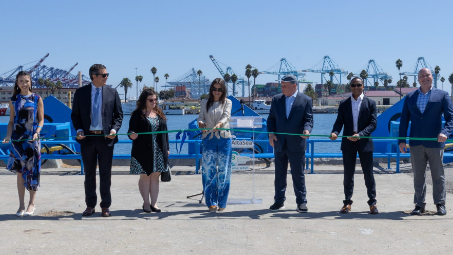
First Onshore Wave Energy Project Launches in Los Angeles, Marking U.S. Milestone
The first onshore wave energy project in the United States launched Tuesday at the Port of Los Angeles, marking a significant milestone for clean energy development. Seven blue steel floaters from Swedish company Eco Wave Power began operating at AltaSea, a nonprofit ocean institute at the port, controlling the natural rise and fall of the ocean to create clean electricity 24 hours a day.
The pilot project generates 100 kilowatts of power, enough to supply approximately 100 homes. However, company officials have outlined ambitious expansion plans to install steel floaters along the port's 8-mile breakwater, which could generate about 60 megawatts of power and supply roughly 60,000 homes.
Technology and Operations
The wave energy system operates through a hydraulic mechanism that differentiates it from offshore wave technology. The bobbing floaters compress pistons, which push hydraulic fluid into storage tanks located on land. As pressure increases inside the tanks, it spins a motor that turns a generator to produce clean electricity. This onshore approach allows Eco Wave Power to keep the “expensive parts” on dry land and avoid disturbing the seabed or marine environment, according to Inna Braverman, the company's co-founder and chief executive.
The technology differs from offshore wave systems, which can be more expensive to install, harder to repair, and more challenging to connect to the electrical grid due to their distance from land. Unlike wind and solar power, which cannot produce electricity around the clock unless accompanied by batteries, wave energy operates continuously 24 hours a day, seven days a week. The wharf at AltaSea had not been used for approximately 20 years before hosting the wave energy project.
Company Expansion and Global Projects
Eco Wave Power is pursuing multiple international projects beyond the Los Angeles pilot. The company has active projects in development in Taiwan, India, Portugal, and New Jersey, and has already connected a wave energy project to the electrical grid in Israel. The company's total project pipeline exceeds 404 megawatts. Braverman noted that the U.S. Energy Information Administration estimates wave power has the potential to provide more than 60% of the country's energy needs.
The company recently completed a feasibility study, identifying 77 sites in the United States suitable for commercial wave energy development. The two-year Los Angeles pilot project cost less than USD 1 million, with funding split equally between Eco Wave Power and oil and gas company Shell. At commercial scale, Braverman said the cost is comparable to onshore wind energy and less expensive than offshore wind.
40+ reviews
Find the Latest Renewable Energy Projects in United States (US)
Gain exclusive access to our industry-leading database of Renewable Energy opportunities with detailed project timelines and stakeholder information.
Collect Your Free Leads Here!
No credit cardUp-to-date coverage
Joined by 750+ industry professionals last month
Environmental and Policy Context
The project supports several ambitious climate goals, including Los Angeles's plan to reach 100% clean energy by 2035 and California's plan to achieve carbon neutrality by 2045. The wave energy installation could also help address pollution issues at the port, which has long struggled with emissions from ship engines, diesel trucks, and freight equipment that release particulate matter into the air.
Communities near the port, including Wilmington and Carson, experience some of the worst air quality in the region. Michael Galvin, the port's director of waterfront and commercial real estate, described projects like Eco Wave Power as “critical for us in our long-term strategy to become the first zero-emission port complex in the world.” The Port of Los Angeles, along with the adjoining Port of Long Beach, aims to convert all cargo-handling equipment to zero emissions by 2030 and all short-haul trucks to zero emissions by 2035.
Regulatory Challenges and Future Outlook
The project required licenses from both the Port of Los Angeles and the U.S. Army Corps of Engineers, a process that took approximately two years. Braverman identified regulatory framework gaps and licensing pathway shortages as among the biggest barriers to wave energy development. Recent California legislation, Senate Bill 605, directs the state to create a comprehensive roadmap for wave energy development.
Braverman expressed optimism that, as the technology develops, future projects can be built and deployed much faster. Bryson Robertson, director of the Pacific Marine Energy Center and a professor at Oregon State University, characterized the project as “a crucial stepping stone toward a proper full-scale deployment in the ocean.” Robertson noted that while the United States has significant wave energy potential, the entire coastline would never be covered in wave energy devices, making strategic deployment crucial.
The Trump administration has been reducing federal funding for renewable energy projects, including wind and solar, while promoting fossil fuels. However, the president's January executive order focused on “unleashing American energy,” naming hydropower as a potential future source of domestic energy, which wave energy proponents hope includes their technology.
Robertson emphasized that “no country in the world owns the marine energy sector,” suggesting the United States has “a very unique opportunity to be a global leader in this sector and sell that technology to the rest of the world.”
Connect with Decision-makers about the Latest Renewable Energy Projects in United States for business Opportunities.
Subscribe to our database on Renewable Energy Projects and Tenders in US to get access to reliable and high-quality insights on upcoming, under-construction, and completed Renewable Energy Projects across the world or in your desired geographical location.
Our user-friendly platform provides essential details, timely updates, key stakeholder contact information, and business opportunities tailored for engineering companies, industry professionals, investors, and government agencies.
Leave a Comment
We love hearing from our readers and value your feedback. If you have any questions or comments about our content, feel free to leave a comment below.
We read every comment and do our best to respond to them all.