


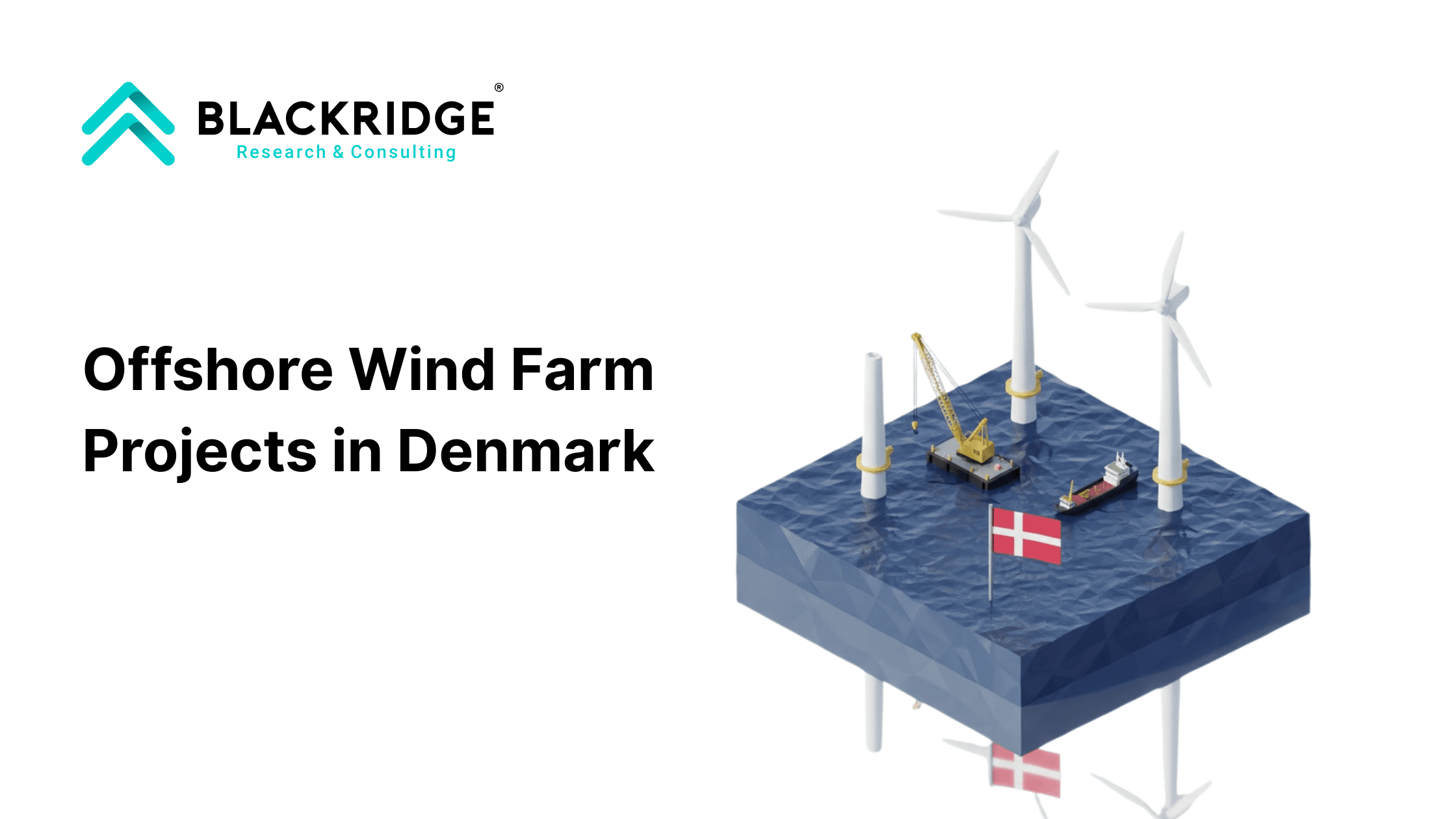
Top 5 Upcoming Offshore Wind Farm Projects in Denmark
Denmark is entering a new phase of offshore wind expansion. The next decade is set to redefine Denmark’s role in Europe’s energy system, with wind generation already capable of exceeding national electricity demand during several periods in 2024-2025. The nation’s shallow North and Baltic Sea waters, proven bottom-fixed technology, and three decades of operational experience give firm support for this growth.
Upcoming largest offshore wind farm projects in Denmark, according to Blackridge Research’s database, are the Bornholm Energy Island, Thor Offshore Wind Farm, VindØ North Sea I & II, Hesselø Offshore Wind Farm, and the Lillebælt Syd & Jammerland Bay cluster. These projects represent the next wave of utility-scale developments and hybrid interconnector systems that will drive Denmark toward its targets of 14 GW of offshore wind by 2030 and 52 GW by 2050.
This article highlights the five biggest offshore projects now advancing in Denmark, based on investment scale, grid impact, and construction progress.
List of Top 5 Upcoming Wind Farm Projects in Denmark 2026
Wind Farm Project | Installed capacity (MW) | Project Owner | Current status |
Bornholm Energy Island Offshore Wind Farm | 3000 - 3800 | Danish Energy Agency | Planning |
North Sea Energy Island Offshore Wind | 3000 | Danish Energy Agency | Planning |
Hesselø Offshore Wind Farm | 800 - 1200 | Danish Energy Agency | Planning |
Thor Offshore Wind | 1000 | Thor Wind Farm I/S | Under construction |
Jammerland Bay Offshore Wind | 240 | TotalEnergies Denmark A/S | Under construction |
Bornholm Energy Island Offshore Wind Farm
The Bornholm Energy Island is the largest upcoming offshore wind farm in Denmark, designed to collect and distribute up to 3-3.8 GW of wind power from the Baltic Sea. The wind farm will double the country’s current offshore wind capacity and supply electricity for over 3.3 million households.
Developed by Energinet and 50Hertz, the project will link Danish and German grids through two 525 kV HVDC interconnectors (2 GW to Germany and 1.2 GW to Zealand), creating one of Europe’s first hybrid offshore wind transmission systems. In September 2025, the EU committed EUR 645 million through the CEF Energy program to support the Danish side of the hybrid interconnector, while NKT and Siemens Energy are delivering the long-distance cable system and converter stations.
The overall estimated project cost for the wind farm is EUR 7 billion. Construction activity is underway as the project moves toward commissioning in 2032
Trusted by Leading EPCs & Manufacturers
Find the Latest Offshore Wind Farm Projects in Denmark
Gain exclusive access to our industry-leading database of offshore wind opportunities with detailed project timelines and stakeholder information.
Request Free Trial → Learn More →
No credit card Up-to-date coverage
North Sea Energy Island Offshore Wind
The North Sea Energy Island is one of Denmark’s largest upcoming offshore wind projects, planned as an artificial island that will collect and distribute at least 3 GW of electricity in its first phase. Located about 80 kilometers west of Jutland, the hub will serve a cluster of offshore wind farms and has long-term expansion potential up to 10 GW by 2040, with a maximum build-out of 40 GW if turbine density increases.
The Danish state will hold majority ownership, while private partners will support development, engineering, and financing. The island will combine on-island transmission facilities with surrounding platforms to speed up construction. It is Denmark’s most expensive energy project to date, with an estimated total cost of EUR 8 billion for the island and roughly DKK 200 billion for associated cables and offshore wind farms.
Construction is progressing toward phased completion, and the energy island will ultimately connect millions of European consumers to large-scale offshore wind and enable new technologies for producing green fuels.
Hesselø Offshore Wind Farm
Hesselø Offshore Wind Farm is planned to deliver 800 to 1,200 MW from a new location in the Kattegat north of Zealand. The project covers 165 square kilometers, with water depths of 20 to 45 meters, and will use 15 to 22 MW turbines, totaling 30 to 80 units. In July 2024, the Danish Energy Agency approved the updated plan after shifting the site south due to unsuitable seabed conditions.
The wind farm will send power ashore through subsea cables landing at Gilbjerg Hoved, supported by a new substation at Pårup and land cables running to the Hovegård high-voltage station. The revised schedule places the first power in 2028 and full completion in 2029, while Energinet continues environmental assessments for the onshore grid link.
On 20 November 2025, the DEA opened the tender for Hesselø under a CfD model, setting a state payment cap of DKK 27.4 billion over 20 years, lowering the minimum capacity requirement to 800 MW, and ensuring the grid will still support at least 1 GW. The project must now reach minimum capacity by 2032.
Thor Offshore Wind Farm
Thor Offshore Wind Farm is set to become Denmark’s largest offshore wind project, delivering more than 1 GW from 72 Siemens Gamesa SG 14-236 DD turbines located 22 kilometers off Thorsminde on the Jutland coast. The project, jointly owned by RWE (51 percent) and Norges Bank Investment Management (49 percent), is under construction and expected to supply green power to over one million Danish households when fully operational by the end of 2027.
Grid connection relies on a new offshore substation that collects and transforms turbine output before sending it via export cables to a new onshore substation at Volder Søndervang. Construction has advanced steadily, including completion of the secondary steel campaign on 6 November 2025 and installation of all monopiles by September.
Turbine installation will begin in spring 2026 from the Port of Esbjerg, with several turbines featuring recyclable blades and low-carbon towers. Operations and maintenance will be based out of a new facility in Thorsminde, scheduled for completion in early 2026.
Jammerland Bay Offshore Wind
Jammerland Bay Offshore Wind is a 240 MW offshore wind project in Denmark moving toward construction after completing its geotechnical surveys in July 2025. The project will install sixteen turbines south of Kalundborg, with the final turbine and cable design shaped by recent seabed drilling.
TotalEnergies holds 85 percent of the project, while European Energy retains a minority stake. The project has secured its construction permit, allowing development to continue after a Danish court cleared an appeal in 2024. Further survey work will continue through 2025 as the partners refine the export cable route from Østrup to a new transformer station near the Kalundborg Refinery.
Once operational in 2029, the wind farm is expected to supply power equal to the consumption of about 400,000 European households when combined with Lillebælt Syd. Environmental requirements include slow-rotation periods to protect bats and bubble-curtain noise mitigation to safeguard porpoises.
Conclusion
Denmark’s offshore wind pipeline shows how rapidly the country is evolving from an established market into a continental energy exporter. The five projects outlined, ranging from hybrid energy islands to next-generation 1 GW-scale wind farms, reflect a system now backed by updated government policies, including the Danish Energy Agency’s streamlined one-stop-shop permitting model and the reintroduction of CfDs to stabilize investor revenue.
Denmark is transitioning from meeting 25% of its electricity needs through offshore wind to becoming a major contributor to Europe’s shared energy security with 2.7 GW in operation today and up to 52 GW planned by 2050. Together, these developments form a clear trajectory: Denmark will remain at the forefront of offshore wind innovation, scale, and cross-border green power globally.
Find the Latest Offshore Wind Farm Projects Around the World with Ease
Are you seeking reliable and up-to-date insights into offshore wind power projects worldwide?
Explore the Global Project Tracking (GPT) platform by Blackridge Research, your go-to resource for the latest offshore wind power projects and tenders across all stages:
Upcoming Projects
Tender Notices
Contract Awards
Projects Under Construction
Completed Projects
Book a Free Demo today and see how the GPT platform can help you unlock opportunities and achieve your business goals.
Leave a Comment
We love hearing from our readers and value your feedback. If you have any questions or comments about our content, feel free to leave a comment below.
We read every comment and do our best to respond to them all.