


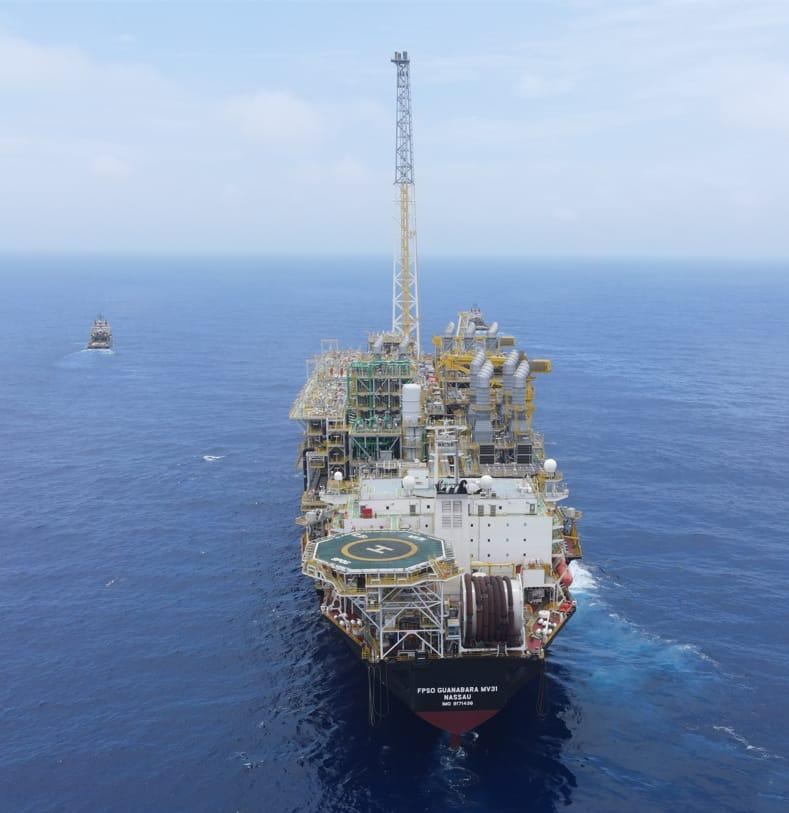
Project at a Glance | |
Project Name | Mero 3 FPSO |
Project Type | FPSO |
Project Location | Off the coast of Rio de Janeiro, Brazil |
Project Cost | Approximately USD 2-3 billion |
Primary Operator | Petrobras (38.6%) |
Production Capacity | 180,000 barrels of oil per day |
Water Depth | 2,200 meters |
Gas Treatment Capacity | 12 million cubic meters of gas |
Length | 341.2 meters |
Beam | 67.2 meters |
Project overview
Mero 3 is a Floating, Production, Storage, and Offloading (FPSO) vessel located off the coast of Rio de Janeiro, Brazil. Developed by Petrobras and other partners, Mero 3 achieved first oil on 30th October 2024. It is the third development phase of the Mero field on the Libra block.
The vessel comprises 15 wells, of which eight are oil producers, and seven are water and gas injectors, supported by a subsea infrastructure comprising 80 km of rigid production and injection pipelines, 60 km of flexible service pipelines, and 50 km of control umbilical.
It has a production capacity of 180,000 barrels of oil per day. Mero 3 focuses on reducing greenhouse gas emissions by reinjecting the associated gas into the reservoir. With the oil production from Mero 3, the overall production capacity, including Mero 1 & Mero 2, has reached 590,000 barrels of oil per day.
Mero 3 FPSO Location
The Mero 3 FPSO (Marechal Duque de Caxias) is located approximately 180 kilometers offshore from Rio de Janeiro, Brazil, in the pre-salt layer of the Santos Basin at a water depth of 2,200 meters.
Project Background
The Mero field is a part of the Libra Production Sharing Contract (PSC), signed in December 2013. It comprises four fields, all fully operational, namely (i) FPSO Guanabara (Mero 1), (ii) FPSO Sepetiba (Mero 2), (iii) FPSO Marechal Duque de Caxias (Mero 3), & FPSO Alexandre de Gusmão (Mero 4).
Mero 3 made the final investment decision (FID) in August 2020. After the naming ceremony on 17 January 2024, Mero 3 left the shipyard in Yantai, China, in February 2024 and reached Mauritius, Africa, to change crew and move cargo, before reaching Brazilian waters in May 2024.
With a compression capacity of 12 million cubic meters of gas, Mero 3 is the first FPSO receiving the high-pressure separation (HISEP) technology. It separates CO2-rich gas from production streams and reinjects it back into the reservoir, reducing the severity of greenhouse gas emissions.
Petrobras intends to implement the HISEP technology on Mero 3 starting in 2028, separating oil & gas at the bottom of the ocean and reinjecting CO2-rich gas.
The FPSO also facilitates water-alternating gas (WAG) reinjection technology, as well as CO2 stripping and reinjection from fuel gas production, with a capacity to compress up to 48 mmscfd of CO2.
The vessel achieved first oil production in October 2024, and after commissioning all three fields, the overall production capacity has reached 590,000 barrels of oil per day.
Trusted by Leading EPCs & Manufacturers
Find the Latest FPSO Projects In South America Region
Gain exclusive access to our industry-leading database of the FPSO projects with detailed project timelines and stakeholder information.
Request Free Trial → Learn More →
No credit card Up-to-date coverage
Mero 3 FPSO Ownership Details
Mero is a unitized field, operated by Petrobras (38.6%), in partnership with TotalEnergies (19.3%), Shell Brasil (19.3%), CNPC (9.65%), CNOOC (9.65%), and Pré-Sal Petróleo S.A. (PPSA) (3.5%) representing the Government in the non-contracted area.
Project Timeline
Year | Event |
30 October 2024 | Mero 3 received its first oil production |
May 2024 | Vessel arrived in Brazilian Waters |
24 February 2024 | Mero 3 left the shipyard in Yantai, China |
17 January 2024 | FPSO Marechal Duque de Caxias named |
2020-2024 | Project’s construction phase |
August 2020 | Mero 3 achieved the final investment decision |
December 2013 | Libra Production Sharing Contract (PSC) signed. |
Mero 3 FPSO Project Cost
The total estimated cost for the Mero 3 FPSO is approximately USD 2-3 billion, with MISC Berhad bearing the complete construction risk during the 2020-2024 build phase at CIMC Raffles in Yantai, China.
Design & Engineering Details
Category | Details |
Vessel Name | FPSO Marechal Duque de Caxias |
Conversion Yard | CIMC Raffles Shipyard, Yantai, China |
Production Capacity | 180,000 barrels of oil per day |
Gas Treatment Capacity | 12 million cubic meters of gas |
Water Depth | 2,200 meters |
Length | 341.2 meters |
Beam | 67.2 meters |
Depth | 29.7 meters |
Mooring & Subsea | 24-point spread mooring; 80 km flowlines, 60 km flexibles, 50 km umbilicals (Subsea 7) |
Mero 3 FPSO Contractor
Contractors | Role |
MISC Berhad | FPSO owner, conversion, lease-and-operate (22.5 years); 100% construction risk taker |
Petrobras (operator) | Lead Contractor: Libra Consortium (38.6%) |
VWS Westgarth (Veolia) | Seawater treatment; EPC for water injection modules |
Subsea 7 | Subsea infrastructure (80 km risers, 60 km flexibles, & 50 km umbilicals) |
Conclusion
Mero 3, also known as FPSO Marechal Duque de Caxias, is an FPSO vessel developed by Petrobras along with other partners. It is the third development phase of the Mero field on the Libra block, achieving its first oil production in October 2024.
With a production capacity of 180,000 barrels of oil per day and a compression capacity of 12 million cubic meters of gas, Mero 3 focuses on reducing greenhouse gas emissions by reinjecting the associated gas into the reservoir using HISEP technology.
Upon achieving first oil, the project has elevated the Mero field's total output to 590,000 barrels per day, solidifying its position as Brazil's third-largest oil field after Tupi and Búzios.
As the project transitions from construction to full-scale operations, it not only bolsters Brazil's energy security and economic growth but also paves the way for the anticipated Mero 4 startup in 2025, promising further expansion of an efficient, competitive energy supply.
Track the Latest & Upcoming FPSO Projects In South America
Subscribe to our upcoming and ongoing FPSO Projects in South America with ease to access reliable, high-quality insights on forthcoming and completed Projects across the country.
Our user-friendly platform provides essential details, timely updates, key stakeholder contact information, and business opportunities tailored for engineering companies, industry professionals, investors, and government agencies.
Start a free demo to take your business to the next level.
Leave a Comment
We love hearing from our readers and value your feedback. If you have any questions or comments about our content, feel free to leave a comment below.
We read every comment and do our best to respond to them all.