


Project at a glance | |
|---|---|
Project Name | Chennai-Salem Expressway |
Project Type | Greenfield |
Project Sector | Infrastructure |
Project Status | Under Construction |
Project Cost | INR 9,681 crores (approx) (USD 1,130 crore) |
Owner | National Highway Authority of India (NHAI) |
Expressway’s speed | 100 km/hr |
National Highways Crossing | 5 |
State Highways Crossing | 10 |
Project Start Date | 2018 |
Project Completion Date | December 2025 (expected) |
Project Overview
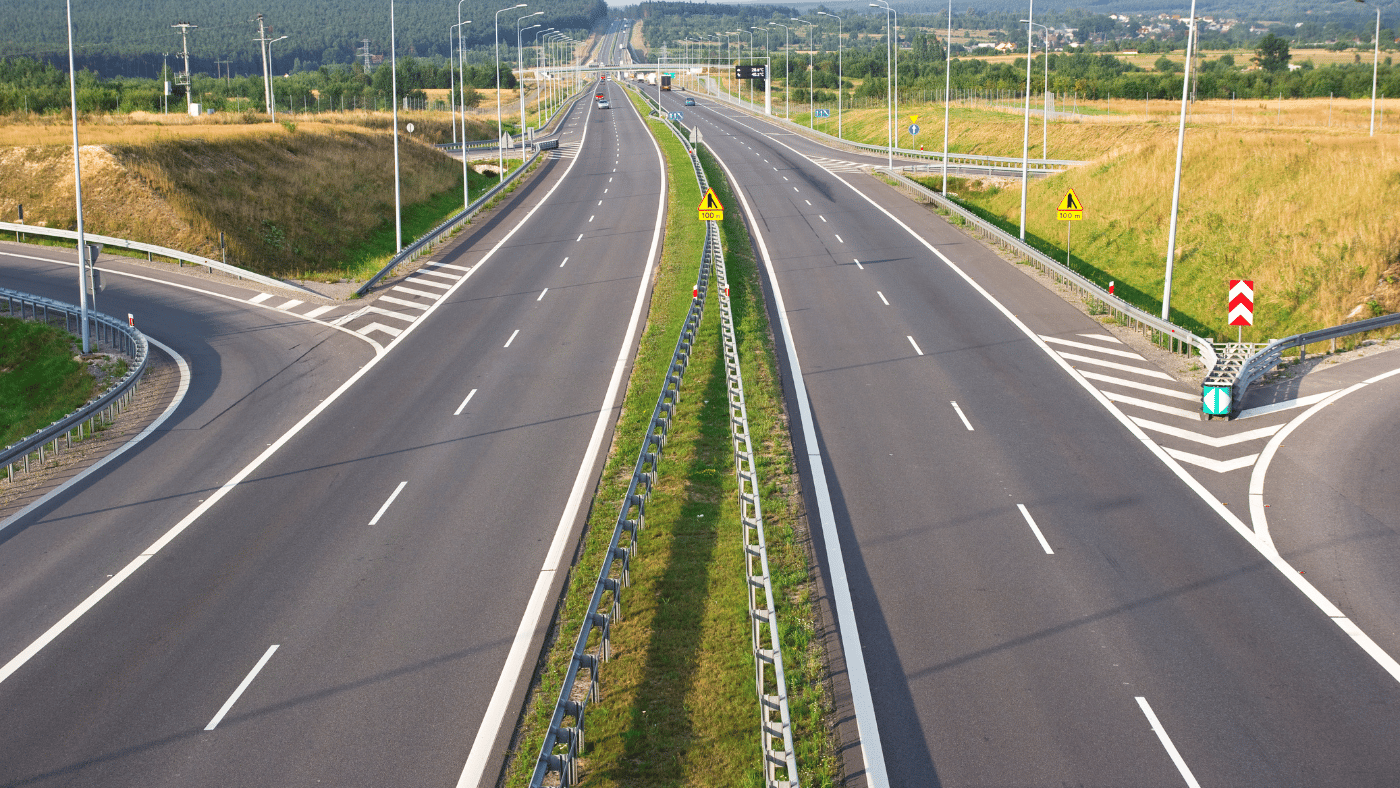
The Chennai-Salem Expressway is a 277.3 km, 6-lane expressway in Tamil Nadu. This greenfield project under the Bharatmala Pariyojana (BMP) program was originally envisioned to be an 8-lane highway with an estimated cost of INR 10,000 crore. Later, it is revised down to 6 lanes and its expected cost is INR 9,681 crores.
The National Highway Authority of India (NHAI) develops it and aims to connect Chennai to Salem. The project is currently facing some delays due to litigation, land acquisition, and environmental concerns. It may further delay the expected completion date (25th December 2025).
Upon its successful completion (expected in December 2025), the expressway will reduce travel time from 5 to 6 hours to 2.5 hours. The expressway will start from Chengam and end at Salem (NH 44 + NH 544). It will pass through some of the districts of Tamil Nadu, including Kanchipuram, Tiruvannamalai, Krishnagiri, Dharmapuri, and Salem.
This Greenfield infrastructure project will remarkably impact the country's real estate sector. It will improve road connectivity and reduce travel time. Thus, it benefits in encouraging investment in the country.
Project Background
The Chennai-Salem Expressway was commenced under the Bharatmala Pariyojana scheme by the National Highways Authority of India (NHAI). It focuses on improving logistic productivity and fosters economic growth in the area. It aims to connect Chennai to Salem, where Chennai is the home to one-third of the country’s automobile industry, and Salem is the home to nearly 125 spinning mills, weaving mills, and garment units.
The 277.3 km long expressway will cross through five districts, namely, Kanchipuram, Tiruvannamalai, Krishnagiri, Dharmapuri, and Salem. This complete run will hit nearly 159 villages in 14 taluks. During certain stretches, elevated corridors have been designed to preserve ecological balance and minimize environmental disruption.
The project requires the acquisition of approximately 2,971 hectares of land, including around 712 hectares of private land and 125 hectares of government land in the Tiruvannamalai district alone. The proposed alignment affects about 13.29 km of forest area, notably impacting the Kalvarayan hill forest between Chengam and Salem.
Find Road Infrastructure Projects and Tenders in India. Get Started Now!
Chennai-Salem Route Map

Chennai-Salem Expressway Route
The Chennai-Salem expressway will pass through some of the major districts of Tamil Nadu, including Chennai, Kanchipuram, Tiruvannamalai, Krishnagiri, and Dharmapuri, to connect to Salem. In the 277.30 km long run, it will hit 159 villages, fueling commercial, industrial, and residential development in Tamil Nadu.
It is noted that the expressway demands the development of these five critical sections:
Tambaram and Harur Section (NH-179B)
Harur to Salem Section (NH-179A)
Chengalpattu to Kancheepuram Section (NH-132B)
Semmampadi to Chetpet Section (NH-179D)
Polur to Tiruvannamalai Section (NH-38)
Also Read: Raipur Visakhapatnam Expressway: Corridor to Economic Growth
Project Timeline
Year | Event |
December 2025 | Expected project completion date |
2023 | Land acquisition and environmental clearances were underway. |
2021-2022 | A Social Impact Assessment (SIA) and Environmental Impact Assessment (EIA) study was conducted. |
December 2020 | The Supreme Court upheld the land acquisition notification, allowing the project to proceed. |
April 2019 | The Madras High Court reversed the land acquisition proceedings, recognizing the environmental concerns. |
April 2018 | The project was announced as part of the Bharatmala Pariyojana initiative. |
Project Scope
NHAI’s greenfield highway project aims to improve connectivity between Chennai and Salem. It will cover five major districts, including Chennai, Kanchipuram, Tiruvannamalai, Krishnagiri, and Dharmapuri. The project scope includes the following:
Building a 6-lane expressway: It will be designed for high-speed vehicular traffic. It has limited access control to ensure safety and smoothness.
Construction of new designs and interchanges: The expressway will bypass the crowded area to reduce travel time and transportation costs.
Merge with National Highway Network: It includes NH-179A, NH-179B, NH-132B, NH-179D, and NH-38. This merger will result in smooth travel and goods transportation.
Land Acquisition: The expressway includes land acquisition of approximately 2,971 hectares. It covers both agricultural land and forest areas. It has compensatory afforestation and rehabilitation plans as per the statutory norms.
Supplies infrastructure facilities: This includes toll plazas, rest areas, truck halts, service roads, and emergency response systems.
Environment and social safeguards: It implemented Environmental Impact Assessment (EIA) and Social Impact Assessment (SIA) to diminish possible dreadful effects.
Chennai-Salem Cost
As per the announcement made by the NHAI, the total estimated cost of the project is INR 9,681 crore (USD 1,130 crore). Upon completion, the expected speed on the expressway is 100 km per hour. It requires a land acquisition of 2,971 hectares, including agricultural, community, and residential lands.
Investors of the Expressway
Company | Role | Responsibility |
National Highway Authority of India (NHAI) | Owner and developer of the project. | Develop the expressway on an Engineering, Procurement, and Construction (EPC) contract basis. |
Feedback Infra Private Ltd (FIPL) | Consultant for the Expressway. | Signed a contract with NHAI to provide consultancy services. |
Delays & Challenges Faced by the Expressway
These are the major challenges faced by the expressway that result in further delays in the completion of the project.
Litigation & Clearances Issues:
In August 2024, Union Minister Nitin Gadkari said that the Detailed Project Report (DPR) was prepared, but it faced delays due to the litigation, and clearances have stalled progress. The necessity for environmental and forest clearances has added to the complexity, with the Supreme Court directing authorities to proceed with land acquisition only after obtaining these permissions.
Land Acquisition Challenges
The expressway requires a land acquisition of approximately 2,971 hectares of agricultural, community, and residential land. But farmers opposed this thing and blocked the expressway again. They feared the loss of their livelihood. The Supreme Court upheld the land acquisition notification in December 2020, but resistance continues, with protests and legal challenges delaying the process.
Environmental concerns
The route passes through 11 protected forests, including areas like Sora Kolathur, Pallipatti Extension, and Nambedu, raising serious environmental concerns. Environmentalists have joined farmers in opposing the project, citing potential deforestation and ecological damage. These concerns have necessitated additional environmental impact assessments, further delaying the project.
Benefits
The primary benefit of the Greenfield Expressway is that it will reduce travel time to 2.5 hours. Thus, it results in a rise in the trade and tourism sectors. It is possible, as Chennai is a regional and cultural hub. Further, it will connect the industrial areas and special economic zones (SEZs) in the Chennai and Salem districts.
Above all, this will boost the real estate development in the region. In the long run, this expansion will trigger domestic, commercial, and industrial development in the 159 villages and five major districts mentioned above. In addition to easing congestion on existing routes, the expressway facilitates the faster movement of goods and people.
The project foresees industry sector growth along the corridor with an improved road infrastructure. It will also attract investments and create multiple jobs during the construction of the expressway. Furthermore, it will lead to the overall growth of the region by improving its access to the market and healthcare institutions.
Conclusion
The Chennai Salem Expressway, a part of the Bharatmala Pariyojana Project (BMP), is expected to be completed by December 2025. The segment of the route will pass through 11 protected forests in Thiruvannamalai, Salem, and Chennai districts.
This project will showcase Tamil Nadu to some of the country's most coveted real estate markets. It will completely transform Tamil Nadu’s real estate markets. Furthermore, it will expand the state’s industrial sector.
Connect with decision-makers about the latest infrastructure projects in India for business opportunities.
Subscribe to our upcoming and ongoing infrastructure projects in India to access reliable, high-quality insights on forthcoming and completed infrastructure projects across the country.
Our user-friendly platform provides essential details, timely updates, key stakeholder contact information, and business opportunities tailored for engineering companies, industry professionals, investors, and government agencies.
Start a free demo to take your business to the next level.
Leave a Comment
We love hearing from our readers and value your feedback. If you have any questions or comments about our content, feel free to leave a comment below.
We read every comment and do our best to respond to them all.