


European Commission Approves €11 Billion French State Aid Scheme for Offshore Wind Development
The European Commission has approved a €11 billion French scheme to support offshore wind energy in line with the objectives of the Clean Industrial Deal. This measure will contribute to the transition towards a net-zero economy and reaching the renewable energy target set at EU level for 2030.
The scheme was approved under the Clean Industrial Deal State Aid Framework (CISAF), which was adopted by the Commission in June 2025. France proposed the €11 billion scheme to support the development of offshore wind energy and boost the clean technology industry in the EU in accordance with Clean Industrial Deal objectives.
Project Specifications and Duration
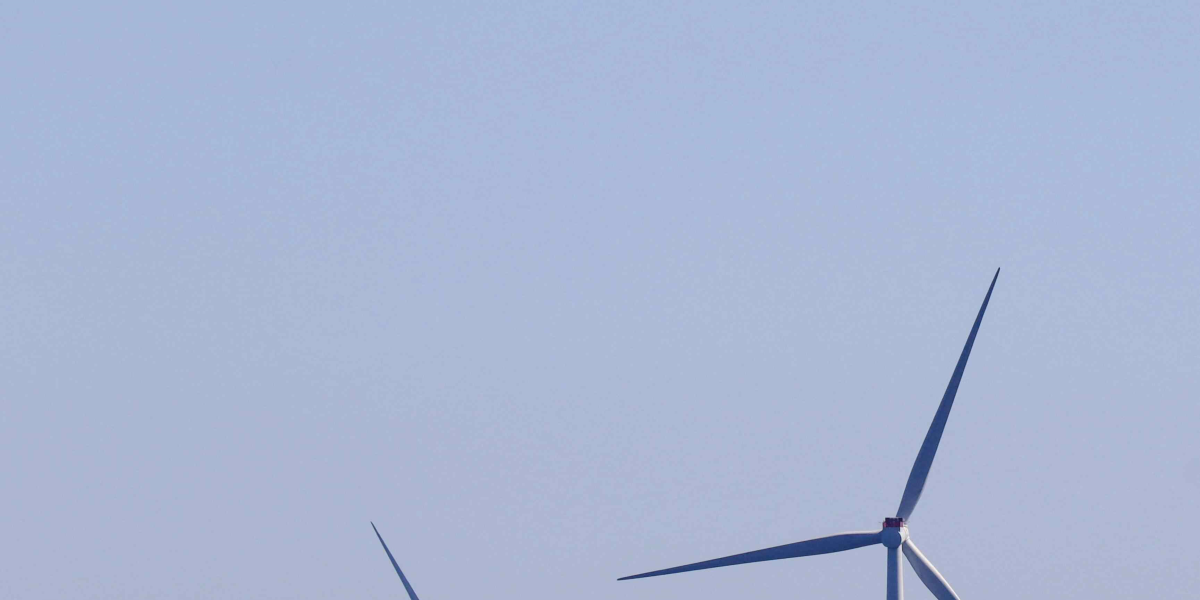
The approved scheme will run for 20 years and will support the construction and operation of three floating offshore wind farms. One wind farm will be located in the sea off the coast of Southern Brittany, while two others will be positioned in the Mediterranean Sea.
Each wind farm is expected to have a capacity of around 500 MW and generate approximately 2.2 TWh of electricity. This energy output is equivalent to the annual consumption of 450,000 French households. The aid will be granted through a transparent and non-discriminatory bidding process, which will be organized to select one beneficiary per offshore zone.
Supply Chain Diversification and Resilience Measures
Resilience has been included as a tender prequalification and award criterion to diversify wind turbine and main specific components supply chains. This measure is designed to reduce dependency on imports from China. The bidding process will incorporate these resilience factors when evaluating potential beneficiaries for each offshore zone.
Financial Structure and Payment Mechanism
Under this scheme, the aid will take the form of a monthly variable premium under a two-way contract for difference (CfD). The premium will be calculated by comparing a reference price, determined in the tender offer of the beneficiary using a pay-as-bid system, to the market price for electricity.
When the market price falls below the reference price, beneficiaries will be entitled to receive payments equal to the difference between the two prices. Conversely, when the market price exceeds the reference price, the beneficiary will be required to pay the difference between the two prices to the French authorities.
Commission Assessment and Legal Framework
The Commission found that the French scheme meets the conditions of the CISAF, specifically sections 3 and 4.1.2. The support will be provided as direct price support through a two-way CfD, awarded via a competitive bidding process. The scheme includes safeguards to ensure markets function properly and avoid compensating producers when market prices are negative.
The Commission concluded that the French scheme is necessary, appropriate, and proportionate to accelerate the transition towards a net-zero economy and facilitate the development of certain economic activities that are important for implementing the Clean Industrial Deal. This assessment aligns with Article 107(3)(c) of the Treaty on the Functioning of the EU and the conditions set out in the CISAF.
Clean Industrial Deal State Aid Framework
The Commission adopted the CISAF on 25 June 2025 to foster support measures in sectors key for the transition to a net-zero economy, in line with the Clean Industrial Deal. The framework allows several types of aid that can be granted by Member States until 31 December 2025 to accelerate the clean energy transition.
These measures include accelerating the rollout of renewable energy and low-carbon fuels, with Member States able to set up schemes for investments in all renewable energy sources as well as energy storage, with simplified tender procedures. Specific rules are also provided to accelerate the roll-out of low-carbon fuels.
The framework also allows temporary electricity price relief for energy-intensive users to ensure the transition to low-cost clean electricity. Before the decarbonisation of the EU's electricity system fully translates into lower electricity prices, such measures will help avoid the risk that industrial activities relocate outside the EU to regions where environmental and climate regulations are absent or less ambitious due to high costs.
Additional measures facilitate the decarbonisation of industrial processes, with Member States able to support investments in the decarbonisation of industrial activities to reduce dependency on imported fossil fuels. This can occur through electrification, energy efficiency, and the switch to the use of renewable and electricity-based hydrogen that complies with certain conditions, with expanded possibilities to support the decarbonisation of industrial processes switching to hydrogen-derived fuels.
The framework ensures sufficient clean technology manufacturing capacity, allowing Member States to grant investment support for strategic projects in line with the Net Zero Industry Act, including batteries, solar panels, wind turbines, heat-pumps, electrolysers, and carbon capture usage and storage. This also includes the production of key components and the production and recycling of related critical raw materials.
Finally, the CISAF includes measures to de-risk private investments required for the roll-out of clean energy, industrial decarbonisation, clean tech manufacturing, certain energy infrastructure projects, and projects supporting the circular economy.
40+ reviews
Find the Latest Offshore Wind Farm Projects Around the World
Gain exclusive access to our industry-leading database of offshore wind opportunities with detailed project timelines and stakeholder information.
Collect Your Free Leads Here!
No credit cardUp-to-date coverage
Joined by 750+ industry professionals last month
Leave a Comment
We love hearing from our readers and value your feedback. If you have any questions or comments about our content, feel free to leave a comment below.
We read every comment and do our best to respond to them all.