


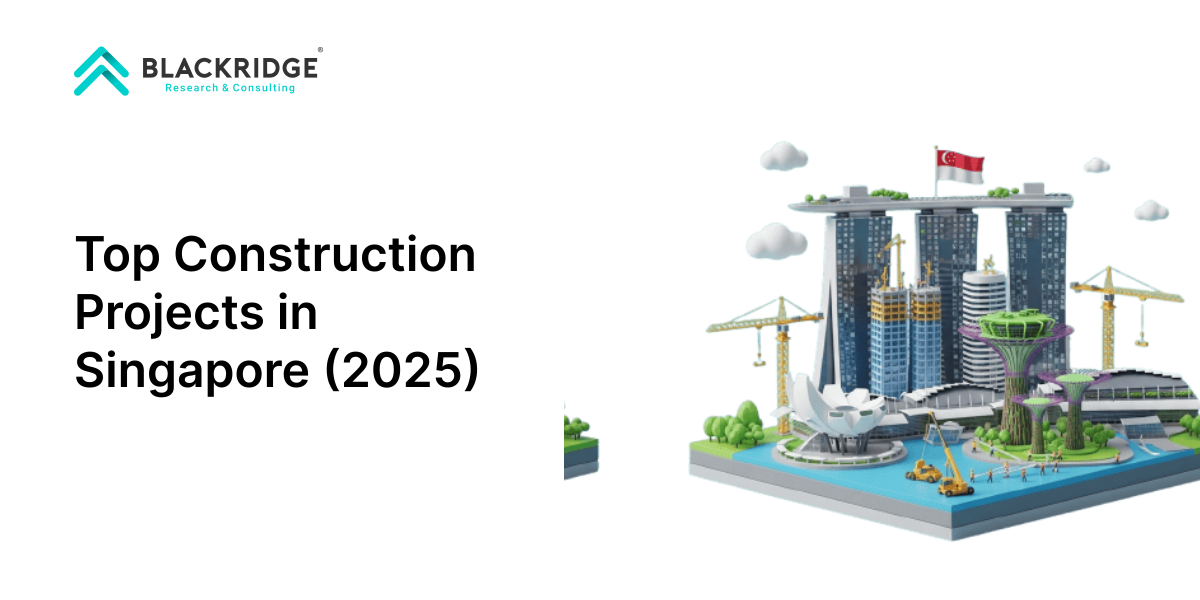
Singapore’s construction sector in 2025 is undergoing a massive transformation, guided by the Urban Redevelopment Authority’s Draft Master Plan 2025 (DMP2025). This blueprint launched on June 26, 2025, outlines development goals for the next 10 to 15 years prioritising liveability, sustainability, and economic resilience.
According to Blackridge Research’s Singapore Construction Industry Database, the sector was valued at approximately USD 31.10 billion in 2023 and is projected to grow to USD 41.76 billion by 2030, at a compound annual growth rate of 4.3%. In Q1 2025 alone, it contributed USD 4.035 to the nation’s GDP.
Biggest ongoing construction projects in Singapore are the Cross Island Line and North-South Corridor, both enhancing connectivity. The upcoming construction projects in Singapore 2025, such as the Jurong Innovation District (JID), are geared toward advanced manufacturing and R&D.
Major infrastructure efforts like Tuas Mega Port and the Deep Tunnel Sewerage System (DTSS) Phase 2 further enhance long-term environmental goals. This article lists down the top 10 construction projects in Singapore (2025) according to the estimated project cost.
List of Top 10 Construction Projects in Singapore (2025)
Project Name | Location | Type of Construction | Estimated project Cost (USD) |
Cross Island Line | Island-wide, Singapore | Infrastructure (MRT line) | 31.68 billion |
Tuas Mega Port | Tuas, Singapore | Infrastructure (port) | 20 billion |
Jurong Innovation District (JID) | Western Singapore (Jurong West/Tengah) | Industrial, Research & Development, Mixed-Use | 20 billion |
Thomson-East Coast Line (Completion) | Woodlands to Upper East Coast | Infrastructure (Water Management, Sewage) | 18.8 billion |
Marina Bay Sands (MBS) Expansion | Marina Bay, Singapore | Hospitality, Commercial, Entertainment, Mixed-Use | 8 billion |
Changi Airport Terminal 5 (T5) | Changi East, Eastern Singapore | Infrastructure (Airport Terminal), Aviation | 7.5 billion |
Deep Tunnel Sewerage System (DTSS) Phase 2 | From Keppel Road to Tuas, Western Singapore | Infrastructure (Water Management, Sewage) | 7.4 billion |
Jurong Lake District (JLD) | Jurong, Western Singapore | Commercial, Residential, Mixed-Use | 6.54 billion |
North-South Corridor (NSC) | Northern Heartlands to City Core | Infrastructure (Expressway, Transport) | 5.53 billion |
Resorts World Sentosa Expansion | Sentosa, Singapore | Hotel, Retail | 5.29 billion |
Cross Island Line (CRL)
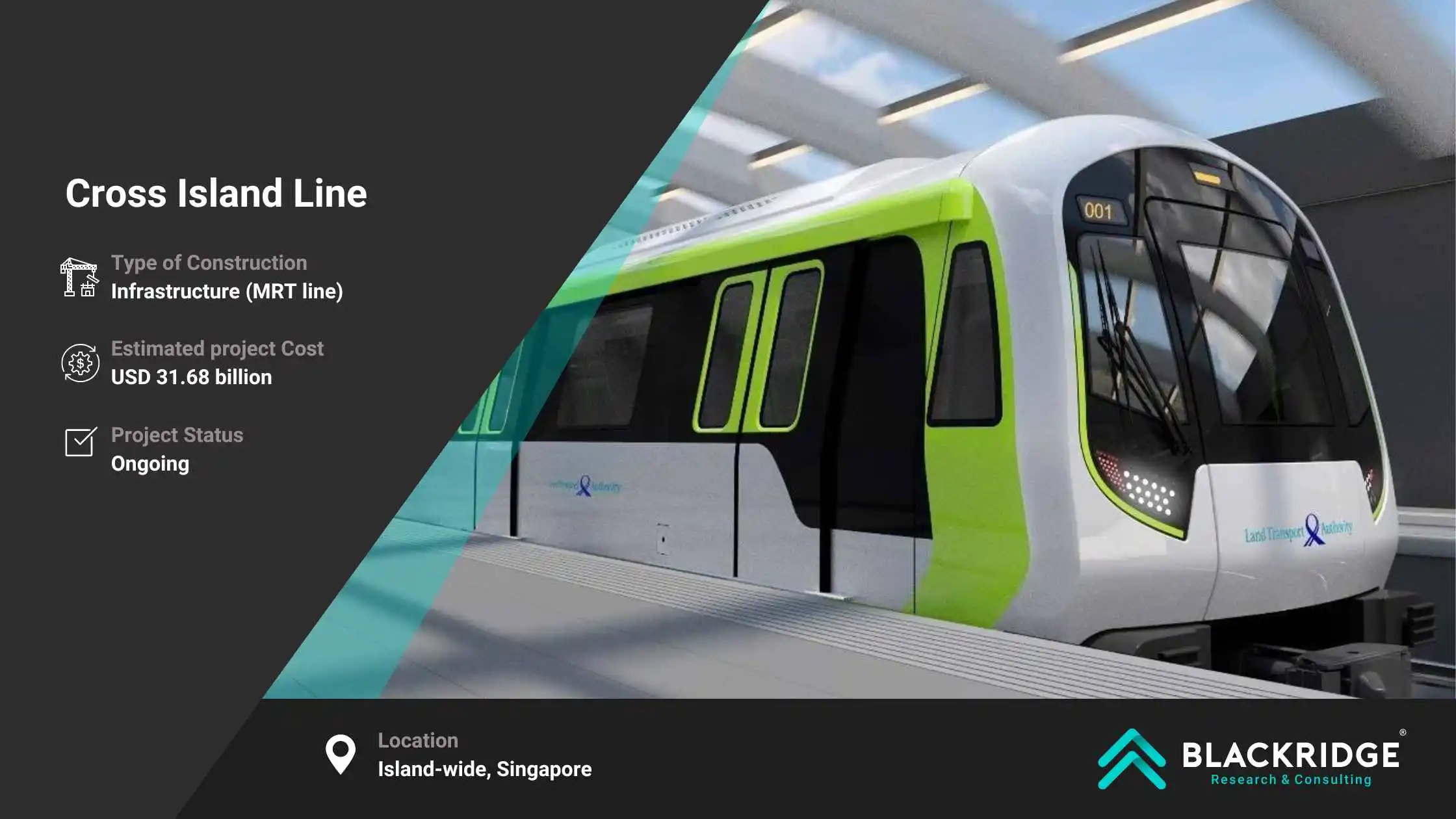
The Cross Island Line (CRL) is the largest ongoing construction project in Singapore, with an estimated construction cost of USD 31.68 billion. The infrastructure project spans approximately 50 km, linking key regions from Changi to the Jurong Industrial Estate. This high-capacity MRT line will run fully underground with a fully automated system.
Once fully completed by the 2040s, the CRL will become the country’s longest underground MRT line, offering a vital alternative to existing lines like the East-West and Downtown Lines.
Opening in phases from 2030, the CRL will add an estimated 30 stations to the network, directly connecting high-density residential, commercial, and industrial zones such as Loyang, Ang Mo Kio, Sin Ming, and Clementi.
Key Highlights of the Project:
Project status: Ongoing
Key Stakeholders: Land Transport Authority (LTA), Woh Hup (Private) Limited, Obayashi Corporation, Shanghai Tunnel Engineering Co (Singapore) Joint Venture, China Communications Construction Company Limited (Singapore Branch), Sinohydro Corporation Limited (Singapore Branch)
Start date: 2020
Completion date: 2040 (tentative)
Latest project update: In July 2025, Singapore’s Land Transport Authority announced that construction had begun on Phase 2 of the Cross Island Line (CRL), adding 15 kilometres and six underground stations to the network.
Two stations, including Clementi and King Albert Park, will serve as interchanges with the East-West and Downtown lines, with completion expected by 2032.
Tuas Mega Port
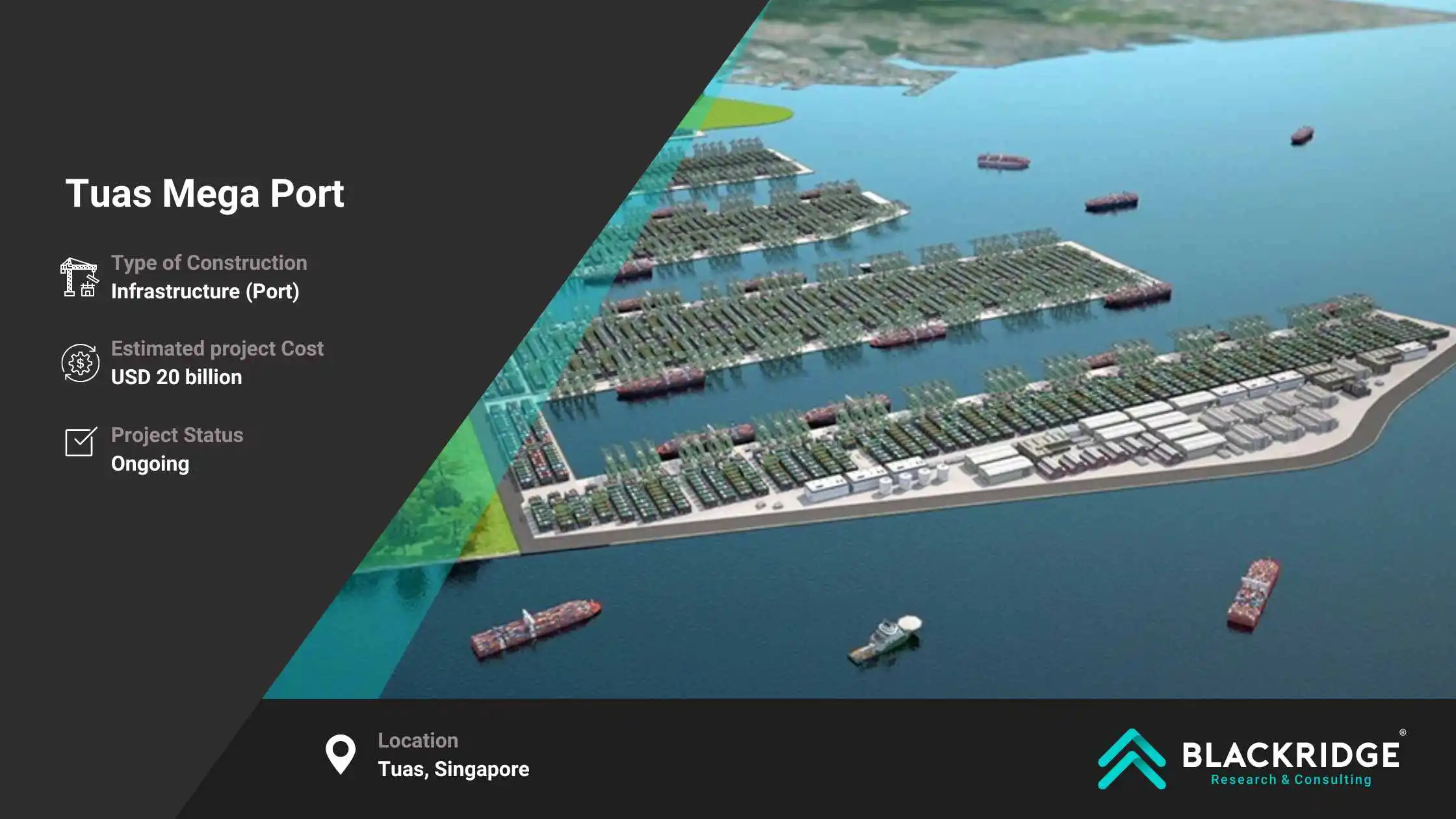
Tuas Port is one of the largest construction projects in Singapore’s maritime development strategy and will become the world's single largest fully automated container port upon full completion. The port’s finger-pier layout, caisson quay walls, and deep berths (up to -23m CD) allow accommodation of ultra-large container vessels over 450m in length.
The project is developed in four phases and designed to handle up to 65 million twenty-foot equivalent units (TEUs) annually. The port is a major feat in space optimisation with over 240 hectares of Ground Space and 115 hectares of reclaimed land.
Environmental efforts, including coral relocation programs and strict marine protections, are also integrated into the port’s development. Tuas Port is fully digital and automated, integrating systems like Just-in-Time operations and Digitalport@SG to streamline port functions and reduce emissions.
Key Highlights of the Project:
Project status: Ongoing
Key Stakeholders: Maritime and Port Authority of Singapore (MPA), PSA Corporation
Start date: 2015 (Phase 1)
Completion date: 2040 (full development)
Latest project update: In May 2025, Tuas Port in Singapore reached a milestone of moving 10 million containers using 200 fast-charging autonomous electric vehicles.
Jurong Innovation District (JID)
.webp)
Jurong Innovation District (JID) is Singapore’s next-generation industrial estate, designed to be a smart, clean, and sustainable hub for advanced manufacturing. Purpose-built for high-tech industries, JID brings together research institutions, innovation enablers, training providers, and modern production facilities into one integrated ecosystem.
This future-ready district supports the entire manufacturing value chain from R&D and prototyping to full-scale production, making it a launchpad for Industry 4.0 leaders in sectors like precision engineering, clean tech, and autonomous mobility.
Liveability and sustainability are central to JID's masterplan. The district features Singapore’s longest 11km car-free sky corridor linking workplaces, residential areas, and amenities with dedicated pedestrian, cycling, and autonomous shuttle lanes.
Key Highlights of the Project:
Project status: Ongoing
Key Stakeholders: JTC Corporation, Ministry of Trade and Industry
Start date: 2016 (initial planning); phased opening began in 2019
Completion date: 2029 (estimated)
Latest project update: In May 2025, Tuas Port in Singapore reached a milestone of moving 10 million containers using 200 fast-charging autonomous electric vehicles.
40+ reviews
Find All Upcoming Construction Industry Projects in Singapore
Gain exclusive access to our industry-leading database of construction project opportunities with detailed project timelines and stakeholder information.
Collect Your Free Leads Here!
No credit cardUp-to-date coverage
Joined by 750+ industry professionals last month
Thomson-East Coast Line (Completion)
.webp)
The Thomson–East Coast Line (TEL) is Singapore’s longest underground driverless MRT line that aims to enhance connectivity along the country’s north-south and east-west corridors. TEL improves access for residents in the east and central regions, offering faster, more direct routes to the city.
The medium-capacity line project spans approximately 43 kilometres with 32 fully underground stations and is represented in brown on the MRT map. The project also integrates the formerly separate Thomson and Eastern Region Lines into one unified corridor.
TEL features eight interchange stations that connect to every major MRT line in Singapore including the East-West, North-South, Circle, Downtown, North East, and the future Cross Island Line. Upon completion the line is expected to serve about 1 million commuters daily upon full completion with travel time savings of up to 50%.
Key Highlights of the Project:
Project status: Partially operational; remaining stages under construction
Key Stakeholders: Land Transport Authority (LTA), SMRT, Encardio Rite
Start date: 2014
Completion date: 2030 (estimated)
Latest project update: A four-station extension between Pasir Ris and Punggol is set to launch in 2032, alongside the completion of Phase 2.
Marina Bay Sands Integrated Resort Expansion (IR2)
 Expansion.webp)
The Marina Bay Sands Integrated Resort Expansion, known as IR2, is a landmark USD 8 billion development set to redefine Singapore’s skyline and tourism landscape. Designed by Safdie Architects (the firm behind the original Marina Bay Sands), IR2 will complement the existing resort with a new generation of ultra-luxury hospitality and world-class entertainment offerings.
The expansion will feature a 570-suite ultra-luxury hotel topped with an iconic rooftop experience, alongside signature F&B outlets, nightlife venues, public attractions, and premium wellness amenities.
IR2 will also include a massive 15,000-seat arena, envisioned as Asia’s leading live entertainment venue, and 200,000 sq ft of top-tier MICE (Meetings, Incentives, Conferences, and Exhibitions) space. With construction beginning in June 2025 and slated for completion by June 2030, the resort is expected to officially open in January 2031, pending regulatory approvals.
Key Highlights of the Project:
Project status: Announced; construction begins June 2025
Key Stakeholders: Las Vegas Sands Corp, Safdie Architects
Start date: June 2025
Completion date: June 2030; expected opening January 2031
Latest project update: On 15 July 2025, Las Vegas Sands broke ground on the USD 8 billion expansion of Marina Bay Sands in Singapore.
Changi Airport Terminal 5 (T5)
.webp)
Changi Airport Terminal 5 (T5) is one of the biggest national infrastructure projects designed to secure Singapore’s position as a leading global air hub for the long term. First announced in 2013, the T5 project is jointly led by the Ministry of Transport (MOT), Civil Aviation Authority of Singapore (CAAS), and Changi Airport Group (CAG).
Located within the 1,080-hectare Changi East development, T5 will add critical capacity to meet the region’s surging air travel demand, particularly in the Asia-Pacific, one of the world’s fastest-growing aviation markets.
Following a two-year pause during the COVID-19 pandemic, the project was redesigned to be more modular, resilient, and sustainable. The terminal will be developed in phases and is expected to open in the mid-2030s with an initial capacity of about 50 million passengers annually.
T5 will future-proof Singapore’s air connectivity and support its continued role as a top global and regional aviation hub with Changi Airport already handling over 68 million passengers and 2 million tonnes of cargo as of 2025.
Key Highlights of the Project:
Project status: Ongoing; redesigned post-pandemic
Key Stakeholders: Ministry of Transport (MOT), CAAS, Changi Airport Group (CAG)
Start date: Concept announced in 2013; major works post-2025
Completion date: First phase expected mid-2030s
Latest project update: In June 2025, a joint venture between Japan’s Penta-Ocean Construction and Singapore’s Koh Brothers Building & Civil Engineering secured a USD 780 million contract to construct connecting tunnels beneath Changi Airport’s upcoming Terminal 5. The tunnelling work is scheduled for completion by 2029.
Deep Tunnel Sewerage System (DTSS) Phase 2
 Phase 2.webp)
The Deep Tunnel Sewerage System (DTSS) Phase 2 is a critical construction project by Singapore’s national water agency, PUB, aimed at strengthening the country's long-term water sustainability.
Building on the success of Phase 1, this second phase completes a nationwide deep sewer network that collects and conveys used water entirely by gravity to advanced water reclamation facilities, eliminating the need for multiple pumping stations.
Once operational, DTSS Phase 2 will channel sewage from the southern and western parts of Singapore to the new Tuas Water Reclamation Plant, forming the backbone of Singapore’s water reuse loop.
The project features a 30 km deep tunnel and approximately 70 km of link sewers ranging from 0.3 to 3 metres in diameter. These tunnels are designed with precise gradients that allow sewage to flow naturally underground, reducing energy consumption and operational costs.
Key Highlights of the Project:
Project status: Ongoing
Key Stakeholders: Public Utilities Board (PUB), Black & Veatch, AECOM, and other global engineering partners
Start date: Late 2010s
Completion date: Expected 2026
Latest project update: The tunneling works for DTSS Phase 2 were successfully completed in August 2023.
Jurong Lake District (JLD)
.webp)
Jurong Lake District (JLD) is Singapore’s most ambitious urban transformation outside the Central Business District. The flagship mixed-use development integrates business, residential, and recreational elements in a sustainable, future-ready environment.
Covering 410 hectares in the western region, JLD is being developed into the largest commercial and regional centre beyond the central area, designed to be car-lite, green, and highly liveable.
Planned through to 2050, the district is expected to generate 100,000 new jobs and 20,000 new homes, supporting the West Region’s population of over 1 million.
The master plan includes over 120 hectares of land progressively released for development over the next 30 years, with vibrant public spaces, leisure attractions, and short-term accommodations integrated throughout.
Key Highlights of the Project:
Project status: Masterplan implementation in progress
Key Stakeholders: Urban Redevelopment Authority (URA), various government agencies, and private developers
Start date: 2010s (planning); phased development ongoing
Completion date: Full build-out targeted between 2040–2050
Latest project update: The contract for the construction of tunnels between the West Coast and Jurong Lake District stations was awarded in June 2024.
North-South Corridor (NSC)
.webp)
The North–South Corridor (NSC) is Singapore’s first integrated multi-modal transport corridor, designed to support the nation’s Walk-Cycle-Ride vision and meet growing travel demand along the north-south axis.
Spanning 21.5 km, the NSC will connect the northern region (Sembawang, Yishun, Ang Mo Kio) to the city and East Coast Parkway (ECP), helping to relieve congestion on the heavily used Central Expressway (CTE).
Initially planned as a conventional expressway, the NSC was reimagined in 2016 to go beyond just vehicular traffic. Once completed, it will feature expressway-standard viaducts and tunnels for private vehicles, while repurposing surface roads for bus lanes, cycling paths, wider footpaths, and green community spaces.
The corridor will be completed in stages from 2027, with full completion expected by 2029 at a cost of approximately USD 5.53 billion.
Key Highlights of the Project:
Project status: Under construction
Key Stakeholders: Land Transport Authority (LTA), contractors including Samsung C&T, Swee Hong, and Penta-Ocean
Start date: Late 2010s
Completion date: Phased from 2027 to 2029
Latest project update: A Master Plan Consultancy was awarded to Henning Larsen in August 2024 to guide the development of the NSC surface streets.
Resorts World Sentosa Expansion
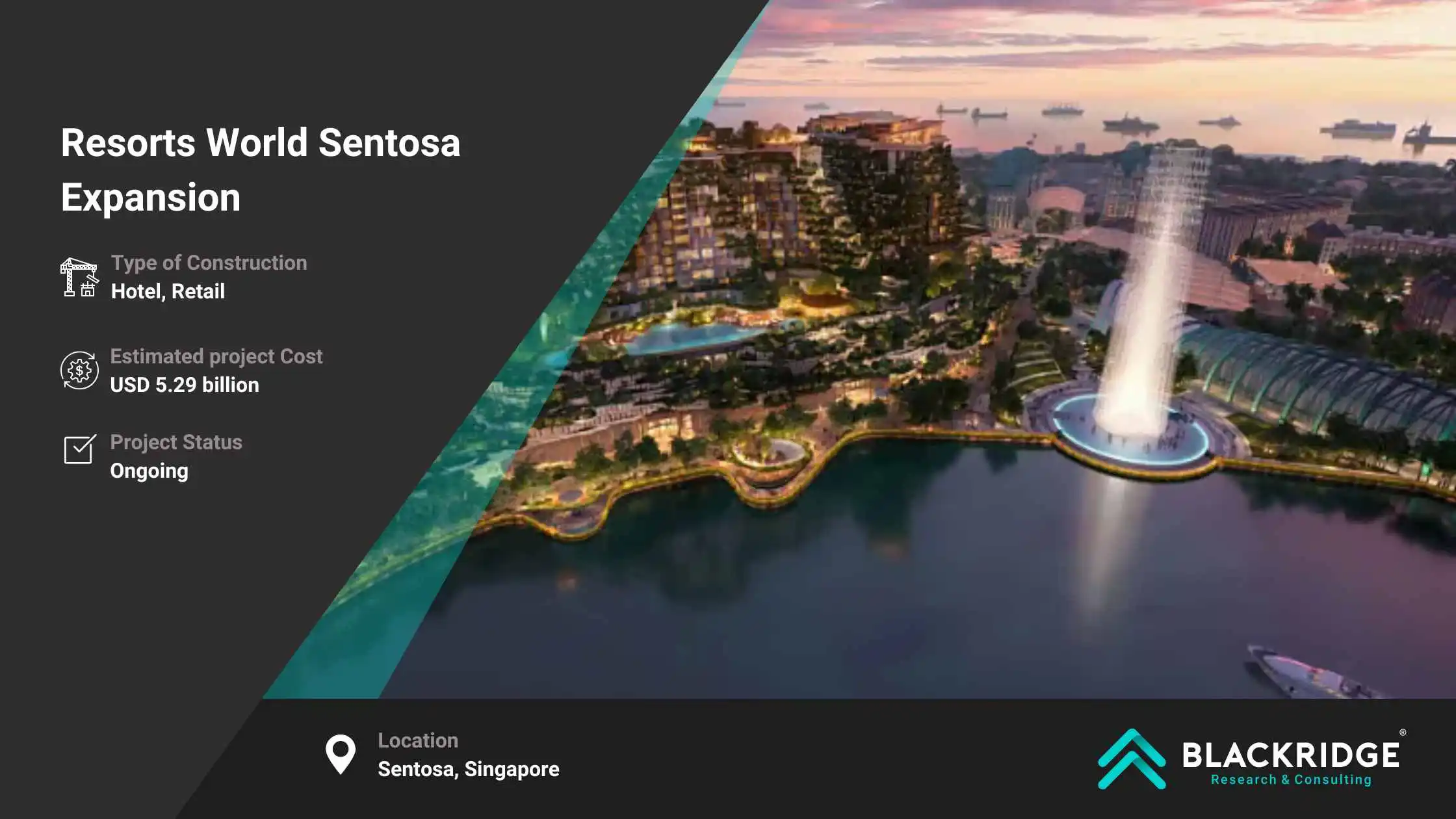
Resorts World Sentosa (RWS), one of Singapore’s premier integrated resorts, is undergoing a significant USD 5 billion expansion aimed at strengthening its position as a top-tier tourism destination in Asia. Known as RWS 2.0, the multi-phase expansion began in Q2 2022 and includes major upgrades across the resort, new attractions, and luxury accommodations.
A key component of the expansion is a waterfront development set to begin construction in July 2025. This will introduce two new luxury hotels with a combined 700 rooms, along with retail, dining, and entertainment offerings. The overall development will roll out in stages, with each phase enhancing RWS’s appeal to both domestic and international visitors.
Upcoming highlights include:
Asia’s first Harry Potter: Visions of Magic experience, launching July 2025
Minion Land at Universal Studios Singapore, opening in Q1 2025, features rides like Despicable Me Minion Mayhem and the exclusive Buggie Boogie carousel.
The future addition of Super Nintendo World will further expand Universal Studios Singapore’s appeal.
Transformation of S.E.A. Aquarium into the Singapore Oceanarium
Renovation and rebranding of the Hard Rock Hotel
Latest project update: A new all-suite luxury hotel replacing the Hard Rock Hotel, set to open in the third quarter of 2025.
Conclusion
Singapore’s top 10 construction projects in 2025 reflect the nation’s strategic focus on infrastructure, innovation, and long-term sustainability. From transport and aviation to tourism, water management, and urban regeneration, with a combined investment of over USD 130 billion.
Projects like the Cross Island Line, Tuas Mega Port, and Jurong Innovation District showcase Singapore’s commitment to enhancing connectivity and economic resilience, while developments such as Marina Bay Sands IR2 and the Resorts World Sentosa Expansion reinforce its global position as a premier destination for tourism and business.
As these projects progress through various stages of planning, construction, and completion, they will not only reshape Singapore’s physical landscape but also lay the foundation for future growth, supporting smart city ambitions, sustainable living, and high-quality urban experiences well into the 2040s and beyond.
Find All Upcoming Construction Industry Projects in Singapore
Are you searching for a trusted platform that delivers accurate, timely, and in-depth insights into upcoming construction projects in Singapore?
Explore the Global Project Tracking (GPT) platform by Blackridge Research, your one-stop source for discovering the latest construction projects in Singapore at every stage of development:
Upcoming Projects
Tender Notices
Contract Awards
Projects Under Construction
Completed Facilities
Book a free demo today to stay ahead with real-time project intelligence and make informed business decisions faster!



![List of Top 5 Largest Construction Companies in Portugal [2026]](https://images.blackridgeresearch.com/zA7C1E09-z4Uj64Eb0zfkw/2b549578-fd97-4e1a-6ee2-9094c80f6400/thumbnail)
Leave a Comment
We love hearing from our readers and value your feedback. If you have any questions or comments about our content, feel free to leave a comment below.
We read every comment and do our best to respond to them all.