



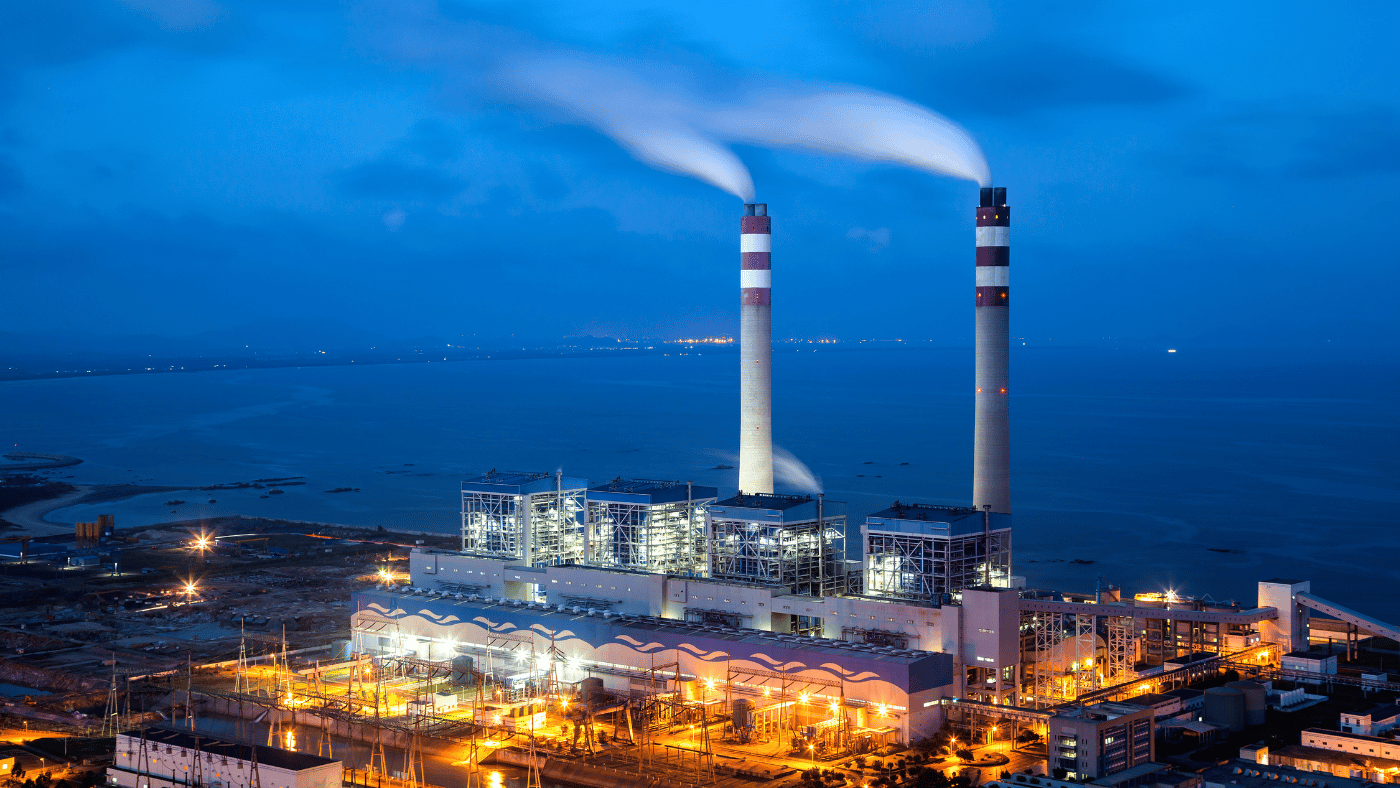
Coal power plants in the US have long been known as a major source of the country's electricity generation. While renewables like solar, wind, and natural gas plants are replacing fossil fuel plants, coal power plants in the United States continue to be a major contributor to the country's electricity needs.
According to the U.S. Energy Information Administration, about 16% of U.S. electricity was coal-based which is forecasted to grow to 15-16% in the coming years. This accounts for 386 million short tons (MMst) of coal-based electricity in 2025. The U.S. electric power sector consumed 7% more coal in January 2025 compared to January 2024, which supports the coal consumption forecast for the coming years.
Plants like Bowen Power Plant, Gibson Station, and Monroe Power Plant continue to operate and fulfill electricity needs for residents of the United States. In this blog, we will see more of such top coal power plants in the United States in detail and some major coal plants’ retirement.
Top Coal Power Plants in the US (2025) (ranked based on coal capacity)
Plant Name
|
Capacity (MW)
| Electricity Generation 2025 (MWh) |
Region
|
Commissioned Year
|
Retirement Year
|
Bowen Power Plant
|
3,499
| 12.24 million |
Bartow County, Georgia
|
1975
|
2035
|
Gibson Station
|
3,340
| 10.60 million |
Owensville, Indiana
|
1972
|
2038
|
Monroe Power Plant
|
3,280
| 14.85 million |
Monroe, Michigan
|
1971
|
2032
|
John E. Amos Power Plant
|
2,933
| 9.02 million |
St Albans, West Virginia
|
1970s
|
Retirement Not Announced
|
James H. Miller Jr. Plant
|
2,822
| 18.87 million |
Quinton, Alabama
|
1978
|
Retirement Not Announced
|
W.A. Parish Generating Station
| 2,737 | 12.97 million | Houston, Texas | 1977 | Retirement Not Announced |
Scherer Plant
| 2,673 | 7.66 million | Monroe County, Georgia | 1982 | One unit retired in 2021, another by 2028 |
Cumberland Fossil Plant
|
2,600
| 9.00 million |
Stewart County, Tennessee
|
1973
|
One unit by 2026, full by 2028
|
Rockport
| 2,600 | 9.60 million | Spencer, Indiana | 1984 | 2028 |
James M. Gavin Power Plant | 2,600 | 12.82 million | Cheshire, Ohio | 1974 |
Retirement Not Announced
|
How are the largest coal power plants ranked?
The ranking uses installed coal nameplate capacity, measured in megawatts (MW).
The following distinctions are important:
Coal nameplate capacity: The combined rated capacity of the coal-fired generating units at a plant.
Net summer capacity: The estimated electricity-generating capability of a unit under specified summer operating conditions. This can be lower than nameplate capacity.
Net generation: The actual electricity produced over a period, normally measured in megawatt-hours (MWh) or gigawatt-hours (GWh).
A power plant with a higher installed capacity doesn’t necessarily generate more electricity per year. Actual generation is impacted by fuel availability, maintenance, dispatch decisions, outages and market conditions.
Retired coal units are not included in the ranking, and natural gas capacity is not added to coal capacity when a facility operates more than one fuel type.
Bowen Power Plant
Key details
Location: Bartow County, Georgia
Operator: Georgia Power
Parent company: Southern Company
Commercial operations began: 1975
Installed coal capacity: Approximately 3,499 MW
Coal-generating units: Four
Plant Bowen, also known as Bowen Steam Plant, is a 3,499 MW capacity coal-fired plant. It is a four-coal-fired unit plant located in Bartow County, Georgia. Developed by Georgia Power Co., a subsidiary of Southern Co. began its commercial operations in 1975.
The Bowen Steam Turbine Power Plant has four coal-fired units. The unit-wise capacity is as follows:
Bowen Steam Turbine Power Plant
|
Capacity in MW
|
Steam Turbine
|
Unit 1
|
805.8
|
Siemens Energy steam turbine
|
Unit 2
|
788.8
|
Siemens Energy steam turbine
|
Unit 3
|
952
|
GE Power steam turbine
|
Unit 4
|
952
|
GE Power steam turbine
|
Total
|
3498.6
|
|
The Integrated Resource Plan (IRP) by Georgia Power will evaluate the future of units 1 & 2 in 2025. Earlier, the Georgia Public Service Commission (PSC,) through IRP 2022, announced the extension of the retirement date for units 1 & 2. For units 3-4, the decision will be made after 31st December 2025.
By 31st December 2025, Units 3 & 4 aim to meet the pollution rules. The Flue Gas Desulphurization Wastewater System (FGDW) is a wastewater treatment plant treating the wastewater from the four units of the Bowen Steam turbine Plant. The retirement of units 1 & 2 won't impact FGDW treating the wastewater from this plant. Earlier, Southern Co announced it would retire the plant by 2035; however, with the new policies and increased electricity demand, the plant might have to operate longer than planned.
Gibson Station
Key details
Location: Gibson County, Indiana
Operator: Duke Energy Indiana
Generating units: Five
Installed coal capacity: Approximately 3,340 MW
First unit entered service: 1972
Gibson Station is Duke Energy's largest coal-fired power plant. It is a five-unit facility coal plant facility with a total capacity of 3,340 MW combined. It is located in Owensville, Gibson County, Indiana, approximately 35 miles north of Evansville, Indiana.
The first unit at Gibson Generating Station began operations in 1972. Unit 5 of the plant became operational in 1983. Unit 5 is co-owned by the Wabash Valley Power Association and Indian Municipal Power Agency. The Gibson Generating Station in Indiana is likely to be retired in 2038. Initially, Gibson was scheduled to retire by 2035; however, Duke Energy proposed the plant energy would adopt state regulators and run on natural gas, extending its retirement to 2038.
Monroe Power Plant

Key details
Location: Monroe, Michigan
Operator: DTE Electric Company
Parent company: DTE Energy
Generating units: Four
Installed coal capacity: Approximately 3,280 MW
Commercial operations began: 1970s
Monroe Power Plant is a coal-fired power plant with a capacity of 3,280 MW. It is a four-unit coal-fired power plant located in Monroe, Michigan, United States. DTE Energy Electric Company, a subsidiary of DTE Energy, developed the Monroe power plant. It began its operations in 1971.
In 2023, DTE announced its plans to retire two units of the Monroe Power plant by 202 and full retirement by 2032. It is one of the largest coal-fired power plants in the US and one of the major sources of greenhouse gas emissions.
John E Amos Power Plant

Key details
Location: Putnam County, West Virginia
Operator: Appalachian Power
Parent company: American Electric Power
Generating units: Three
Installed coal capacity: Approximately 2,933 MW
Commercial operations began: 1970s
The John E Amos Power Plant, also known as the Amos Plant, is a 2,933 MW capacity coal-fired plant located in St Albans, Putnam, West Virginia. It is developed, owned, and operated by Appalachian Power Co, a subsidiary of American Electric Power (AEP).
It began its commercial operations in the 1970s. The John E Amos Plant features three dry-bottom boilers powered by low-sulfur coal and Northern Appalachian Basin high-sulfur coal.
It has three coal-fired units, the first two units have 816.3 MW capacity, and Unit 3 started in October 1973 as the first 1,300 MW power plant in the US. Babcock & Wilcox (B&W), one of the hydraulic fracking companies in the US, provided FPS® ignition equipment to repair/refurbish 96 oil ignitors in Unit 3 as per OEM standards (Original Equipment Manufacturer). GE Power supplied electric generators for all three units of the plant.
James H Miller Jr Electric Generating Plant

Key details
Location: Jefferson County, Alabama
Operator: Alabama Power
Parent company: Southern Company
Generating units: Four
Installed coal capacity: Approximately 2,822 MW
Commercial operations began: 1978
James H. Miller, Jr. Electric Generating Plant is a 2822 MW coal-fired plant located in Quinton, Jefferson, Alabama. It is located 20 miles northwest of Birmingham on the Locust Fork branch of the Black Warrior River.
It has four generating coal-fired units with a generating capacity of 2,640,000 kW. It was commissioned in 1978. Alabama Power Co, a subsidiary of Southern Power CO., currently owns this plant.
All four units in the plant are equipped with GE Power Steam turbines and Babcock & Wilcox Enterprises (B&W) supplied steam boilers for the plant. The James H. Miller, Jr. Electric Generating Plant is the fifth-largest coal plant by capacity in the US. No retirement has been announced for this plant. One of the reasons suggested is its region doesn't have many sources of electricity. The James H. Miller, Jr. plant is one of the largest sources of electricity in that region.
W.A. Parish Generating Station

Key details
Location: Fort Bend County, Texas
Operator: NRG Energy
Fuel types: Coal and natural gas
Coal capacity: Approximately 2,737 MW
Carbon capture project: Petra Nova
The W.A. Parish Generating Station is a 3,880 MW coal-fired power plant located in Houston, Texas. It is one of the coal power plants with carbon capture and storage (CCS) in the world.
W.A. Parish Generating Station consists of a 2,737 MW coal plant and an 1143 MW natural gas plant, accounting for a total capacity of 3,880 MW. It was commissioned in 1977. In 2017, a 240 MW Carbon Capture Utilisation and Storage project (CCUS), Petra Nova, was added to unit 8 of the plant. This CCUS project was designed to capture about 90% of the CO2 emissions from the plant. It receives about 37% of emissions from unit 8 of the plant.
The Petra Nova Project, also known as the W.A. Parish Post-Combustion CCS Sequestration Project, was developed as a part of the U.S. Government's Clean Coal Power Initiative.
It was developed by the Department of Energy (DOE) in partnership with a joint venture of NRG Energy and JX Nippon Gas Exploration Corporation. It is owned and operated by NRG Energy, Inc. and JX Nippon Oil and Gas Exploration Corporation.
By October 2017, it achieved a milestone of capturing more than 1 million tons of CO2. The CO2 captured by Petra Nova facility is used in Enhanced Oil Recovery (EOR). by December 2019, Petra Nova captured over 3.9 million CO2. Carbon capture projects add another technical and commercial dimension to the future of fossil-fuel power generation. For a supplier-focused overview, see our guide to carbon capture companies.
The Petra Nova Project's cost is estimated to be USD 1 billion. NRG Energy received USD 167 million from the DOE Clean Coal Project Initiative (CCPI) 2010. NRG Energy and JX Nippon Oil and Gas Exploration Corporation contributed USD 300 million each as equity for the project.
Japan Bank provided a USD 250 million loan for International Cooperation and Mizuho Bank (backed by Nippon Export and Investment Insurance (NEXI)). This plant halted its operations in 2020 due to a plunge in oil prices during the COVID-19 breakdown. However, it resumed its operations back in September 2023.
Scherer Plant

Key details
Location: Monroe County, Georgia
Major operator: Georgia Power
Other owners: Oglethorpe Power, MEAG Power and Dalton Utilities
Original coal-generating units: Four
Unit 4 retirement: 2021
Remaining coal capacity: Approximately 2,673 MW
Scherer plant is a 2,673 MW plant located in Monroe County, Georgia. It has four coal-fired units. It is owned, developed, and operated majorly by Georgia Power Co., a subsidiary of Southern Co. It began its commercial operation in 1982.
Each unit has a capacity of 891 MW, of the four units, unit 4 was closed down in 2021. Oglethorpe Power, Municipal Electric Authority of Georgia, Georgia Power, and Dalton Utilities own units 1&2 with a stake of 60%, 30.2%, 8.4%, and 1.4%.
GE Power supplied electric generators and steam boilers for units 1 & 2. Southern Co. announced its plans to close another unit by 2028.
Cumberland Fossil Plant

Key details
Location: Stewart County, Tennessee
Operator: Tennessee Valley Authority
Generating units: Two
Installed coal capacity: Approximately 2,600 MW
Commercial operations began: 1970s
Cumberland Fossil Plant spread across 1,425 acres, is built with a capacity of 2,600 MW. It is located on the shores of Barkley Lake in Stewart County, Tennessee. It is 20 miles southwest of Clarksville, Tennessee, and is accessible from state Route 149.
The 2,600 MW is the combined capacity of two coal-fired units in the plant, developed and owned by the Tennessee Valley Authority (TVA). It is also one of the largest generating assets in the TVA coal portfolio.
It was commissioned in 1973 and produces about 16 billion kilowatt-hours of electricity each year, sufficient for more than 1.4 million homes. In 2023, TVA announced its plans to retire the plant in two stages. One unit will be retired by the end of 2026, and the second unit by 2028. Before the retirement of the first unit, TVA announced its plans to build a 1,450 MW Combined Cycle Gas plant that (CCGPT) will become operational by 2026.
Trusted by Leading EPCs & Manufacturers
Find the Latest Coal Power Projects Around the United States
Gain exclusive access to our industry-leading database of coal power project opportunities with detailed project timelines and stakeholder information.
Request Free Trial → Learn More →
No credit card Up-to-date coverage
Rocport

Key details
Location: Spencer County, Indiana
Operator: Indiana Michigan Power
Parent company: American Electric Power
Generating units: Two
Installed coal capacity: Approximately 2,600 MW
Commercial operations began: 1980s
Rockport is a 2600 MW plant located in Spencer, Indiana. It is developed and owned by Indiana Michigan Power Co, a subsidiary of the American Electric Power Co Inc (AEP). It has two coal-fired units each with a capacity of 1300 MW.
It is co-owned by AEP and Indian Michigan Power Co. It was commissioned in December 1984. The ground-breaking of the plant began in 1977. Since the plant began operations, both unit 1 and unit 2 have generated about 200,850,580 MWh and 181,132,882 MWh, respectively. The Rockport plant is scheduled to retire from operations by 2028.
James M. Gavin Power Plant

Key details
Location: Gallia County, Ohio
Generating units: Two
Installed coal capacity: Approximately 2,600 MW
Commercial operations began: 1970s
Ownership changed: 2017
James M. Gavin Power Plant is located in Cheshire, Gallia, Ohio. It has a capacity of 2,600 MW. It is one of the largest coal-fired power plants in the country. Earlier owned by American Electric Power (AEP), on 30th January 2017, it sold James M. Gavin Power Plant and three natural gas plants to Lightstone Generation LLC, a joint venture of Blackstone and an affiliate of ArcLight Capital Partners LLC (ArcLight), for approximately USD 2.1 billion.
The plant became operational in 1974 with two coal-fired units. On 19th December 2000, AEP announced its plans to install a urea-based selective catalytic reduction (SCR) system at the plant. The change in plant design was proposed to reduce nitrogen oxide emissions, a major contributor to air pollution. Installing an SCR system at the plant can reduce up to 90% of the emissions from the plant. The installation was completed in 2008 at an estimated cost of 200 million. No retirement year has been announced by the company.
Coal Power Plant Retirements and Operational Changes in the US
The retirement of coal-fired generating capacity is an important part of the changing US electricity landscape. However, announced retirement dates, delayed closures, emergency operating orders and completed retirements must be treated as separate developments.
According to the US Energy Information Administration (EIA), the United States retired approximately 2.6 GW of coal-fired generating capacity in 2025. This was the lowest annual retirement total since 2010.
The EIA also reported that approximately 4.8 GW of planned 2025 retirements were delayed, while some previously announced closure plans were cancelled.
Three developments illustrate why retirement information needs to be regularly updated.
Intermountain Power Project – Utah
The Intermountain Power Project was one of the largest coal-fired generating facilities in the western United States, with approximately 1,800 MW of coal capacity.
However, its two coal-fired generating units retired in October and November 2025.
The facility should therefore no longer be included in a ranking of operating coal power plants in 2026.
The site has transitioned towards natural gas generation, including a new combined-cycle facility. The new gas capacity must not be counted as coal capacity.
J.H. Campbell Generating Plant – Michigan: Retirement Delayed
J.H. Campbell Generating Plant in West Olive, Michigan, was originally scheduled for retirement in May 2025. However, its closure was delayed following federal emergency orders intended to maintain electricity-system reliability.
The facility comprises three coal-fired generating units with approximately 1,561 MW of combined capacity. Its planned retirement has subsequently been reported as November 2026 in the EIA monthly generator inventory.
The November date should be treated as a reported retirement schedule, not confirmation that all three units have completed retirement. The plant's final operating status should be checked against the next EIA inventory and Consumers Energy announcements.
Bowen, Scherer and other plants – Capacity changes
Large coal stations can experience changes in their generating capacity when individual units retire, undergo maintenance or receive regulatory approval for continued operations.
Plant Bowen and Scherer illustrate why the distinction between historical plant capacity and currently operating coal capacity matters.
For Scherer, the retirement of Unit 4 reduced the number of operating coal units from four to three. Its historical capacity should not be used as though all four units remain operational.
Similarly, capacity figures for Bowen should be taken from the latest generator inventory rather than combining older unit-level figures with future retirement assumptions.
The key point: A retirement announcement does not establish that a generating unit has retired. Actual operating status should be verified through the latest EIA inventory and the relevant utility or regulatory filings.
Future Of Coal Power Plants In The US
In 2025, electric generators announced their plans to retire 8.1 GW of coal-fired capacity, which is equal to 4.7% of the total U.S. coal fleet that was operational in 2024. (Latest update: US generators planned to retire 6.4 GW of coal capacity in 2026, almost 4% of the coal fleet operating at end-2025, though plans can change.)
In 2024, about 4 GW of coal capacity was retired, which is low compared to the 9.8 GW coal capacity that was retired during 2014-2023.
Some of the major coal plants like the Intermountain Power Project (1,800 MW) in Utah, J.H. Campbell (1,331 MW) in Michigan, and Brandon Shores (1,273 MW) in Maryland, are set to shut down, reflecting the ongoing transition in the energy sector.
The shutdown of coal power plants is leading to replacing them with alternative renewable and natural gas plants. The Intermountain Power Project will be replaced by an 840 MW natural gas combined cycle power block expected to be online by July 2025.
(Latest Update: IPP's coal units stopped generating on 26 November 2025 but are kept in operable condition under Utah law while the state seeks buyers; the IPP Renewed gas project's first unit entered commercial operation in October 2025.)
Trusted by Leading EPCs & Manufacturers
Find Get a Customized North America Coal Fired Power Generation Market Report
Gain exclusive access to our industry-leading database of coal power project opportunities with detailed project timelines and stakeholder information.
Request Free Trial → Learn More →
No credit card Up-to-date coverage
Data Sources and Ranking Methodology
Blackridge Research ranks coal-fired power plants using generator-level information published by the US Energy Information Administration (EIA).
The ranking considers:
Installed nameplate capacity of coal-fired generating units.
Operating status of individual generators.
Combined coal capacity at each generating station.
Exclusion of retired coal units.
Exclusion of natural gas and other non-coal generating capacity.
Capacity figures are expressed in megawatts (MW). Actual electricity generation is reported separately in megawatt-hours (MWh).
The primary data source is the EIA's Preliminary Monthly Electric Generator Inventory (EIA-860M). Annual electricity generation figures are checked separately against EIA-923 data.
Monthly EIA-860M figures are preliminary and may be revised. Planned retirement dates are not treated as completed retirements unless the relevant generator is recorded as retired or the closure is independently confirmed.
Data reference: September 2026 EIA-860M inventory.
Conclusion
Coal power plants in the US continue to contribute to the country's electricity needs. With a shift towards renewable energy and natural gas plants, several large coal power plants like Intermountain Power Project, J.H. Campbell, and Brandon Shores are set to retire, plants like Bowen Power Plant, Gibson Station, and Monroe Power Plant continue to contribute to the electricity needs of United States.
Stay Updated on the Latest Coal Power Plants in the United States!
Subscribe to Blackridge’s US Coal Power Plants Database to get access to:
Reliable and high-quality insights
Upcoming, in progress, and completed and retired coal power plants list
Stage-wise tracking for each project
Essential details on key stakeholder contact information
Regular updates
Start a free demo to take your business to the next level!


Leave a Comment
We love hearing from our readers and value your feedback. If you have any questions or comments about our content, feel free to leave a comment below.
We read every comment and do our best to respond to them all.