


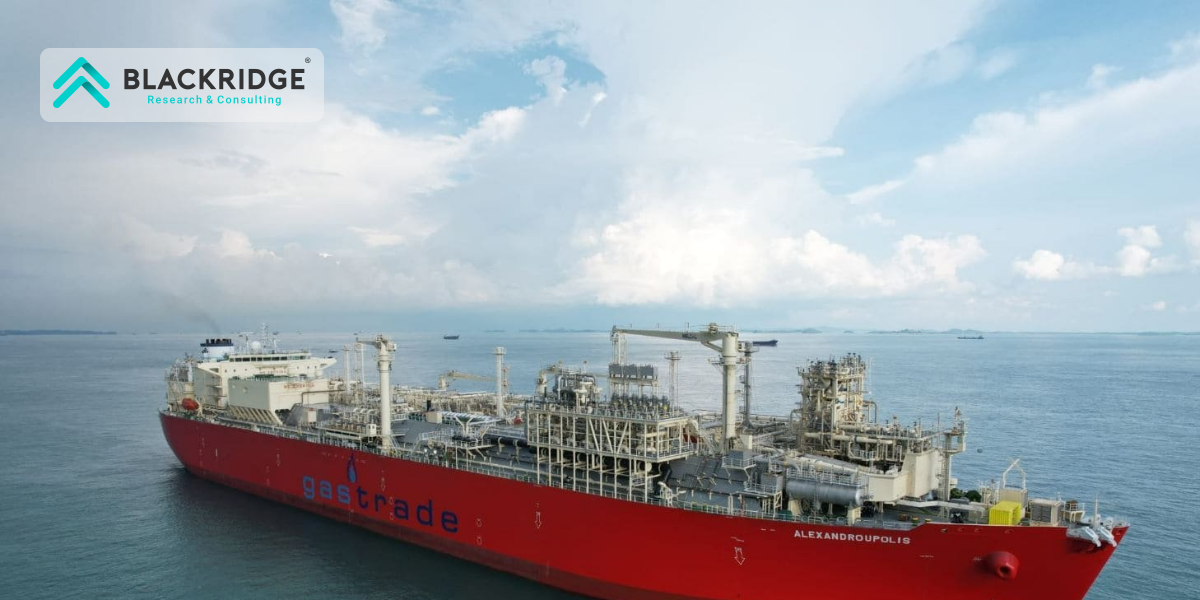
| Category | Details |
| Project Name | FSRU Alexandroupolis |
| Designed, Built, Owned, and Operated | Gastrade |
| Location | Aegean Sea, Greece |
| Conversion Shipyard | Seatrium Shipyard (formerly Keppel Shipyard), Singapore |
| Converted Into | Floating Storage and Regasification Unit (FSRU) |
| FSRU Name Post-Conversion | Alexandroupolis |
| Storage Capacity | 153,500 m³ |
| Nominal Gas Send-Out Rate | 625,000 m³/hour |
| Peak Gas Send-Out Rate | 944,000 m³/hour |
| Annual Regasification Capacity | 5.5 bcm (Equivalent to 4 mtpa LNG) |
| Potential Maximum Capacity | Up to 8 bcm per year |
| Mooring | Spread 12-point mooring system |
| Vessel Status | Active |
| Start of Commercial Operation | October 1st, 2024 |
Project Overview
The FSRU Alexandroupolis is a strategic project that aims to enhance Greece’s energy security by importing, storing, and regasifying, liquefied natural gas (LNG) for regional distribution. The FSRU vessel commenced commercial operations on October 1, 2024, and has a regasification capacity of 5.5 billion cubic meters per year.
The Alexandroupolis FSRU project was developed by Gastrade with an estimated investment of EUR 360 million to EUR 450 million. It connects to the Greek National Natural Gas Transmission System (NNGTS) to ensure efficient gas supply to Greece and neighboring countries.
FSRU Alexandroupolis Location
The FSRU Alexandroupolis is strategically located in the Aegean Sea, approximately 17.6 km southwest of Alexandroupolis and 10 km from the shore of Makri village, at a water depth of 40 meters.
The facility is secured with a 12-point spread mooring system with eight suction anchors. It is connected to the Greek National Natural Gas Transmission System (NNGTS) via a 28 km subsea and onshore pipeline. This offshore location minimizes land use impact, ensures safer LNG carrier access, and offers logistical advantages due to its proximity to Alexandroupolis.
Project Background
The Alexandroupolis FSRU was conceptualized by Dimitris Copelouzos over 15 years before its operational launch as a strategic response to Southeastern Europe's energy security challenges. The 2009 Russia-Ukraine gas dispute highlighted the risks of relying on a single supply route, prompting the need for diversification.
In 2010, Gastrade S.A. was established with the objective of developing an offshore LNG import terminal, securing Greece’s first Independent Natural Gas System (INGS) license in 2011.
The Alexandroupolis FSRU is a vital component of the "Vertical Corridor" initiative, designed to enhance natural gas connectivity between Greece, Bulgaria, Romania, Hungary, Slovakia, Moldova, and Ukraine. The Alexandroupolis LNG terminal offers imports from suppliers such as the United States, Qatar, and Egypt, strengthening Europe's energy security.
Development and Ownership Structure
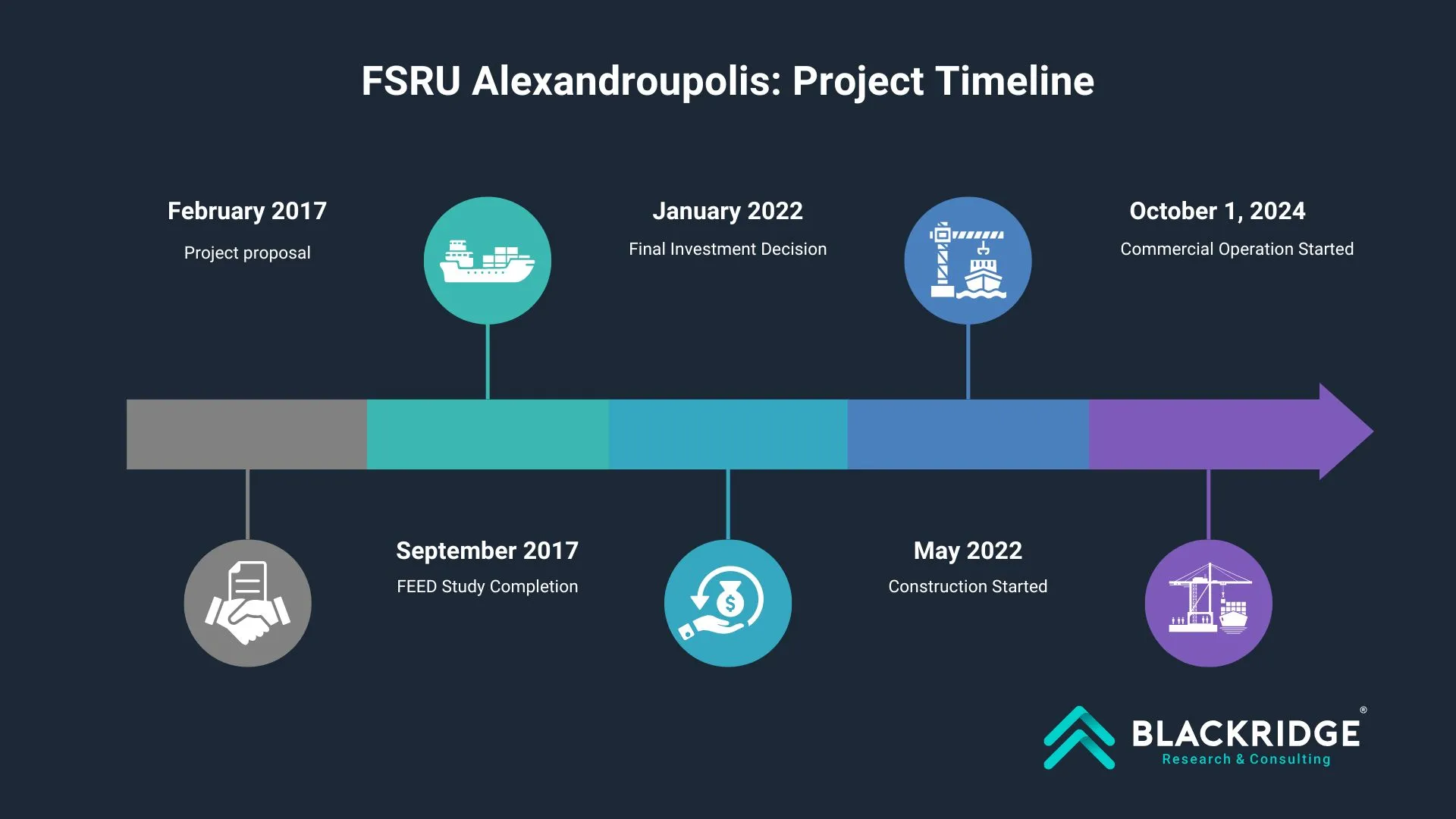
Proposed in February 2017 by the Alexandroupolis Independent Natural Gas System (INGS), the project is developed by Gastrade, a consortium of:
- Copelouzos Group (20%)
- GasLog Cyprus Investments (20%)
- DEPA Commercial (20%)
- Bulgartransgaz (20%)
- DESFA (20%)
The Alexandroupolis FSRU strengthens energy security by introducing a new gas supply source, promoting a competitive gas trading hub, and integrating with key infrastructure such as the Gas Interconnector Greece-Bulgaria (IGB) and the Trans-Adriatic Pipeline (TAP).
Engineering and Market Test
The project's Front-End Engineering and Design (FEED) study was completed in September 2017 and co-funded by the EU’s Connecting Europe Facility (CEF) with a EUR 592,419 grant. By December 31, 2018, the first phase of the Market Test saw 20 companies express interest in a 12.2 bcm/y capacity, demonstrating strong market demand. Following initial delays, the Final Investment Decision (FID) was made in January 2022, securing financial backing for project execution.
Recognized as a Project of Common Interest (PCI) by the European Commission (EC), the Alexandroupolis FSRU project has received significant support through European regional development fund and bond financing, with an estimated investment ranging from EUR 360 million to EUR 450 million.
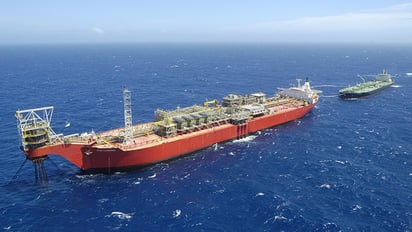
GasLog led the conversion of the GasLog Chelsea into the Alexandroupolis FSRU. The Floating regasification unit features large-scale LNG storage and a dedicated pipeline connection to diversify energy sources and strengthen the energy security of Greece and Southeastern Europe.
Design and Engineering Details
| Feature | Specification |
| Number of Storage Tanks | 4 large LNG storage tanks |
| Regasification Units | 4 units (each processing 400 m³/hour) |
| Boil-Off Gas Management | To handle vaporized gas |
| LNG Transfer System | Specialized loading arms for cryogenic LNG transfer |
| Heating System for Regasification | Combined open and closed loop intermediate fluid heating medium system |
| Safety Systems | Hazard detection, emergency shutdown, fire protection, spill containment |
| Waste Management Systems | Comprehensive utilities and waste-handling facilities |
Project Cost and Financing
The FSRU Alexandroupolis project was initially estimated at EUR 360 million (USD 378 million). However, due to inflation and additional expenses, costs have risen to approximately EUR 450 million.
The conversion of the LNG carrier GasLog Chelsea into an FSRU was valued at approximately USD 265 million, and the Alexandroupolis INGS Terminal Pipeline was estimated to cost an additional EUR 80 million (USD 91 million).
Financing for the project came from multiple sources, including EUR 283 million in debt financing raised through three bond issues by the National Bank of Greece in June 2022. Additionally, the European Union provided some important grants:
- EUR 592,419 from the Connecting Europe Facility (CEF)
- EUR 166.7 million from the European Structural and Investment Funds
- EUR 106 million from the European Commission (approved in October 2023 under EU State aid rules)
Contractors Details of FSRU Alexandroupolis
| Company | Role in the Project |
| GasLog LNG Services | Converted LNG carrier GasLog Chelsea into the FSRU; Operator of the facility |
| Seatrium Shipyard (formerly Keppel Shipyard) | Conducted the physical conversion of the FSRU |
| Hill International | Provided commissioning services |
| Tractebel | Offered commissioning expertise for offshore and onshore pipelines |
| Corinth Pipeworks | Fabricated and supplied 30-inch SAWL steel pipes for the 28 km pipeline |
| Saipem S.p.A. | Installed the offshore and onshore gas pipeline |
| Wood Group | Completed the Front-End Engineering Design (FEED) |
| Metocean Services International (MSI) & BMT | Conducted environmental monitoring and developed a metocean criteria report |
| DESFA (Hellenic Gas Transmission System Operator) | Built and operates the metering and regulating station |
Project Timeline
Current Status of FSRU Alexandroupolis
As of March 2025, the FSRU Alexandroupolis is currently situated in the Aegean Sea, with its position reported as "At anchor." The vessel is currently at an operational halt, which typically indicates that it is awaiting its next operational task. The facility has also played a key role in LNG imports, with UK-based BP delivering LNG cargo to Bulgargaz via the terminal.
Recognizing its contribution to the maritime and energy sectors, Gastrade received the ‘Ship of the Year’ award at the 2024 Lloyd’s Greek Shipping Awards.
Future Prospects
The Alexandroupolis FSRU has already demonstrated its importance by contributing to increasing Greek gas consumption, which rose from 50.9 TWh in 2023 to 66.2 TWh (6.3 bcm) in 2024.
The Alexandroupolis LNG terminal has already secured 60% of its technical capacity contracted to long-term regasification commitments. Fourteen Greek and international energy companies have booked nearly all available capacity until at least 2030. Among these, Venture Global LNG has secured one mtpa for five years starting in 2025, along with Bulgargaz (Bulgaria’s state gas company) and the government of North Macedonia.
To meet the growing demand for LNG imports, Gastrade SA is considering expanding its LNG infrastructure. The company has proposed the development of a second FSRU, the Thrace FSRU, in the Thracian Sea near the existing Alexandroupolis terminal. Initially planned with a 5.5 bcm per year (4 mtpa) capacity, the project has since been revised to 6 bcm per year (4.4 mtpa), further strengthening gas supply capabilities in Southeast Europe.
Conclusion
The FSRU Alexandroupolis is an important energy project that helps bring LNG into SE Europe (southeast europe) and decrease Russian gas. It has strong storage and regasification capacity and connects to Greece’s gas system, making it a key part of the region’s energy supply. The project took over a decade to develop and received funding from both the EU and private investors.
It recently faced technical issues that stopped regasification services after starting operations in October 2024. Despite this, the project has a strong future, with many companies already booking its capacity and plans for a second FSRU in the region. Its role in the "Vertical Corridor" initiative and its potential to become a major LNG hub show its long-term value for Greece and Central Europe.
Connect with Key Decision-Makers in Europe’s FSRU Industry
Subscribe to our Europe FSRU Project and Tender Database to gain valuable insights into upcoming, ongoing, and completed FPSO projects.
Why Subscribe?
- Access Reliable Insights – Stay updated with high-quality information on FPSO developments.
- Discover Business Opportunities – Identify potential contracts, tenders, and partnerships.
- Get Key Stakeholder Contacts – Connect with industry leaders, decision-makers, and project owners.
- User-Friendly Platform – Navigate easily to find critical project details and timely updates.
Who Benefits?
Engineers, industry professionals, investors, and government agencies looking to expand their network and business prospects.
Start a Free Demo Today and unlock new growth opportunities!

Leave a Comment
We love hearing from our readers and value your feedback. If you have any questions or comments about our content, feel free to leave a comment below.
We read every comment and do our best to respond to them all.