

You need tech talent for an urgent project — not six months from now, but today.
You may have tried hiring locally and hit a wall. Now you are stuck wondering: Do I add extra hands to my team with staff augmentation? Or should I hand over the entire project to an outsourcing vendor?
Well the truth is both models sound tempting. But choosing the wrong one can delay your project, hurt quality, or even cost you clients. So, before you commit, you need to truly understand how staff augmentation vs outsourcing differ — and which one fits your exact situation.
In this guide, we will explain the differences between the two practices, as well as their commonalities. We will see some use cases as well to teach you how to make the right choice.
Staff Augmentation vs Project Outsourcing: 6 Core Differences You Must Know
There are two primary approaches for organizations to enlist external aid: staff augmentation and project outsourcing. Knowing the core differences between these models is key to picking the right approach for your project and goals.
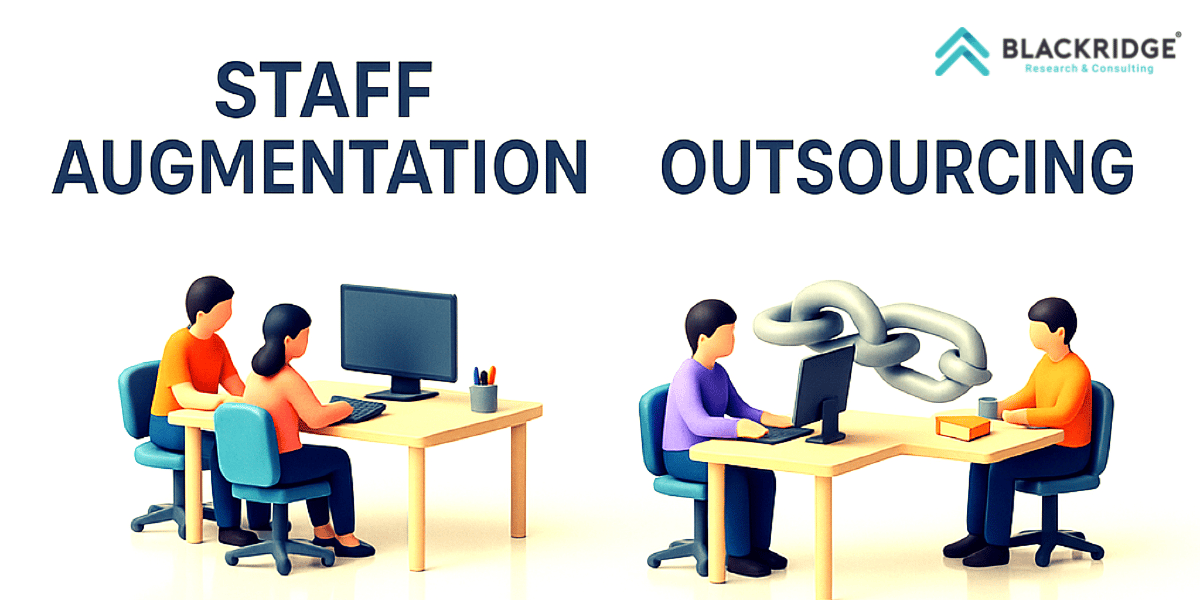
Staff augmentation involves bringing in external specialists or collaborating with a KPO partner who provides the required service to enhance your current team temporarily to fill the skill and resource gaps. They work under your supervision, follow your processes, and help you fill specific skill gaps or meet deadlines.
For example, you are a digital marketing agency with short-term web development projects. But currently, you lack React.js experts. Since the need is temporary and not recurring, you can augment two React developers instead of hiring them full-time.
Augmentation can be skill-based, project-based, or on-demand.
Skill-based augmentation: you source professionals with niche competencies that your team doesn’t currently offer.
Project-based augmentation: You temporarily expand your team size to deliver a specific project more quickly.
On-demand augmentation: You quickly scale your team up or down based on workload fluctuations.
Augment your staff with cost 30% lower than global standard
Project outsourcing, on the other hand, is an employment strategy of handing over an entire function, task, or project to an external company. They manage everything — from planning to execution — while you focus on your core business.
Suppose, a UK e-commerce brand wants to design and build a mobile app but lacks an internal tech team. So, the brand completely outsourced it to a software agency in Eastern Europe.
While they may sound similar, these two models differ in some important ways. So, let's get into the distinctions between the two:
Control Over Work
In any staff augmentation model, the employer has full control and he/she stays in charge of the project. The added staff work under your management, following your processes and culture. You can also directly manage and oversee the work done.
When you outsource a service or project, the vendor takes control of how the work gets done. For example, your sales reps are busy. So, you are outsourcing customer service to specialised agencies to save time and costs. Here, you focus on results, but you have less say in the daily execution and team dynamics.
Cost Structure
One major advantage of staff augmentation is cost savings on short-term projects. You can tap into global talent from countries like India, the Philippines, and China, where the cost of skilled professionals is significantly lower than in Western countries. For example, hiring a software engineer from India can cost a fraction of what it would in the US. Plus, you save on infrastructure, training, and onboarding costs, since the experts you hire are ready to hit the ground running.
On the other hand, outsourcing usually involves paying for a packaged service or project. While it can also reduce costs, outsourcing companies add their own management fees, and you have less control over individual team salaries.
Talent Integration
Staff augmentation allows external professionals to integrate smoothly into your existing team. They adapt to your internal workflows, attend your meetings, and align with your culture, making it feel like an in-house extension.
In contrast, in project outsourcing, the external team is self-sufficient and works autonomously. You do not get involved in their internal processes. They work as a separate unit, and communication is usually milestone-based, rather than continuous daily collaboration.
This makes outsourcing vs staff augmentation very different in how deeply the external resources are embedded into your business.
Flexibility and Scalability
With staff augmentation, you can easily scale your team up or down based on project requirements. Need extra developers for a few months? Hire them temporarily. Need to cut back later? No problem.
Outsourcing, however, works more like a contractual service. If the scope needs to change, you usually have to renegotiate the entire contract. This flexibility makes staff augmentation vs IT outsourcing especially relevant for businesses with fluctuating workloads.
Focus on Core Business
Using project outsourcing, you can offload non-core tasks and free up your internal teams to focus on strategic activities. Since the vendor handles execution, your leadership team can concentrate on growing the business.
On the other hand, staff augmentation is better suited when you still want close oversight on every part of the work. It ensures that your projects stay true to your vision. Although, it may demand more internal time and effort for management.
Ownership and Responsibility
In staff augmentation, the accountability of the outcomes and results of the project comes to your shoulders. Since the external staff act under your leadership, the quality of the deliverables remains your responsibility.
In outsourcing, responsibility for deliverables shifts to the vendor. They are contractually obliged to meet the terms, deadlines, and quality standards you agreed upon. This difference makes staff augmentation vs software outsourcing a critical decision depending on how much risk you want to manage yourself.
To summarize, here is a quick comparison table on staff augmentation vs outsourcing
Criteria | Staff Augmentation | Project Outsourcing |
Control | Full control over the team and process | Vendor controls execution |
Cost | Predictable, pay as you go | May have hidden costs |
Team Integration | Seamless integration into your company | Operates independently |
Project Ownership | You own deliverables and knowledge | Vendor owns execution and delivery |
Flexibility | Highly flexible, easy to scale | Less flexible, contract-bound |
Risk & Quality Management | You directly manage quality | Quality depends on the vendor’s standards |
Staff Augmentation and Outsourcing: What They Have in Common?
Now that you know about the differences between outsourcing vs staff augmentation, below are some functions that make them common.
Access to Global Talent: Whether you're augmenting your team or outsourcing a project, both models tap into global skill sets. In fact, 78% of organizations are turning to global outsourcing to deal with local talent shortages according to a 2024 Global Outsourcing Survey.
Cost Efficiency: Both options help cut overhead costs associated with full-time hiring — such as employee benefits, infrastructure, and onboarding expenses.
Flexibility: You can easily scale up or down based on project demands without committing to permanent contracts.
Focus on Core Business: By supplementing or outsourcing teams, your internal employees can stay focused on core operations instead of being stretched too thin.
When to Choose Outsourcing Over Staff Augmentation (and Vice Versa)?
Not sure when to pick staff augmentation vs IT outsourcing? Well, there is no one-size-fits-all criterion. You need to check your:
Project needs - Do you have in-house talent, or does the project fall short on staff?
Control sharing freedom - How involved do I want to be in the day-to-day management of the project? Are you willing to share control or want to retain it?
Budget limitations - What is your budget? Are you open to fixed contract cost models, or want an hourly or project-based model?
Scalability needs - Are you planning to scale up or down your business?
Which Model Is Best for Your Development Needs: Augmentation or Outsourcing?
Today’s business world demands fast scaling, smart hiring, and cost-effective execution.
Choose Staff Augmentation if:
You need temporary, specialized talent: Say you are a startup building a product and need extra engineers to complete a crucial feature ahead of your next funding round.
You want direct control over the project: Staff augmentation means these professionals integrate into your team, following your processes and daily standups.
You want to reduce costs without compromising quality: For instance, hiring software developers from India — where the median salary is about USD 31,000 compared to USD 179,000 in the US — lets you maintain quality while saving significantly on labor.
You require flexibility: Your business might face seasonal peaks. With augmentation, you can expand your workforce during busy periods and scale down when needed.
You need to keep sensitive information in-house: If your project involves confidential data, augmented staff working on it should follow your internal protocols. It is important to keep everything protected.
Choose an Outsourcing partner if:
You need end-to-end project delivery: For example, your company needs a mobile app developed but doesn’t have the in-house capacity, so you hand over the entire project to a trusted partner.
You want quicker results without micromanagement: Outsourcing shifts project responsibility to an external team that manages timelines, resources, and deliverables.
You face budget constraints but need full project support: Outsourcing allows you to access skilled offshore teams — like those in Eastern Europe, at a fraction of local costs.
You want to free up your internal team: Delegate non-core tasks (like data entry or routine IT support) so your key employees can stay focused on strategic goals.
Staff Augmentation vs IT Outsourcing: Which Works Best for Tech Teams?
For tech companies and startups, the debate of staff augmentation vs IT outsourcing often boils down to agility vs accountability.
Staff Augmentation is ideal for scaling up your tech team without losing daily control. It’s great for agile workflows where priorities shift often.
Outsourcing is better when you want an external team to take complete ownership, typically working against a defined scope and timeline.
Conclusion
Ultimately, the right choice between staff augmentation vs outsourcing comes down to your company’s unique needs, control preferences, and project complexity.
If you need temporary help with full transparency and flexibility, staff augmentation wins. If you are after turnkey solutions with less management overhead, outsourcing is your best bet.
Still unsure which model fits your business?
Let’s discuss how Blackridge Research & Consulting can help you solve both augmentation as well as outsourcing requirements. Whether you need a temporary staffing solution or a long term partner, we are ready with our resources at your disposal.





Leave a Comment
We love hearing from our readers and value your feedback. If you have any questions or comments about our content, feel free to leave a comment below.
We read every comment and do our best to respond to them all.