


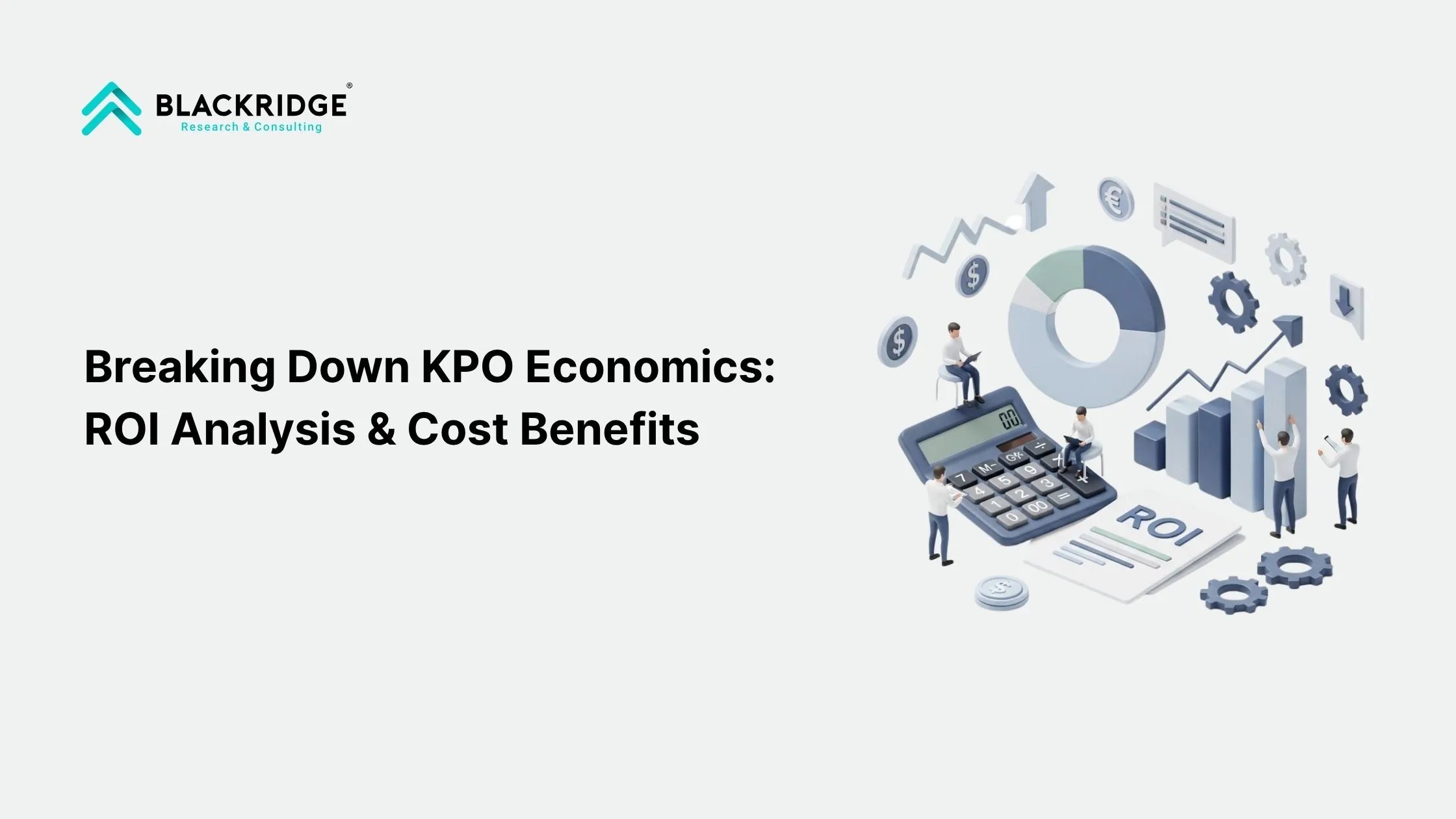
The global KPO (Knowledge Process Outsourcing) market, valued at USD 111 billion in 2024, is projected to surpass USD 360 billion by 2030—representing a staggering 21% compound annual growth rate. This isn't just another outsourcing trend; it represents a fundamental shift in how successful companies operate and compete.
Despite this impressive growth, every B2B leader faces a critical question in today's economy: In an era of tightening budgets and increased scrutiny over expenses, is KPO actually worth the investment?
The answer is a resounding yes, and the economics prove it beyond doubt.
How do in-house resources fall short of desired output, sometimes?
Before examining KPO's benefits, consider the crushing hidden costs of maintaining knowledge-intensive processes internally. A typical financial analyst in the US commands USD 85,000 annually, plus benefits, training, and infrastructure costs that easily push the total to USD 120,000.
Multiply that by the specialized roles your business needs—data scientists, market researchers, legal experts, and clinical researchers—and the numbers become staggering. KPO providers can deliver these same services while saving companies up to 40% compared to hiring full-time specialists.
This isn't merely about salary arbitrage; it's about accessing world-class expertise without the crushing overhead that's killing your margins.
KPO’s Proven ROI and Business Impact
The ROI from strategic KPO partnerships often exceeds expectations. Consider Shop Direct, the UK retailer that transformed from catalog sales to digital dominance. They partnered with EXL for data analytics expertise, creating a digital platform that analyzed website performance, sales, and customer behavior.
The result? They didn't just save costs—they generated entirely new revenue streams through data-driven insights. Similarly, Best Buy's partnership with Accenture proved so effective that they expanded their relationship in 2020, demonstrating sustained value and measurable returns.
Companies using KPO consistently report cost optimization as their top priority, with the outsourcing model driving efficiencies and boosting profitability in ways traditional hiring cannot match. The financial sector alone accounts for 35% of total KPO market revenue, followed by medical services at 25%, proving that these industries have discovered competitive advantages that internal teams simply cannot provide.
KPO Benefits Beyond Cost Savings
The global talent pool available through KPO isn't just about lower costs—it's about accessing specialized expertise that might not exist in your local market at any price. Countries like India, China, and the Philippines maintain deep pools of highly skilled professionals, including engineers, lawyers, and architects, who offer world-class expertise at competitive rates.
Leading KPO providers like Accenture, Genpact, and Wipro are actively investing in AI and machine learning capabilities, developing proprietary platforms to deliver superior results. When you partner with these providers, you're not simply buying services—you're accessing their R&D investments, cutting-edge technology, and continuous innovation efforts.
This means your business benefits from advances in AI, machine learning, and analytics without making those massive investments yourself.
The Quality Paradox
Here's what surprises many executives: KPO often delivers significantly higher quality than internal teams. Why? Because it's their core competency and competitive advantage. KPO providers measure performance based on accuracy, turnaround time, and client satisfaction, while internal teams juggle multiple responsibilities and competing priorities.
Speed-to-Market Benefits
Time-to-insight has become the ultimate competitive weapon in today's fast-moving markets. Internal teams face hiring delays, training periods, and capacity constraints that kill opportunities. KPO providers can deploy experienced teams immediately, often delivering results in weeks rather than months.
A global technology company looking to enter a new market can engage a KPO provider to conduct comprehensive market analysis, delivering actionable insights for market entry strategies faster than internal teams could be assembled and trained.
How Does KPO Provide Operational Flexibility and Diversification?
Internal teams face crushing utilization challenges that drain profitability. Your market research analyst might be fully busy during product launches but underutilized during quiet periods, creating hidden costs and inefficiencies.
KPO providers solve this through scale economics—they maintain high utilization across multiple clients while providing you with surge capacity exactly when needed. This operational flexibility allows you to scale up or down based on business demands without the fixed costs of permanent staff.
Maintaining specialized knowledge internally creates dangerous concentration risk. What happens when your key analyst leaves? Or when regulatory requirements change overnight? KPO providers maintain deep benches of expertise and stay current with industry developments as part of their core business model, providing business continuity that individual hires cannot offer.
The Technology Multiplier Effect
AI and machine learning technologies are being integrated into KPO services to enhance efficiency and deliver more accurate insights than ever before. A pharmaceutical company outsourcing clinical research doesn't simply get research services—they gain access to AI-powered data analysis tools, machine learning models for patient stratification, and predictive analytics that would cost millions to develop internally.
Competitive Intelligence Edge
Market Research Outsourcing represents the fastest-growing KPO sub-segment, driven by increasing demand for consumer insights and data analytics. Companies using KPO for competitive intelligence gain access to global research capabilities and advanced methodologies that would be prohibitively expensive to develop internally.
Your competitors who haven't adopted KPO are operating with incomplete information while paying premium costs for inferior internal capabilities—a competitive disadvantage that only grows over time.
KPO: Building Partnerships, Not Just Vendor Relationships
The most successful companies don't treat KPO as simple vendor relationships—they develop strategic partnerships that transform their competitive position. These partnerships drive business efficiency, innovation, and talent development, improving operations and creating better customer experiences that drive revenue growth.
The key to KPO success lies in strategic implementation. Start with non-core but knowledge-intensive processes where quality standards are measurable and results are quantifiable. Build relationships with providers who demonstrate innovation capability and technological advancement, not just cost savings.
Digital transformation and data analytics are driving massive KPO adoption, with companies needing access to skilled talent in AI, machine learning, and cloud computing. The question isn't whether you can afford KPO—it's whether you can afford the competitive disadvantage of not adopting it.
The Bottom Line
The economics of KPO aren't simply compelling—they're transformational for companies that implement them strategically. While your competitors struggle with internal capacity constraints and escalating talent costs, KPO provides access to global expertise, cutting-edge technology, and operational flexibility at a fraction of internal costs.
The USD 111 billion KPO market exists because it delivers measurable, quantifiable value that transforms business economics. The companies driving 21% annual growth aren't making emotional decisions—they're making calculated economic choices based on proven ROI and competitive necessity.
Get the skilled workforce you need without the management burden
Forget about recruitment, onboarding, training, performance management, or payroll administration. Our pre-trained KPO professionals plug directly into your workflows, managed by our team while delivering to your specifications. You get pure productivity without any of the operational overhead. Explore overhead-free workforce expansion options.




Leave a Comment
We love hearing from our readers and value your feedback. If you have any questions or comments about our content, feel free to leave a comment below.
We read every comment and do our best to respond to them all.