

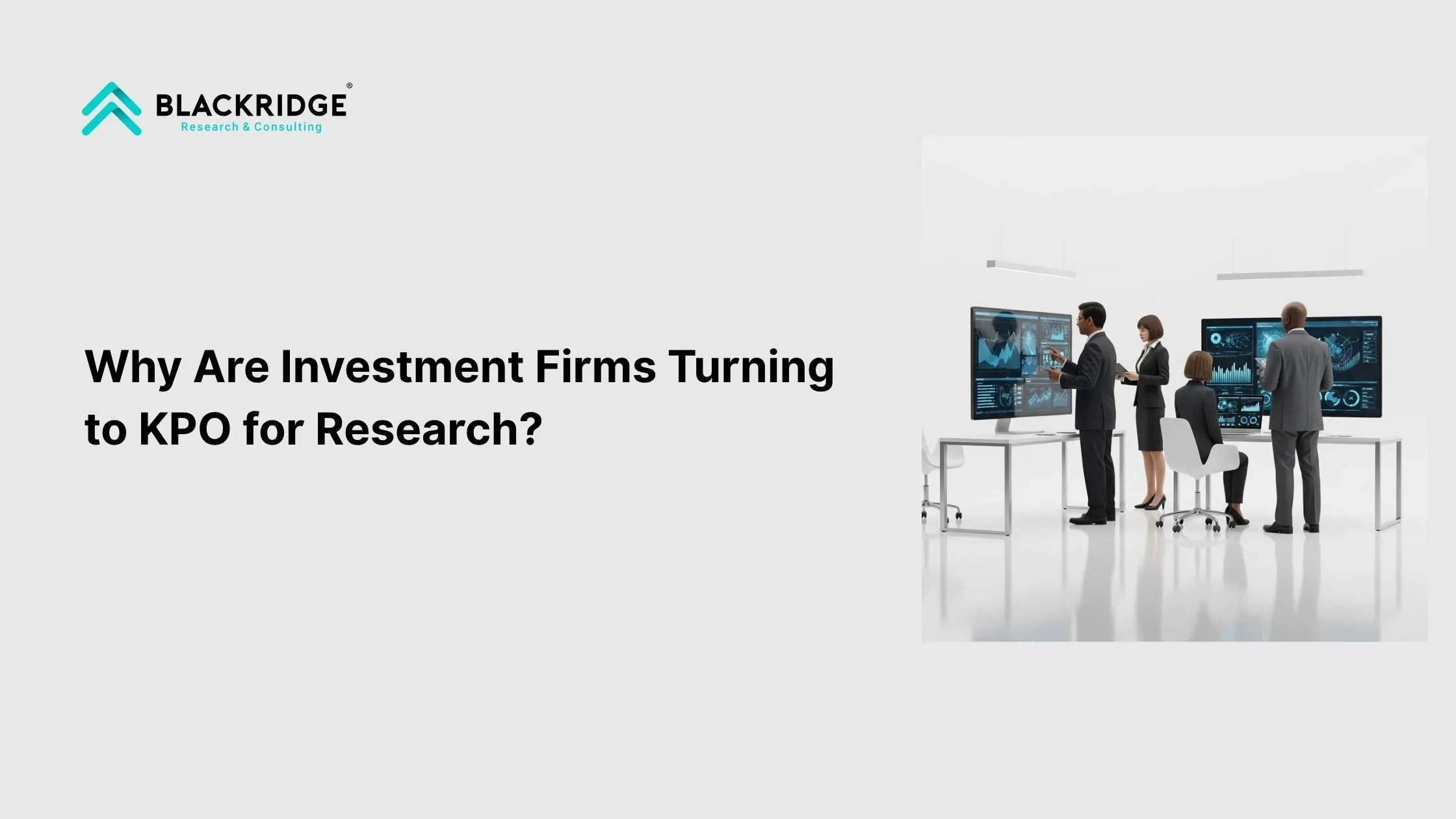
Investment firms face a growing challenge. They need more research than ever before. Markets move faster. Data comes from everywhere. Clients demand deeper insights. Yet hiring skilled analysts is a challenge; both in terms of costs and time. Even if they get one, there is no guarantee of getting the desired outcome.
This is where KPO service firms with financial analysis can fill the gap while minimizing the cost and saving time. Moreover, while the KPO company has to ensure quality service, the client firm is set worry-free to focus on other essential business functions.
Understanding Knowledge Process Outsourcing
KPO, or Knowledge Process Outsourcing, involves sending high-level work to outside experts. These experts have advanced degrees and deep knowledge in specific fields. They can perform complex analysis, create detailed reports, and solve difficult problems.
The difference between regular outsourcing and KPO is like comparing a calculator to a computer. Regular outsourcing handles simple, repetitive tasks. KPO tackles work that requires critical thinking and expertise.
Investment firms use KPO for many research activities. These include financial modeling, market analysis, due diligence reports, and regulatory compliance research. The work requires understanding complex financial concepts and industry trends.
The Cost Challenge Driving Change
Investment firms spend enormous amounts on research. According to industry data from 2024, large investment banks spend between USD 3 billion and USD 5 billion annually on research operations. Wall Street firms typically allocate 15% to 20% of their total operating expenses to research activities.
Hiring a senior financial analyst in New York costs firms around USD 150,000 to USD 200,000 per year. This includes salary, benefits, office space, and technology costs. A team of ten analysts can cost over USD 2 million annually before they produce a single report.
KPO providers offer significant savings. The same quality work can cost 40% to 60% less when outsourced to specialized firms. A financial model that costs USD 10,000 to create internally might cost only USD 4,000 through KPO. These savings add up quickly across hundreds of research projects.
The cost advantage comes from several factors. KPO providers operate in regions with lower labor costs. They focus solely on research, creating efficiency through specialization. They also spread fixed costs across multiple clients.
Quality and Expertise Benefits
Many people assume outsourced work means lower quality. This assumption proves wrong with KPO. Leading KPO providers employ analysts with impressive credentials. They recruit from top universities and hire professionals with CFA certifications, MBA degrees, and industry experience.
A 2024 study by Greenwich Associates found that 78% of investment firms rated their KPO research quality as equal to or better than internal work. The study surveyed 200 investment firms across North America and Europe.
KPO providers often have deeper expertise in specific areas. They might specialize in emerging markets, healthcare investing, or environmental analysis. This specialization allows them to develop knowledge that individual firms cannot match internally.
Consider pharmaceutical research. A KPO provider focusing on healthcare might employ former drug researchers, regulatory experts, and medical professionals. An investment firm would struggle to maintain this level of specialized knowledge across all sectors they analyze.
Access to Global Talent and Markets
Investment firms compete for the same pool of analysts in major financial centers. This competition drives up salaries and makes hiring difficult. KPO opens access to talent worldwide.
India is one of leading KPO destinations for financial services. The country produces over 3 million graduates annually, including many with strong quantitative and analytical skills. Indian KPO providers employ over 400,000 professionals in finance-related roles.
Other regions also contribute specialized knowledge. Eastern European providers excel at complex mathematical modeling. Southeast Asian firms offer expertise in emerging market analysis. This global talent pool gives investment firms access to skills they might not find locally.
Time zone differences create additional advantages. While New York analysts sleep, teams in Mumbai can continue working on research projects. This around-the-clock capability speeds up project completion and improves client service.
Technology and Infrastructure Advantages
Modern KPO providers invest heavily in technology. They use advanced analytics platforms, artificial intelligence tools, and cloud computing infrastructure. These investments help them deliver better results faster.
Many KPO firms have adopted machine learning for data analysis. They can process vast amounts of market data, identify patterns, and generate insights more quickly than traditional methods. This technology advantage benefits their investment firm clients.
The infrastructure requirements for financial research continue growing. Firms need powerful computers, specialized software, and secure data storage. KPO providers spread these costs across many clients, making advanced technology more affordable for everyone.
Bloomberg terminals alone cost USD 24,000 per user annually. A KPO provider serving 50 clients can justify this expense more easily than a smaller investment firm needing just a few terminals.
Regulatory and Compliance Support
Financial regulations become more complex each year. Investment firms must comply with rules across multiple jurisdictions. This compliance work requires specialized knowledge and constant updates as regulations change.
KPO providers often maintain dedicated compliance teams. These teams stay current with regulatory changes and understand requirements across different markets. They can help investment firms navigate complex rules without hiring full-time compliance specialists.
The Markets in Financial Instruments Directive (MiFID II) in Europe provides a good example. This regulation requires detailed research documentation and unbundling of research costs. Many investment firms turned to KPO providers for help implementing these requirements.
Regulatory reporting represents another growth area. Investment firms must file numerous reports with different formats and deadlines. KPO providers can manage this process, ensuring accurate and timely submissions.
Scalability and Flexibility Benefits
Investment research needs fluctuate significantly. A firm might need extensive analysis for a major acquisition one month and minimal research the next. Maintaining full-time staff for peak periods creates inefficiency during slow periods.
KPO arrangements provide flexibility to scale research capacity up or down. Firms can access additional analysts for large projects without long-term commitments. This scalability helps manage costs and maintain efficiency.
Seasonal patterns also affect research needs. Many firms require intensive analysis during earnings seasons or before major market events. KPO providers can allocate additional resources during these busy periods.
The COVID-19 pandemic demonstrated the value of flexible arrangements. Firms with KPO relationships could maintain research output even when their internal teams faced disruptions.
Challenges and Risk Management
KPO relationships do present challenges. Data security represents the primary concern for investment firms. Financial research involves sensitive information that must remain confidential.
Leading KPO providers address security through multiple measures. They use encrypted communication, restrict data access, and submit to regular security audits. Many providers achieve certifications such as SOC 2 Type II and ISO 27001.
Quality control requires ongoing attention. Investment firms must establish clear standards and monitoring processes. Regular review of KPO output helps maintain quality and identify potential issues early.
Cultural and communication differences can create challenges. Time zone gaps might delay urgent projects. Language barriers could lead to misunderstandings. Successful KPO relationships require clear communication protocols and regular interaction.
Market Growth and Future Trends
The financial services KPO market continues expanding rapidly. Market research firms estimate the sector will grow from USD 52 billion in 2024 to USD 78 billion by 2028. This represents a compound annual growth rate of 12%.
Several trends drive this growth. Artificial intelligence and machine learning create new research possibilities. Environmental, social, and governance (ESG) investing requires specialized analysis. Cryptocurrency and digital assets need expert evaluation.
The rise of passive investing also influences KPO demand. As management fees decline, firms seek cost-effective ways to maintain research capabilities. KPO provides a solution for delivering quality research at lower costs.
Regulatory technology (RegTech) represents another growth area. As compliance requirements increase, firms need specialized help managing regulatory obligations. KPO providers are developing new services to meet these needs.
Access the Best Financial Intelligence without Full-time Cost
Partner with seasoned financial analysts who deliver institutional-grade insights, modeling, and reporting without incurring the costs of hiring, onboarding, training, and other full-time hiring liabilities and challenges. Meet with an expert to know how it helps you scale up or down at will.



Leave a Comment
We love hearing from our readers and value your feedback. If you have any questions or comments about our content, feel free to leave a comment below.
We read every comment and do our best to respond to them all.