


Vizhinjam Seaport: First Container Transhipment Port in India
Table of Contents
- Loading contents...
Vizhinjam Seaport: First Container Transhipment Port in India
| Project at a glance | |
| Project name | Vizhinjam Port |
| Project type | Greenfield |
| Project location | Vizhinjam, Thiruvananthapuram, Kerala |
| Sector | Infrastructure |
| Owner | Government of Kerala |
| Founder | C.P. Ramaswami Iyer |
| Concession period | 40 Years (2015 - 2054) |
| Concessionaire | Adani Vizhinjam Port Private Ltd. (AVPPL) |
| Total Cost | INR 8,867 crores |
| Capacity | Phase 1 - 1MillionTEUs
Phase 2 - 2.5 MillionTEUs
Phase 3 - 3.3 MillionTEUs |
| Current Status |
|
| Investors |
|
| Employment Generation | 5,500 direct jobs |
Vizhinjam Port Project Overview
The Vizhinjam International Seaport is one of the largest port projects in India, and it was developed by the government of Kerala in partnership with Adani Ports and Special Economic Zone Ltd, (APSEZ). It aims to cater to container transshipment alongside multipurpose and break bulk cargo. Port development is based on the landlord model under a public-private partnership (PPP) component on a Design, Build, Finance, Operate, and Transfer (DBFOT) basis.
The project area is around 600 to 700 acres, which will be available after the recoupment of the sea. The port will contain 1.5 km and 6 km breakwaters with the harbor basin and wharfs. In the future, the project will accommodate 30 berths, which would be capable of handling large Mother Vessels.
In phase 1, Vizhinjam port's handling capacity is 1 million twenty-foot equivalent units (TEUs). It will increase to 2.5 million TEUs in Phase 2 and 3.3 million TEUs in Phase 3. The port will be the Gateway of South India and will increase the nation's reserve capacity.
Vizhinjam International Seaport Project Scope
The Vizhinjam International Seaport is being developed in multiple phases, incorporating world-class infrastructure to support container handling, cruise tourism, naval operations, and fishing activities. The project scope includes:
- Breakwater Construction: A total breakwater length of 4,100 meters, comprising a 3,040m north breakwater, a 140m spur breakwater for the fish landing harbor, a 200m extension in Phase 2, and an additional 720m extension in Phase 3.
- Container Berths: A total berth length of 2,000 meters, developed in three phases—800m in Phase 1, an additional 400m in Phase 2, and another 800m in Phase 3. A container yard will be developed in alignment with the quay expansion.
- Cruise Berths: 500 meters of cruise berths, developed in two phases—300m in Phase 1 (which will initially serve both cruise and multipurpose cargo) and an additional 200m in Phase 3.
- Port and Coast Guard Berths: A 100m berth for port crafts and a 120m Coast Guard berth, both to be constructed in Phase 1.
- Naval Berthing Facilities: Dedicated 500m berth for the Indian Navy, developed in Phase 1 to support defense operations.
- Fish Landing Center: A 500m fish landing center will be developed in Phase 1 to facilitate local fishing activities.
Project background
Let’s look at the project background of India's first deep water container transshipment port, Vizhinjam International Seaport Thiruvananthapuram (Trivandrum Port).
Vizhinjam Port History
Vizhinjam has a history of maritime trade dating back to the second century BCE. It was a center of trade in ancient times. In the 1st century CE, the Greek traveler Periplus Maris Erythrea mentioned Vizhinjam as a village with a natural deep sea.
Efforts to develop Vizhinjam Port began in 1991 when the Kerala government initiated feasibility studies and tender processes. In August 2015, the Kerala Government signed a contract with Adani Vizhinjam Port (AVPL) for the Vizhinjam port project.
According to the agreement, the Adani Group will own and operate Vizhinjam Port for 40 years. The Kerala government will get the revenue generated by the port after 15 years. The port predicts it will save Indian exporters money on cargo transshipment.
The Government of Kerala, through VISL, appointed the International Finance Corporation (IFC) as its Transaction Advisor in the structuring and implementation of the Vizhinjam port project. The IFC also helped organize a well-structured and transparent bid transaction, as the port was initially proposed to be developed using the PPP model.
IFC, with the help of Drewry Shipping International, UK, carried out the market assessment and Royal Haskoning as their technical consultant to prepare a preliminary project plan for the proposed project.
Drewry's studies indicated that because of the small immediate hinterland, the biggest potential for the Vizhinjam project was to attract container transshipment traffic. Because of the intense competition from the Colombo and Vallarpadam terminals in Cochin and other ports. Studies projected that Vizhinjam would need to adopt aggressive pricing strategies for container handling services.
Commercial operations of the Vizhinjam port began in December 2024. That month, the port was assigned a new location code—IN TRV 01—which is easily identifiable with the capital city of Thiruvananthapuram. The new code is “IN” for India, “TRV” for Thiruvananthapuram, and “01” for the port. The formal inauguration and official commissioning of the port will be scheduled by convenience of prime minister Narendra Modi.
Vizhinjam Port Construction
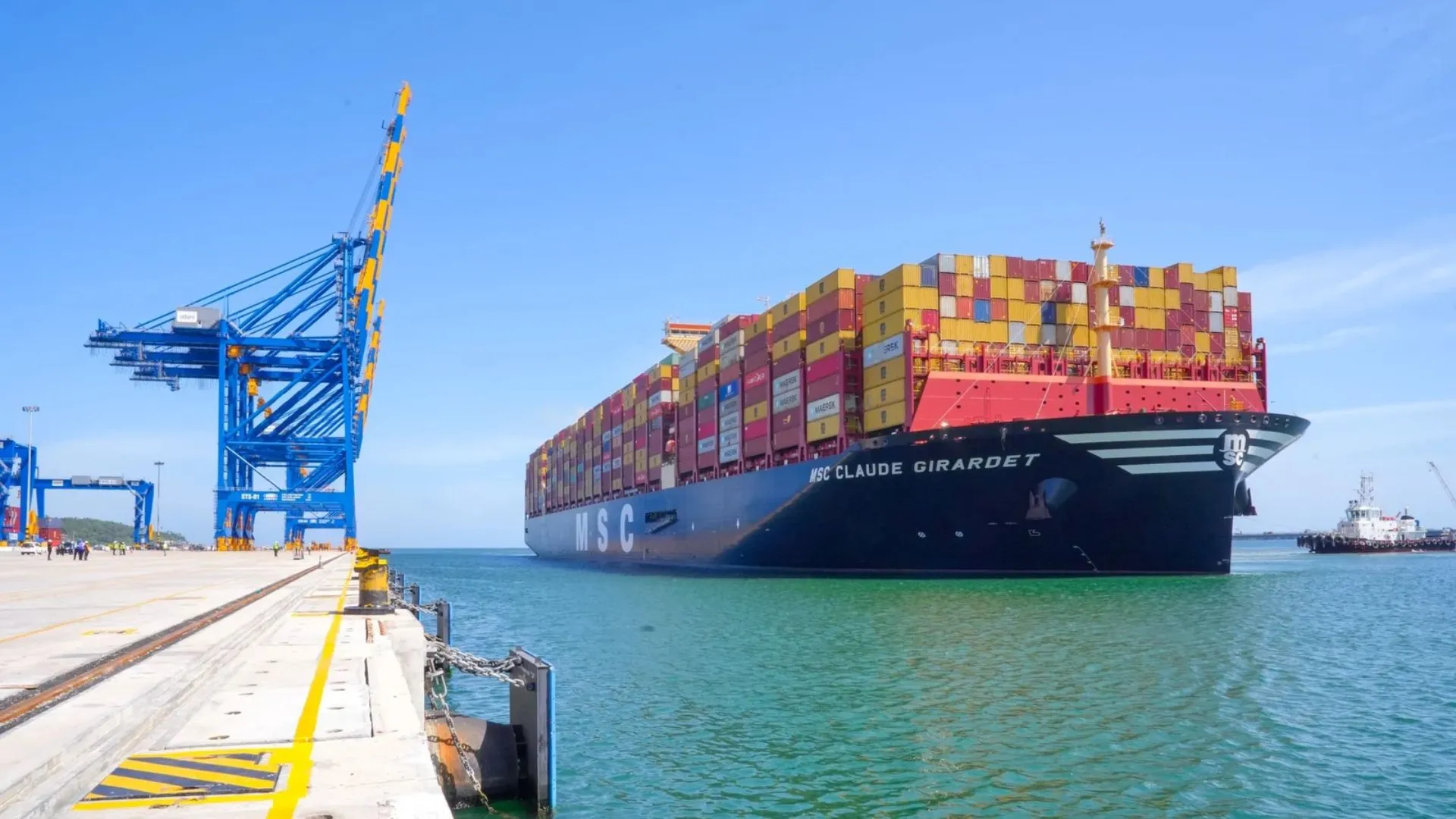
Construction of Vizhinjam Port began on 5 December 2015, and Adani Group expected the first ship to berth by 1 September 2018. Delays arose due to Cyclone Okchi (2017), limestone shortage, local opposition from fishing communities, and the COVID-19 pandemic. Despite setbacks, the project progressed, and it received its first general cargo ship, Zhen-Hua 15, on 12 October 2023. On 11 July 2024, the Indian port marked a major milestone by welcoming its first mothership (container ship) MV San Fernando carrying cranes.
Investors of the Vizhinjam Seaport Limited
| Investor | Investment | Roles and Responsibilities |
| Government of Kerala | INR 5596 crores (61.5%) |
|
| Adani Group | INR 2454 crores (28.9%) |
|
| Government of India (Viability Gap Funding) | INR 800 crores (9.6%) |
|
Vizhinjam Port Location
(port location image)
The Vizhinjam Port is located in Vizhinjam, a coastal town in the Thiruvananthapuram district in the state of Kerala, India. It lies on the west coast of India, along the Arabian Sea, which is part of the Indian Ocean and close to the international shipping route. The port's precise geographical coordinates are 8°21' N and 77°0' E. The sea is 23 to 27 meters deep at the site, making it easy to berth larger container ships.
It is situated within the Neyyattinkara taluk of Thiruvananthapuram. The Vizhinjam Harbour is part of this deepwater container transshipment port and is strategically positioned near the international east-west shipping route. The Green Port is 20km away from the Trivandrum International Airport. It lies 10 nautical miles from the east-west shipping channel connecting Europe, the Persian Gulf, and Southeast Asia.
Project Cost
The project cost of Vizhinjam International seaport is INR 8,867 crores. In June 2024, Karan Adani, managing director of APSEZ, announced an investment of INR Rs 20,000 crore by 2028 to develop India's first transshipment hub and deepwater container terminal. APSEZ itself is set to invest INR 10,000 crore in the project.
Project Timeline
(insert project timeline image)
Key contractors and Stakeholders
| Role | Organization | Responsibilities |
| Concessionaire | Adani Vizhinjam Port Private Limited (AVPPL) | Leading the project |
| Breakwater Construction | HOWE Engineering Projects (India) Pvt. Ltd. | Constructing the port's breakwater using ACCROPODE™ II armor units. |
| Strategic Advisor | IL&FS Infrastructure Development Corporation Ltd. | Assisting with project structuring and procurement of consultants and developers. |
| Consultancy Services | M/s L&T-RAMBOLL Consulting Engineers Limited, in association with ROGGE | Knowledge Partners |
| Feasibility Studies | Marine Consulting GMBH, Germany, RAMBOLL, Denmark, and L&T Capital Company Limited | Conducting feasibility studies of the project |
Benefits of the Vizhinjam International Seaport Project
The Vizhinjam International Seaport Project is set to transform India’s maritime sector by establishing the country’s first deepwater transshipment port. The project will bring multiple economic, logistical, and strategic advantages:
Economic Growth and Job Creation
- The port is expected to generate over USD 10 billion in annual economic activity.
- It will create over 100,000 direct and indirect jobs, boosting employment in Kerala and across India.
- The development of related industries like ship services, logistics, and bunkering will enhance business opportunities.
Cost Savings and Trade Efficiency
- Reduces logistics costs, making Indian exports more competitive in global markets.
- Enhances operational and logistical efficiencies, leading to faster cargo handling and reduced transit times.
- Saves foreign exchange by reducing India’s dependence on foreign transshipment hubs like Colombo, Singapore, and Dubai.
Strengthening India’s Position as a Maritime Hub
- The port’s deepwater capabilities will allow it to handle the world’s largest container ships, improving India's standing in the global shipping industry.
- It will attract foreign direct investment (FDI) into India’s port and logistics sector.
- Enhances India's connectivity to major international trade routes between Europe, Asia, and the Middle East.
Infrastructure and Regional Development
- Encourages the growth of supporting infrastructure, such as roads, railways, and logistics hubs.
- Improves India’s overall port capacity and efficiency, benefiting other Indian ports.
- Boosts tourism by attracting cruise ships and enhancing Kerala’s coastal economy.
Current Status of Vizhinjam Port
As of February 2025, the Vizhinjam port is partially operational. The Vizhinjam International Seaport Project has reached an operational milestone of handling 163 vessels and processing 300,000 TEUs of cargo to date.
The port is currently witnessing its busiest schedule, with seven ships from the Mediterranean Shipping Company (MSC) expected to arrive within a week. The port’s connectivity infrastructure is advancing, with the Konkan Railway Corporation’s Detailed Project Report (DPR) for rail connectivity formally accepted by the central government. This development is expected to enhance the port’s integration with the national logistics network, improving cargo movement efficiency.
The expansion of Vizhinjam Port into Phase 2 and Phase 3 is currently under review. The Union Ministry of Environment and Forests (MoEF) is expected to grant environmental clearance following the expert appraisal committee’s (EAC) recommendation. These phases, with a combined estimated cost of INR 9,540 crore, will only commence upon obtaining the necessary regulatory approvals. As part of the second and third phases of the Vizhinjam port development, 77.17 hectares of land will be reclaimed from the sea.
The Kerala Coastal Zone Management Authority (KCZMA) had previously advised the central government to issue environmental and Coastal Regulation Zone (CRZ) clearance in December 2024, and Vizhinjam International Seaport Ltd. (VISL) officially applied for environmental clearance on January 4, 2025. A final decision from the MoEF is currently pending, which will determine the commencement timeline for the next phases of development.
In November 2024, Kerala Chief Minister Pinarayi Vijayan announced the signing of a supplementary concession agreement with Adani Vizhinjam Port Private Limited to accelerate the project's completion. The new agreement targets completing all phases of Vizhinjam International Seaport by 2028, much ahead of the original 2045 deadline.
Future Developments of the Project
The Phases II and III of the Vizhinjam International Seaport Project are set to transform the port into a major multimodal logistics hub by 2028. The upcoming development phases will include a 1,200m extension of the container berth, a 900m extension of the main breakwater, and the development of a 1,220m multipurpose berth with an annual handling capacity of 33.49 million metric tonnes.
Additionally, a 250m liquid berth integrated along the breakwater will be capable of handling 5 million metric tonnes per annum, supported by a dedicated liquid cargo storage facility within the port premises. Once completed, these phases will enable Vizhinjam Port to handle up to 5 million TEUs of container traffic annually, positioning it as a leading transshipment hub in South Asia.
Beyond cargo operations, Vizhinjam is set to become a sea-air transshipment hub. Plans include a 10-km rail tunnel from Balaramapuram to Vizhinjam, which is expected to be completed within four years to enhance rail-based cargo movement. Also, road connectivity to National Highway 66 is scheduled for completion within two years, improving inland logistics efficiency.
The project also prioritizes sustainable development. A waste management system is already in place, including a material recovery facility constructed at Vizhinjam at a cost of INR 1.04 crore. This ensures environmentally responsible operations as the port expands.
Project Summary
The Vizhinjam International port is located at Vizhinjam, Thiruvananthapuram, Kerala, and is owned by the government of Kerala. Its founder is Mr. C.P. Ramaswami Iyer. The port development is based on the landlord model under the PPP component on a DBFOT basis. It aims to cater to container transshipment alongside multipurpose and break bulk cargo. After the project, the port's handling capacity is expected to be 5 million TUE, and it will cater to 12,000 TEU vessels in the future.
The investors of the project are - (i) Adani Vizhinjam Port (Group led by Gautam Adani), (ii) the Government of Kerala, and (iii) the Government of India. The government of Kerala made the highest share of investment in the project, with 61.5%. The Adani port project is beneficial not only to the state of Kerala but also to India. It reduces operational and logistics costs by increasing the employment ratio. It promotes tourism and boosts the economy, not only of Kerala but of the whole of India.
FAQ’S
Q.1. What is the milestone of the Vizhinjam Port?
Minister of Ports Shri V N Vasavan Commended the achievement, saying that the Vizhinjam port is breaking records, handling 100,000 + TEUs (20 20-foot containers) and welcoming 46 ships in four months.
Q.2. Who is the CEO of the Vizhinjam port?
The CEO of the Vizhinjam International Seaport Limited (VISL) is Sreekumar K. Nair.
Q.3. Who is developing the project?
Adani Ports and Special Economic Zone Limited is developing the project under a Public Private Partnership (PPP) model.
Q.4. What is the PPP model?
It is the agreement signed between the government and private sector companies.
Q.5. What are the challenges of the project?
The project's three main challenges were Environmental concerns, fishermen's protests, and delays due to COVID-19.
Q.6 How has COVID-19 affected the Vizhinjam Port project?
The COVID-19 pandemic was one of the challenges in the Vizhinjam project. Due to the ongoing pandemic, the deadline was extended by five years. The pandemic caused global health and economic crises, affecting maritime trade and the transport industry.
Connect with decision-makers about the latest infrastructure projects in India for business opportunities.
Subscribe to our upcoming and ongoing infrastructure projects and tender database in India to access reliable, high-quality insights on forthcoming and completed infrastructure projects across the country.
Our user-friendly platform provides essential details, timely updates, key stakeholder contact information, and business opportunities tailored for engineering companies, industry professionals, investors, and government agencies.
Start a free demo to take your business to the next level!
Leave a Comment
We love hearing from our readers and value your feedback. If you have any questions or comments about our content, feel free to leave a comment below.
We read every comment and do our best to respond to them all.