


Chabahar Port in Iran- “A Golden Gate” to Central Asia
Table of Contents
- Loading contents...
Project at a glance | |
Project name | Chabahar Port |
Project type | Greenfield |
Project Sector | Infrastructure |
Project status | Under construction |
Location | Southeastern Iran |
India’s contribution |
|
Investors |
|
Contractors |
|
Project Start Date | 1983 |
Project Overview
Chabahar Port is a deepwater seaport located in Southeastern Iran on the Gulf of Oman. As Iran's only oceanic port, it is an important trade hub. It involves two ports - Shahid Kalantari and Shahid Beheshti, each having five berths. The project aims to provide an alternative trade route between India and Afghanistan through the Chabahar port. It is achievable as Chabahar Port is only 800 kilometres from the Afghan border, making it a closer option than Pakistan’s Karachi Port.
Afghanistan and the Central Asian countries of Turkmenistan, Uzbekistan, and others are close to the port. Thus, Chabahar is the "Golden Gate" for these landlocked countries.
In 2016, Prime Minister Modi announced an investment of USD 500 million in developing the Chabahar Port. The Chabahar port agreement was aimed to boost economic ties with Iran and to develop a sea-land access route to Central Asia, bypassing Pakistan.
Later, India signed a trilateral agreement with Afghanistan and Iran to facilitate the hassle-free transport of goods between India and Afghanistan through the Chabahar Port.
In 2018, the Shahid Beheshti terminal port came into operation as an investment of USD 25 million by Indian Ports Global Limited (IPGL). Over 450 vessels have run, showing the port's growing capacity and efficiency.
Project Background and History
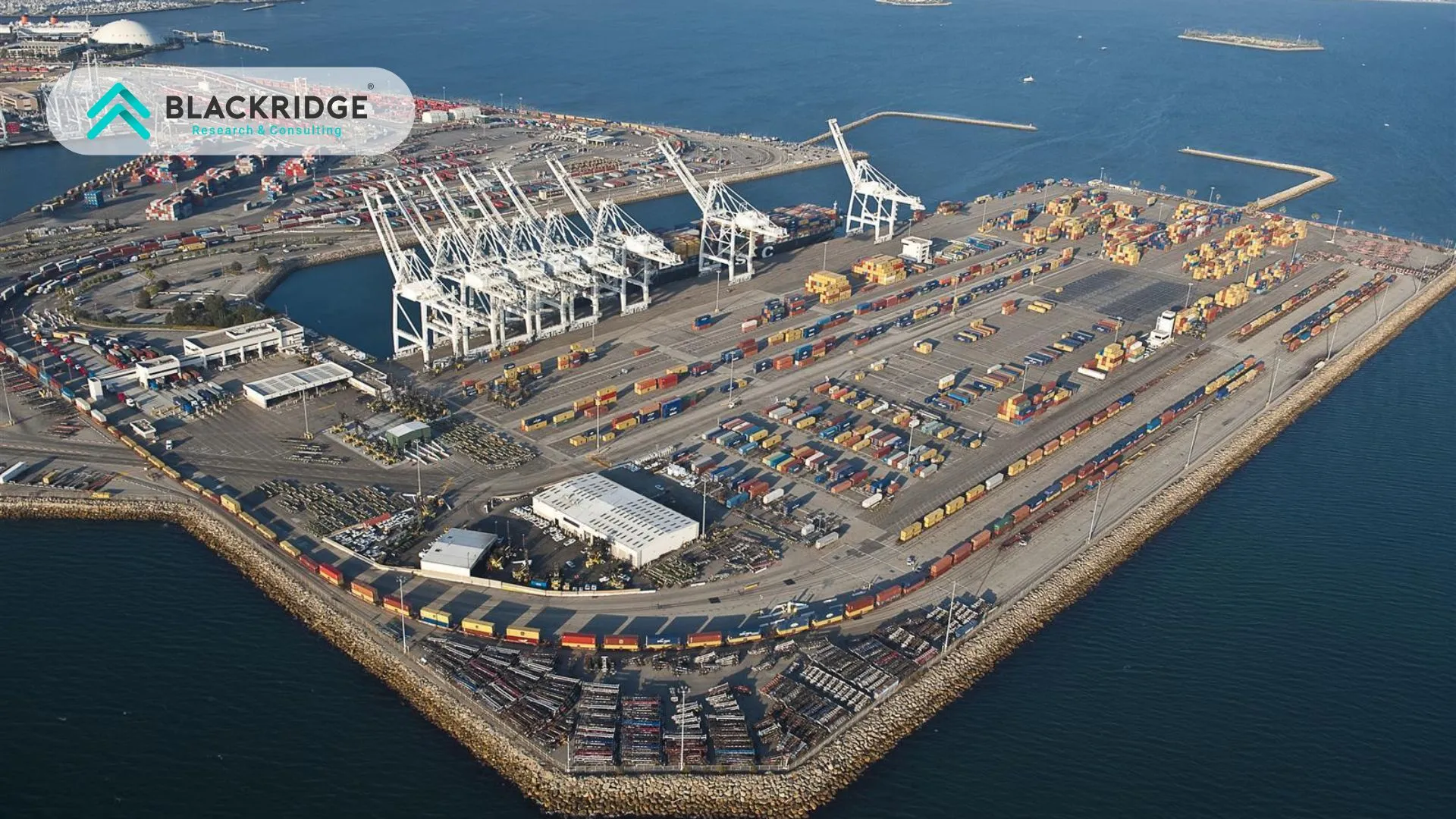
The Last Shah put forward the proposal for the Chabahar Port in 1973, but the 1979 Iranian Revolution hindered the development. Iran began building the port in 1980, during the ongoing Iran-Iraq War, to decrease its dependence on Persian Gulf ports, which were at risk of attack by Iraq. Since the project became operational in 1983, Iran has been able to trade with ease and increase its reliance on Gulf ports.
India came in for the development of the Port when it signed the agreement to further develop the Shahid Beheshti Port in 2003. However, this agreement failed due to sanctions against Iran. Further, in May 2015, a bilateral agreement was signed between India and Iran, which stated India would rebuild one of the ports at Shahid Beheshti Port. It would also reconstruct a 600-meter-long container-handling facility at the port.
The port's cargo handling capacity in 2015 was 2.1 million tons, expanded to 8.5 million tons in 2016, and is expected to reach 86 million tons in the future. It became an essential port for Iran during the Iran-Iraq War. Ships failed to enter the Persian Gulf due to the insecurity in the Strait of Hormuz during the war. Consequently, Chabahar became an important port during the war.
The Chabahar Port consists of two ports - Shahid Kalantari and Shahid Beheshti. In 1982 and 1983, Iran constructed four 45-meter berths at Shahid Kalantari and four 150-meter berths at Shahid Beheshti.
In February 2019, Afghanistan launched a New Export Route to India through Chabahar Port. At the inauguration of the export route, officials said 23 trucks carrying 57 tonnes of dried fruits, textiles, carpets, and mineral products were dispatched from the southwestern Afghan city of Zaranj to Iran’s Chabahar Port.
Despite its proactive approach, the Chabahar-Zahedan railway line construction was slowed by repeated funding delays, inter-regional disputes, and bureaucratic obstacles, and only 65% of the project was completed by 2023. By using the Eastern and Western corridors of the INTSC, India will access a Eurasian market, primarily Central Asia.
Project Scope
Being a major strategic and economic project, Chabahar Port aims to enhance regional connectivity and trade. It is Iran’s only oceanic port and is a “Golden Gateway” to landlocked countries like Afghanistan and Central Asian Countries.
Infrastructure development
Port Expansion: The project expands and develops the Shahid Beheshti Terminal at the Chabahar Port. In 2017, the port's handling capacity was 8.5 million tons annually. In 2024, it increased to 60,000 TEU(Twenty-foot equivalent unit), highlighting a 558% rise from 2022-23. The port expects to handle up to 1,00,00 TEUs by FY26.
Berth and Terminal Development: Phase I includes the development of two container berths, each 640 meters and 540 meters long.
Equipment upgrade: India commits to supply cargo-handling equipment like mobile harbour cranes. It plans to expand its capacity to 5,00,000 TEUs in 10 years.
Other Infrastructure: The project includes developing backup areas, warehouses, and connectivity infrastructure like roads and railways to ensure efficient cargo movement.
Road and Rail Connectivity
Chabahar-Zahedan Railway: The project scope includes providing a railway line of 628 km, connecting Chabahar to Zahedan. As a result of Indian funding delays, Iran has had to construct this on its own since 2020.
Regional trade hub: Chabahar Port aims to provide a transit hub between South Asia, Central Asia, and the Middle East, bypassing Pakistan to ease trade.
Economic and Trading Aims
The alternative trade route to Afghanistan and Central Asia: Chabahar Port allows India to gain access to Afghanistan and Central Asia. It ends India’s dependence on Pakistan for trading with Afghanistan.
Industrial Development: In the coming days, the port will invest in developing industries like aluminum smelters and urea plants in the Chabahar Special Economic Zone, boosting economic activity.
Read: Vizhinjam Seaport: First Container Transhipment Port in India
Chabahar Port Location
The Chabahar Port is located on the Makran coast of Sistan and Baluchistan Province, on the Gulf of Oman. It is the only port in Iran with direct access to the Indian Ocean. Due to its proximity to Afghanistan and the Central Asian countries of Turkmenistan, Uzbekistan, and others, the port is known as the "Golden Gate" to these landlocked countries.
Project Cost for Chabahar Port
The construction of the Chabahar Port gained momentum in 2016 when PM Narendra Modi announced an investment of USD 500 million to develop the Port during a visit to Tehran. In 2018, the Shahid Beheshti terminal port came into operation as an investment of USD 25 million by Indian Ports Global Ltd.
Afterward, India strengthened its commitment to the Chabahar Port by multiplying the port development budget from USD 5.5 million in 2020-21 to USD 12.3 million in 2022-23.
Bilateral Agreement Between India and Iran
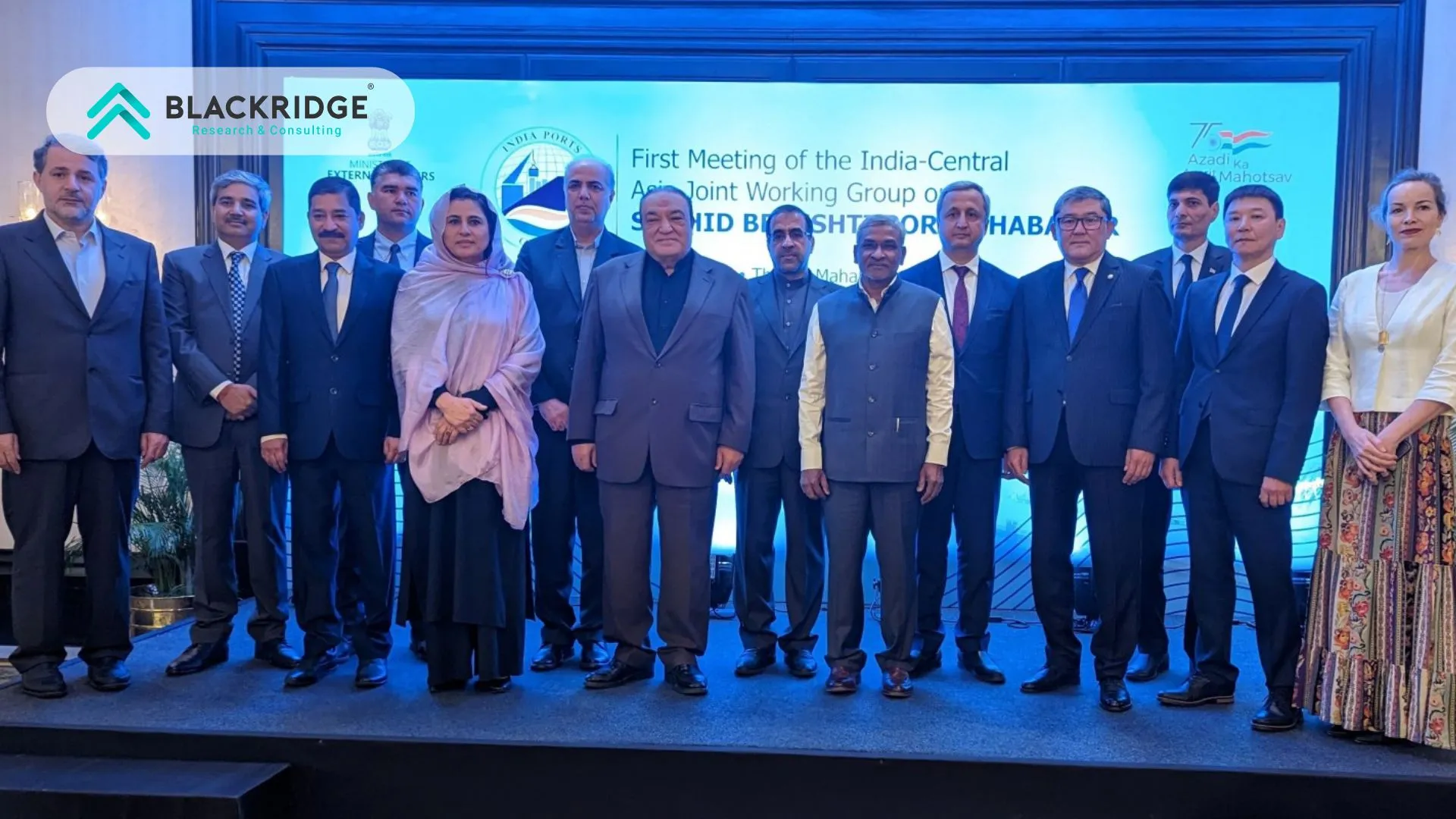
In May 2015, a memorandum of understanding was signed between India and Iraq, marking India's commitment to developing the Chabahar port. On May 13, 2024, India and Iran signed a 10-year agreement to develop the Chabahar Port in Iran.
This long-term agreement is crucial to India’s economic and geopolitical strategy for Central Asia and beyond. The bilateral agreement between Indian Ports Global Limited (IPGL) and Iran’s Port and Maritime Organisation (PMO) replaces a one-year contract, assuring the port’s continuous operations.
The agreement also permits India to operate the Shahid Beheshti terminal at Chabahar. IPGL invested approximately USD 120 million. Moreover, India promised a USD 250 million credit line for the jointly agreed-upon project to develop infrastructure in Chabahar.
Following the agreement, India Ports Global will refurbish and reconstruct two container-handling facilities at the port, with a length of 640 meters and 600 meters, respectively. The berths are to be developed at USD 85 million during a period of 18 months. It will initiate ancillary infrastructure by fixing four Rail-mounted gantry cranes, sixteen rubber-tire cranes, two reach stackers, two empty handlers, and six mobile harbour cranes.
India provided USD 400 million worth of steel to construct a rail link between Chabahar and Zahedan. According to the twelve memoranda of understanding signed in May 2016, India's commitment to Iranian infrastructure would cost USD 635 million. The agreement also shows that India would develop various industries, including aluminum and urea production plants, in the Chabahar economic zone.
A Trilateral Agreement Between India, Iran, and Afghanistan
The Trilateral Transit Agreement, known as the Chabahar Agreement, was signed on May 23, 2016. It is between India, Iran, and Afghanistan and aims to provide hassle-free transport of goods between India and Afghanistan through Chabahar Port.
It was signed during a meeting attended by Indian Prime Minister Narendra Modi, Iranian President Hassan Rouhani, and Afghan President Ashraf Ghani. After signing the agreement, India took over the operation of the Shahid Beheshti terminal in 2018 and sent its first shipment of humanitarian aid from India to Afghanistan via Chabahar in 2017.
The Chabahar Route allowed India to export goods to Afghanistan and Central Asia without relying on Pakistan. Iran benefited from seeing an increase in port activity and revenue. Afghanistan enjoyed access to the global markets, restoring its economy.
Investors of Chabahar Port
Country | Investment | Purpose |
India | Direct Investment: USD 85 million for the development of the port.
2024 Agreement: Further investment of USD 120 million for port infrastructure.
Credit line Investment: USD 250 million.
Indian Government Investment: USD 500 million in 2016. An additional USD 400 million will be used to construct rail links. | To enhance regional connectivity and facilitate trade with Afghanistan and Central Asia, bypassing Pakistan. |
Iran | Direct Investment: Approximately USD 1 billion in infrastructure development and equipment for Shahid Behesti Port. | To establish Chabahar as a strategic port and boost trade. |
Afghanistan | Direct Investment: USD 35 million | To provide a direct maritime link to global markets. Reduce its reliance on the Pakistani Ports. |
Contractors of Chabahar Port
Sl. no | Contractors | Role |
1 | India Ports Global Limited (IPGL) | Operating the Shahid Beheshti terminal under a 10-year agreement signed in May 2024. |
2 | Aria Banader Iranian Port | Partnered with IPGL in May 2016 to operate the container and multi-purpose terminal at Shahid Beheshti port. |
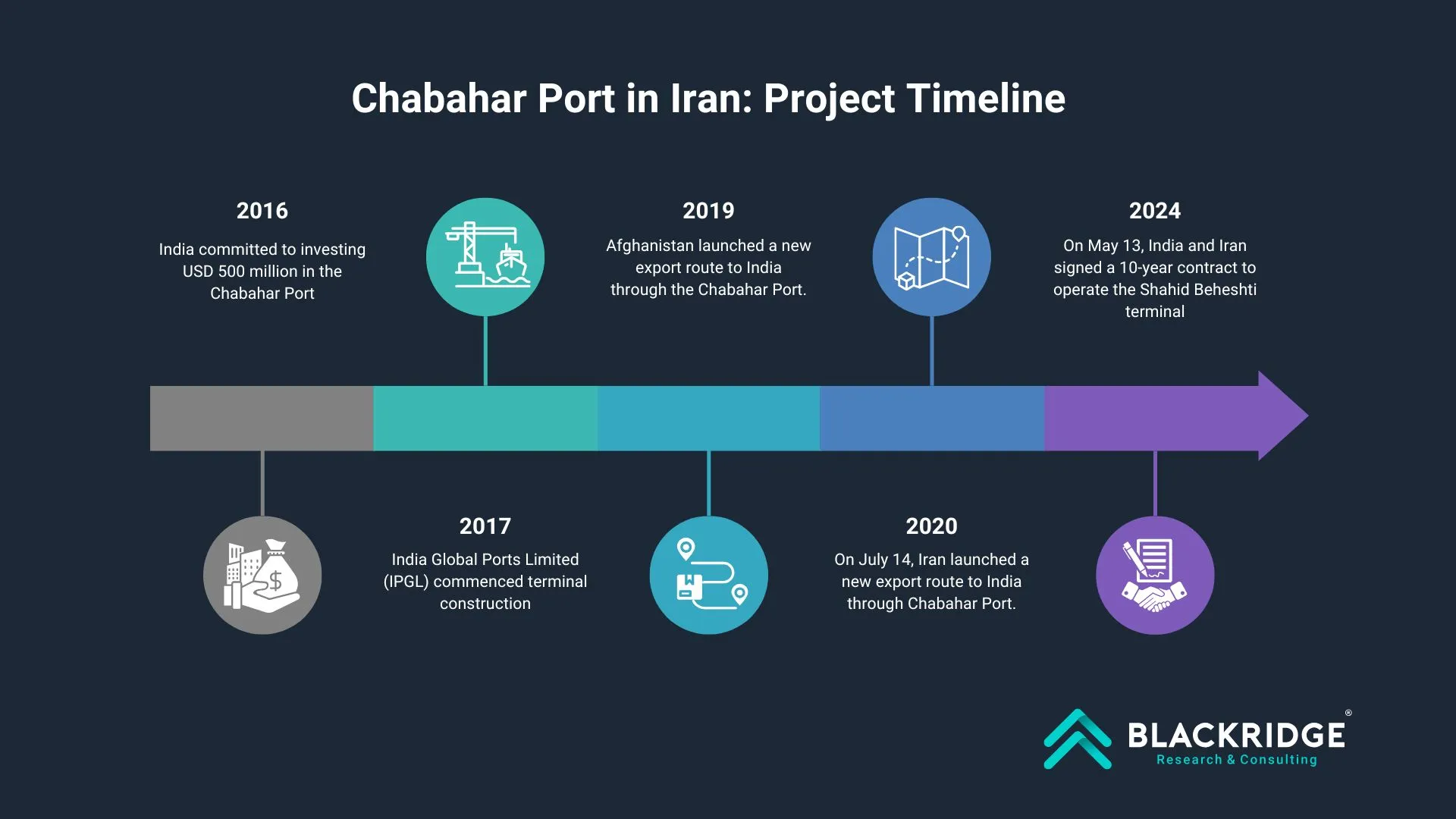
Project Timeline
Year | Event |
2024 | On May 13, India and Iran signed a 10-year contract to operate the Shahid Beheshti terminal. |
2020 | On July 14, Iran launched a new export route to India through Chabahar Port. |
2019 | Afghanistan launched a new export route to India through the Chabahar Port. |
2017 |
|
2016 | In May, India committed to investing USD 500 million in the Chabahar Port. |
2003 | The construction of a railway line between Chabahar Port and Zaranj. |
2000 | An agreement was signed with Russia to establish the International North-South Transport Corridor (INSTC) |
1982-1983 | The construction of four 45-meter berths at Shahid Kalantari and four 150-meter berths at Shahid Beheshti terminals started. |
1980 | During the Iran-Iraq war, the Chabahar Port gained strategic importance. |
1973 | Proposal for Chabahar Port by the Last Shah of Iran. |
US Sanctions Waiver for Chabahar
The US government is reviewing the sanctions waiver for the Chabahar Port of Iran. The US has a Waiver for India’s involvement in Chabahar. The crucial elements of the Waiver include:
First Waiver: In 2018, the US lifted sanctions on Chabahar, enabling India to enjoy humanitarian and regional connectivity benefits.
Renewed Waiver: India has received an additional exemption that allows the continuation of operations at the Shahid Beheshti Terminal and related connectivity projects.
Impact of US Sanctions on India
Potential Disruption in Development: The new US directive restricts India from continuing its operations at the Chabahar port. Despite US sanctions on Iran, India continues to import oil from Russia amid growing global pressure.
Effect on Trade and Connectivity: Since 2018, the port has handled over 90,000 TEUs of container traffic and more than 8.4 million metric tons of cargo.
Declining Trade with Iran: Sanctions made India decrease its trade with Iran. In 2018-19, India’s imports from Iran were worth USD 13 billion, primarily crude oil. However, after 2019, imports fell to less than USD 1 billion annually. Between April and October 2024, India imported USD 216 million worth of goods from Iran.
Importance of the Chabahar Port Project
The Chabahar port has benefited India in many ways. It gave easy access to Afghanistan and enabled India to access the Eurasian market easily. The benefits are discussed below.
Trade Route
Earlier, India was largely dependent on Pakistan for access to Afghanistan and Central Asia. However, Chabahar Port benefited India by providing an alternative trade route to Afghanistan that bypassed Pakistan. It reduced India’s reliance on Pakistan to access easy trade with Afghanistan.
Unlike Bandar Abbas, the busiest port in Iran, Chabahar acts as a gateway to the International North-South Transport Corridor (INTC), which includes sea, rail, and road routes linking India, Iran, Russia, Central Asia, and Europe.
The Chabahar corridor will encourage the Middle East states including the United Arab Emirates and Saudi Arabia to trade with India.
Economic Benefits
The Port will raise connections with the resource-rich Central Asian Countries and Afghanistan.
Apart from Iran and Afghanistan, India will also access the markets of Russia, Eurasia, and Europe.
Cargo movement through the INSTC route is expected to save 30% of cost and 40% of transportation time.
Central Asian nations, rich in resources, have shown an interest in utilising Chabahar Port to connect to the Indian Ocean and enter the Indian Market.
Humanitarian Assistance
As a result of the COVID-19 pandemic, the port played a crucial role in providing humanitarian aid to Afghanistan.
Through the Chabahar Port, India transferred 2.5 million tonnes of wheat and 2,000 tonnes of pulses to Afghanistan.
In 2021, India supplied 40,000 liters of eco-friendly pesticide, malathion, to Iran through the port to combat locust attacks.
Strategic Influence and Regional Stability
India's operation of Chabahar Port will enhance its strategic influence in the Indian Ocean region and strengthen India's geopolitical position.
The Chabahar port will act as a counter to China’s development of the Gwadar port in Pakistan.
Latest News of the Chabahar Port Development
On February 5, 2025, the Trump administration lifted all sanctions waivers that allowed India to continue its work on Iran's Chabahar Port. The order is part of his broader 'maximum pressure' campaign against Iran, which targets Iran's nuclear ambitions, missile programs, and support for terrorism.
Iran is going to successfully develop a spaceport at Chabahar with Russia’s help, from where it will launch satellites, rockets, and even ballistic missiles. The facility will compete with the US’s Cape Canaveral in Florida, as Chabahar is located near the equator, making launches easier.
The spaceport is expected to open by the end of 2025. Once it's completed, Chabahar will be a 14,000-hectare complex that will serve as Iran’s primary hub for space missions.
India is expected to invest approximately 4,000 crore in a capex-led expansion of operations in Iran’s Chabahar Port. The Indian Navy has placed orders for nearly five mobile harbor cranes as it aims to expand its capacity fivefold to 500,000 TEUs over the next 10 years.
Conclusion
Chabahar is a seaport in Southeast Iran. This important trade hub involves two ports - Shahid Kalantari and Shahid Beheshti, each having five berths. It aims to provide an alternate trade route between India and Afghanistan, ending India’s dependence on Pakistan. It is a “Golden Gate” to Afghanistan and Central Asian Countries. The project comes with trade, economic, and humanitarian aid benefits.
In 2016, Prime Minister Modi announced an investment of USD 500 million in the development of Chabahar Port. Furthermore, IPGL invested USD 25 million in operating the Shahid Beheshti terminal. In May 2024, as India signed an agreement with Iran to operate Shahid Beheshti, IPGL invested USD 120 million in developing the port. Since 2016, the Indian government has allocated INR 400 crores for the Shahid Beheshti port.
Connect with decision-makers about the latest infrastructure projects in the U.S. for business opportunities.
Subscribe to our upcoming and ongoing infrastructure projects and tender database in Iran to access reliable, high-quality insights on forthcoming and completed infrastructure projects across the country.
Our user-friendly platform provides essential details, timely updates, key stakeholder contact information, and business opportunities tailored for engineering companies, industry professionals, investors, and government agencies.
Start a free demo to take your business to the next level.
FAQs
What is the expected container handling capacity in 2025?
It is expected to handle 75,000 TEU in 2025.
What is one of the main reasons Chabahar is important for India’s energy security?
Chabahar Port provides a critical trade route to Afghanistan and Central Asia, which is essential for the economic development and stability of Afghanistan. It highlights Chabahar’s role in supplying humanitarian aid and economic goods to Afghanistan.
Who will manage Chabahar Port?
On 24 December 2018, an Indian company, India Ports Global Limited (IPGL), through its wholly owned subsidiary, India Ports Global Chabahar Free Zone (IPGCFZ), took over the operations of Chabahar Port.
How many countries are associated with the Chabahar Port?
It is associated with three countries - India, Iran, and Afghanistan.
Leave a Comment
We love hearing from our readers and value your feedback. If you have any questions or comments about our content, feel free to leave a comment below.
We read every comment and do our best to respond to them all.